
Gender definitions bill could get Senate vote today
The Alabama Senate could vote as early as today on a bill that puts into state law gender definitions.
Senate Bill 79, substituted in a committee on Wednesday, defines women as having a reproductive system that at some point produced ova and defines men as having at some point produced sperm.
Sponsor Sen. April Weaver, R-Briefield, said the bill is needed to give “definite guidance” to state agencies.
The original version of the bill put restrictions on public bathroom usage, based on the definitions. That language was removed.
Opponents of the bill said it is anti-transgender and seeks to further marginalize trans Alabamians.
Committee approves bills targeting illegal immigration
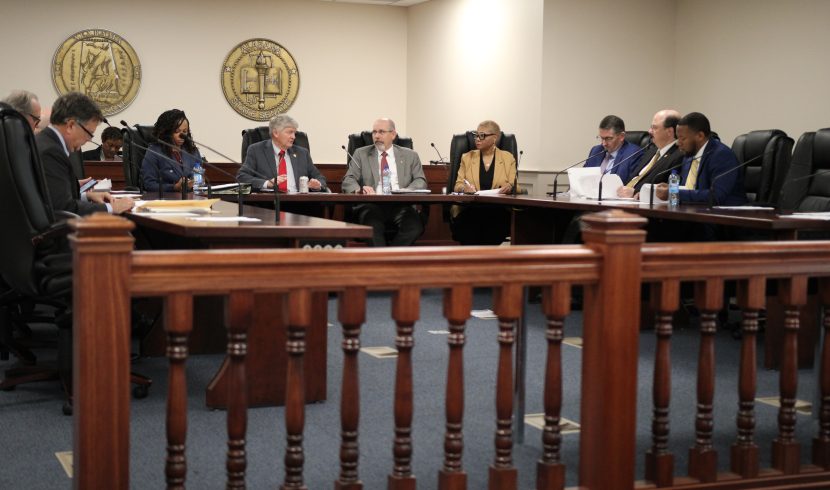
A Senate committee on Wednesday approved a series of bills lawmakers say will crack down on illegal immigration in the state, putting them in line now for a vote before the Senate.
There was an overflow crowd in the Senate County and Municipal Government Committee meeting with some speaking during public hearings against some of the bills, including a proposal to create a new felony penalty for human smuggling if someone transports another person they know or should know is an undocumented immigrant.
Another bill increases the fees on wire transfers of money to other countries. People could get the fees back as a tax credit when they file their income tax returns.
“People are sending cash they don’t pay taxes on,” bill sponsor Sen. April Weaver, R-Brierfield, said.
“This amounts to theft,” Sen. Kirk Hatcher, D-Montgomery, argued.
House and Senate Republicans have said complementing the Trump administration’s crackdown on illegal immigration is a goal of theirs.
Bill to purge old misdemeanor warrants approved in committee
Warrants for Class B and C misdemeanors would expire after 10 years under a bill approved in an Alabama Senate Committee on Wednesday.
Sen. Arthur Orr, R-Decatur, sponsored Senate Bill 82 after a constituent in his district, Clarissa Curbow, was arrested last year in her home and in front of her child 11 years after a verbal altercation at a Dollar General.
Orr’s proposal does not apply to sex offenses, domestic violence, or offenses that involve the use of a deadly weapon.
“This bill will hopefully prevent someone from being embarrassed and being jailed by an arrest for a low level charge that happened many years prior as happened to Ms. Curbow,” Orr told Alabama Daily News. “Her bad experience will maybe prevent that from happening to others. For felony and serious misdemeanor crimes, abuse, sex crimes and other crimes, those warrants will always be active no matter how many years pass and offenders be brought to justice. They won’t be able to run out the clock.”
The bill would require local courts to review and purge warrant records annually.
It now moves to the Senate.
Committee approves changes to state VA leadership structure
A Gov. Kay Ivey-supported bill to change the leadership structure of the Alabama Veterans Affairs Department was approved in committee Wednesday, though there was opposition.
Sen. Sam Givhan, R-Huntsville, abstained after saying he liked some part of the bill but is concerned about it “basically removing all the authority” of the board.
Sens. Josh Carnley, R-Ino, and Keith Kelley, R-Anniston, voted against Senate Bill 67 and said they’d heard concerns from veterans in their areas.
The bill comes after last year’s controversy with VA leadership that ended with Ivey using the power of her office to remove the former commissioner who was backed by the board.
The VA commissioner is now selected by the Alabama Veterans Affairs Board. Besides the governor, the board is made up of representatives nominated to the governor from several veterans’ organizations.
The bill, sponsored by Sen. Andrew Jones, R-Centre, would reduce the number of board members from more than a dozen to a “less cumbersome” nine and make most of them appointees of the governor. Its role would be more advisory, Jones explained Wednesday.
Jones said last year’s conflict with Kent Davis, the former commissioner, “brought up a lot of concerns.”
“We have to have someone who works with and coordinates with the governor’s office,” Jones said. “… This bill ensures that that happens.”
He also said he thinks the change to the board would broaden representation because not all veterans belong to the organizations that currently nominate board members.
The bill now moves to the Senate.
Vaccine parental consent bill passes committee
For the third year in a row, the House Judiciary Committee approved a bill Wednesday that would require minors to receive written parental consent before receiving vaccinations.
“Right now in Alabama, the age of medical consent is 14, so a 14-year-old could walk in and get any type of shot they wanted,” explained Rep. Chip Brown, R-Hollingers Island, the sponsor of the bill. “So what this does is it just says that parents have to give consent to any vaccination.”
The bill includes exemptions for minors 14 and up that are not dependent on a parent or legal guardian for support, and was passed unanimously with no discussion by the committee.
Parole board reform bill delayed, support uncertain
A bill that would reform the Alabama Parole Board that was scheduled to be heard in the House Judiciary Committee Wednesday was postponed by a week at the request of its sponsor, and with some opposition in the committee, its future remains uncertain.
The bill, sponsored by Rep. Chris England, D-Tuscaloosa, would reform the parole board by requiring its members to follow its parole release guidelines, or provide a written justification for deviating from them. It would also establish an oversight body for the board to ensure compliance.
Support for reforming the parole board has grown, with parole grant rates in the state steadily declining year over year from 2019 to 2023, dropping from 31% to 8%, respectively. While parole grant rates increased dramatically in 2024, England has argued that his bill would provide a level of consistency to the board’s decision making that he feels is currently lacking.
Rep. Matt Simpson, R-Daphne, told ADN he felt there were better methods of addressing concerns with the parole board, and would likely not support England’s proposal.
“There’s a number of bills on trying to reform the parole board, we’ve talked about increasing the number of people on the parole board from three to five or seven. I think that’s probably a better strategy than to create another level of the bureaucracy overlooking the parole board,” Simpson said.
Committee approves measure to impose automatic death sentence for child rape
The House Judiciary Committee advanced a bill Wednesday that would impose an automatic death sentence for Alabamians convicted of child rape.
Sponsor Rep. Matt Simpson, R-Daphne, is an assistant district attorney who’s prosecuted child rape cases. He said the existing maximum penalty for child rape of life in prison did not go far enough. The bill originally applied to those convicted of raping a child younger than 6, though Rep. Chris England, D-Tuscaloosa, introduced an amendment that would raise the applicable age to 12 and under, an amendment that was approved unanimously by the committee.
Simpson said that the bill is also an effort to overturn a 2008 U.S. Supreme Court ruling that prohibited automatic death sentences for child rapists.
“The rationale in Kennedy v. Louisiana was that it was cruel and unusual punishment, and it was (ruled) unusual because only six states were offering the death penalty for child rape and sodomy at that time,” Simpson said. “This is an attempt to challenge that. There are six other states going along with Florida and Tennessee to try to show if more states are on board, then it’s not unusual, and therefore, that rationale does not apply.”
Florida was the first state to implement a similar law in 2023, and in 2024, Tennessee adopted its own version.
Bill that would increase state borrowing power for prison construction delayed
A bill that would increase the borrowing power of the state for prison construction was delayed Wednesday in a Senate committee, but sponsor Sen. Greg Albritton, R-Range, told Alabama Daily News that he was optimistic for its passage.
Senate Bill 60, would lift the cap on the amount in bonds that the state is authorized to sell for use toward prison construction, from $785 million to $1.29 billion, with the hopes of securing funding for the second of two proposed 4,000-bed prisons. Originally scheduled to be heard at the Senate General Fund Finance and Taxation Committee, which Albritton chairs, he said he was asked to postpone for one week debate on the bill.
“I’ve heard some concerns, those who don’t like to go into debt, which I understand, I don’t either,” Albritton told ADN. “But my goodness, when you consider how much debt we’ve paid off! Now is not the best time in the market, but there have been worse times, so I think we have the flexibility to do this correctly.”
State Finance Director Bill Poole said Wednesday that Gov. Kay Ivey doesn’t object to the borrowing authority being increased, but “has made no commitment we will exercise that authority.”
He said the state already has the capacity to borrow about $300 million more for prison construction.
“There’s no plan at this point in time to borrow additional money,” Poole said.
Effort to expand health insurance access for gig workers advances in committee
Members of the Senate General Fund Finance and Taxation Committee unanimously approved a bill Wednesday that would establish a portable benefits program for gig workers such as rideshare app drivers and other independent contractors.
Sponsored by Sen. Arthur Orr, R-Decatur, and in the House by Rep. Neil Rafferty, D-Birmingham, the bill would help facilitate corporations to provide health insurance and retirement benefits to independent contractors, of which there are an estimated 79,000 in the state. The benefits would be transferable as well, meaning gig workers who change jobs would be able to carry over their benefits to a new employer.
“Independent contractors are still out there fending for themselves, and the ability for special accounts to be set up to help with health care, retirement, without breaching the independent contractor status, this would – if we’re able to pass it – give them the ability to establish some benefits that would be portable,” Orr said.
Orr said that the bill was modeled after legislation adopted in Utah in 2023, and that employers with independent contractors in the state had expressed support for the effort.