
BIRMINGHAM, Ala. – Alabama education officials tightened a proposal to count career readiness test results in the state’s high school academic ratings after commenters raised concerns about the rigor of the original plan.
The revised proposal is part of Alabama’s application for federal education flexibility, submitted in late June. It would allow some students who do not meet the state’s current ACT proficiency standard to be counted as proficient if they score well on the ACT WorkKeys career readiness test.
The application comes as the Trump administration pushes to shift more education decisions from Washington to the states.
The U.S. Department of Education encouraged states last September to apply for Ed-Flex authority, which allows states to waive certain federal rules for school districts without seeking federal approval each time.
Eleven states had Ed-Flex authority when the department issued that invitation last September. Since then, at least 11 additional states have received approval.
Federal officials are now reviewing Alabama’s application, and state officials have been answering additional questions, State Superintendent Eric Mackey told Alabama Daily News.
“We’re in that process now,” Mackey said. “We’re going to be in this back-and-forth period for the next few weeks, and then we’ll have some kind of an update probably in August.”
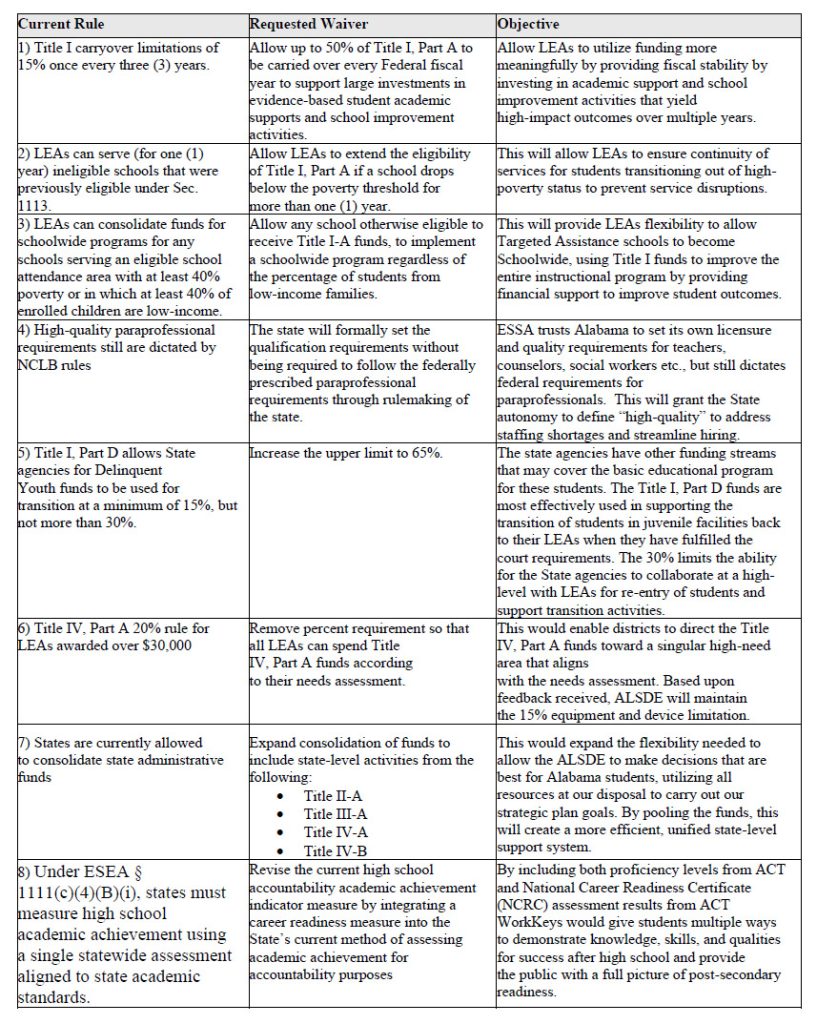
Alabama’s application seeks flexibility in three main areas: giving school districts more freedom in using federal funds, changing the way high school academic achievement is calculated by adding WorkKeys results to ACT scores, and allowing the state to combine certain federal program funds for statewide activities.
It also asks the federal government to allow Alabama to set its own qualification requirements for paraprofessionals, including special education aides, instead of continuing to use federal standards.
High school testing
Alabama officials argue that the current federal accountability system overlooks students who may not meet the state’s ACT proficiency standard but demonstrate strong workplace skills on WorkKeys.
Alabama now uses ACT results to measure academic achievement in its federal high school accountability system. Under the proposal, all 11th graders would take WorkKeys in the fall and the ACT in the spring.
The state wants to calculate high school academic achievement using students’ ACT composite scores together with their WorkKeys results.
Critics say WorkKeys measures employability skills, not the full range of Alabama’s academic standards, and therefore should not be used to determine academic proficiency. They have suggested recognizing it elsewhere in the accountability system.
In the application, the department said commenters raised concerns about the rigor of the four-tier scoring system first proposed in February. In response, the department changed the calculation so fewer students would be placed in the two tiers considered proficient.
Under the first proposal, about 31% of students would have landed in Tier 3, the first proficient level. Under the revised plan, about 19% would be in Tier 3. The share of students in the lowest tier would rise from about 40% to 57%.
The department said the change was meant to reduce the number of students placed in the higher levels and make those levels more accurately reflect advanced college and career readiness.
Under the revised plan:
- Students who score 19 or higher on the ACT would generally be considered proficient or highly proficient.
- Students who score between 15 and 18 could also be considered proficient if they earn a Gold or Platinum credential on WorkKeys. A Silver credential would not be enough.
- Students who score 14 or below on the ACT would still be considered below proficiency, no matter how well they score on WorkKeys.
Data in the application show that about 4% of Alabama students in the Class of 2026 scored between 15 and 18 on the ACT and earned Gold on WorkKeys. That is the clearest group that would be newly counted as proficient because of its WorkKeys score.
The proposal would also replace separate ACT English and math performance levels with the ACT composite score. The application does not show how many additional students or schools could be affected by that change.
A coalition of national education and civil-rights organizations urged Alabama not to use WorkKeys in the academic-achievement calculation. The coalition included EdTrust, All4Ed, the National Parents Union, UnidosUS, the National Center for Learning Disabilities and the Center for Strong Public Schools.
The organizations said WorkKeys does not measure all of Alabama’s high school academic standards and should not be used to decide whether a student is academically proficient. They suggested using WorkKeys elsewhere in the accountability system, such as the college- and career-readiness measure.
The coalition supported some of the funding flexibility Alabama is seeking but said the state should include safeguards to ensure that federal money still reaches the students it is meant to help.
The state department held two public-comment periods and said it received more than 80 comments. The application says the department changed the testing plan and kept a limit on technology-equipment spending after reviewing that feedback.
Federal funding flexibility
The department also asked federal officials for more flexibility in how it uses and distributes federal education funding, which is governed by detailed rules.
Most of those requests involve funding under Titles I, II, III and IV. State officials argue that greater flexibility would allow local school leaders to direct federal money toward improving services for students with the greatest needs.
The state also asked for permission to pool certain federal funds from Titles II, III and IV for state-level activities tied to the department’s strategic plan.
The EdTrust-led coalition supported some of the funding flexibility Alabama is seeking but said the state should include safeguards to ensure federal money still reaches the students it is meant to help.
The U.S. Department of Education is required to issue a written decision within 90 days after receiving a complete application. Because federal officials are still asking Alabama questions, it is unclear when that 90-day period began. Mackey said he expects some kind of update in August.
A table summarizing the Alabama Department of Education’s Ed-Flex request is below.