

MONTGOMERY, Ala. – A new state audit of the Alabama Department of Corrections has found an “underlying sense of secrecy” within the agency, as well as poor conditions and insufficient reporting of incidents within the department’s facilities.
The 367-page audit was conducted by the Alabama Department of Examiners of Public Accounts at Kilby Correctional Facility in Montgomery County between May and October. It found a “reactive culture” in the ADOC’s central offices, a lack of adherence to internal policies across several levels of the agency and unsanitary conditions within the prison facility.
Based on these findings, the audit offered five primary recommendations to improve the state’s correctional system.
“By strengthening governance, standardizing operations, improving oversight, supporting its workforce, and investing in facility conditions and rehabilitation efforts, ADOC can move from a reactive operational model toward a proactive, performance-driven correctional system that is safer, more accountable, and more effective in achieving long-term public safety outcomes,” the audit concluded.
The ADOC often conducts internal audits and investigations into accusations of officer violence, but lawmakers have increasingly called for outside, independent audits after the 2025 documentary “The Alabama Solution” showed alleged violence and poor conditions within Alabama’s system. Criminal justice advocates have said that the ADOC’s internal audits are insufficient and biased.
Citing the documentary as his inspiration, Sen. Larry Stutts, R-Tuscumbia, filed a bill during this year’s session to create a new oversight coordinator position and office within the examiners’ department.
The bill passed out of the Senate Judiciary Committee, but instead of bringing it to the Senate floor for a full vote, Stutts struck a deal with the ADOC to create a pilot program for auditing.
This first audit was originally intended to center on one of the state’s prisons, but when auditors began the process, they discovered overarching issues that were connected to practices at the ADOC’s central office. This led the examiners to dig into the system as a whole, the audit said.
‘Underlying sense of secrecy’ within the ADOC’s central office
While trying to gather information, auditors ran into “an underlying sense of secrecy within the agency, whether perceived or actual,” the audit said.
Those conducting the audit had difficulty obtaining internal records and had to route requests through the ADOC’s legal department, ultimately issuing subpoenas to obtain certain information.
Auditors were also not allowed direct access to most of the ADOC’s staff without a representative from legal present, which the audit said “exposed the review process and the responses provided to potential manipulation.”
The audit said that the examiners’ restricted access “raised red flags.” The Alabama Department of Examiners of Public Accounts is an independent agency is housed within the Alabama Legislature, making it part of the legislative branch, while the ADOC is part of the executive branch.
“ADEPA is the oversight body in the State for state agencies like ADOC,” the audit said. “If ADEPA is forced to operate with restricted access, this reflects a significant disregard for the oversight functions that are essential to ensuring transparency, accountability and effective governance within ADOC and the prison system.”
The employees who did speak with the auditors and the documents the ADEPA was able to obtain “suggested an organizational culture that is often more reactive rather than proactive in addressing operational issues.”
One of the audit’s primary recommendations was to “strengthen central-office governance, accountability and independent oversight.”
The audit suggested that the ADOC look into structural changes that would improve “independence and public confidence” by housing oversight and investigative functions in a different department and bulking up the ADOC’s legal division.
It also recommends that the ADOC move more legal work in house instead of relying on the attorney general’s office and outside counsel.
“With no (deputy attorneys general) at the agency, ADOC has expended significant resources for outside counsel,” the audit reads. “Also, the attorneys employed by the agency have not had to fulfill that obligation of their position. This has resulted in inefficient use of agency resources and has contributed to concerns regarding the consistency, quality, and reliability of legal guidance provided.”
Stutts, who said he hadn’t read the whole report yet, told Alabama Daily News he wants to see high-level change within the ADOC.
“The point that they made about there being some secrecy and hard to get information, I’ve seen that same thing,” Stutts said. “I’m looking forward to a new (gubernatorial) administration, and I think the changes have to come from the top down. I understand the people have tried to work with what they have, but we’ve got to change the whole culture. And I said last year that moving into a new facility, if we ever get to move into it, is not going to change the Department of Corrections until we change the culture, we can’t take the old culture with us.”
Republican Governor-elect Tommy Tuberville will get to appoint a new commissioner of the ADOC. Tuberville did not respond to a request for comment.
Facility-level issues
The audit also takes an in-depth look at the programs and infrastructure at Kilby specifically.
While walking through the prison, auditors found missing fire extinguishers, mold, broken and unsanitary toilets, broken tiles, lights out, bugs, cobwebs and faulty HVAC.
“The review identified deteriorating infrastructure, inconsistent access to basic services, limited programming opportunities, and ineffective communication mechanisms across facilities,” the audit reads. “These conditions were associated with increased health and safety concerns, challenges in supervision and service delivery, and shortcomings in program participation and reentry preparation.”
Auditors also found frequent deviations from standard operating procedures and insufficient documentation across various sectors of the prison.
Auditors surveyed people incarcerated at Kilby, asking about topics like their access to food, recreation, religious services and facilities. More than 79% of the 58 inmates surveyed reported insufficient caloric intake from the meals provided by the prison, 70.7% said their housing units were not clean and 82.8% reported inadequate pest management.
The ADOC’s response
The ADOC referred ADN to its response included in the audit report and did not provide further comment.
ADOC Commissioner Greg Lovelace said in a response letter that the ADOC does not agree with everything included in the report but said that “disagreement should not be mistaken for resistance to oversight.”
Lovelace pointed out that the audit had a broad scope and moved very quickly, including that the ADOC provided the ADEPA access to more than 20,000 files and 32 boxes of Kilby-specific documents.
“Based on that number alone, I believe it is fair to question whether the pace at which this audit was conducted allowed for the depth of review necessary to support conclusions across so many different areas of correctional operations, particularly when ADEPA itself acknowledges that some programs at Kilby could not be examined with the same level of intensity,” Lovelace wrote.
Lovelace also said that the small inmate survey conducted as part of the audit is not representative of all of the inmates at Kilby or across the system.
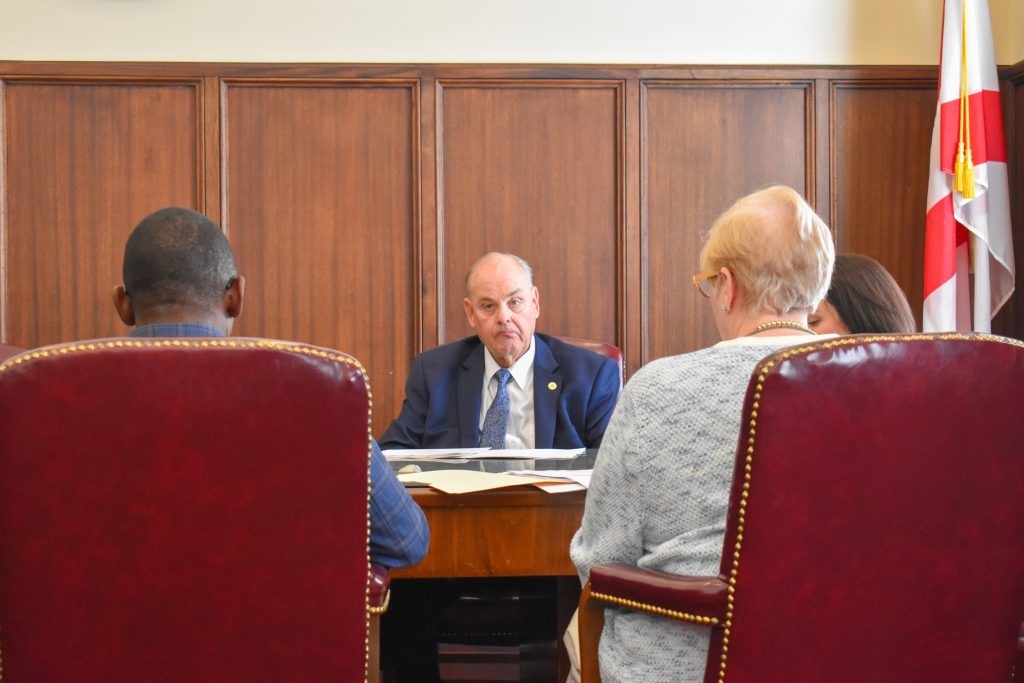
Though he said the department is taking the audit into consideration, he highlighted improvements he’s made since taking over as commissioner in May, including growth in the correctional workforce. Lovelace said he does not want the report’s findings to “overshadow the important work being done every day by the men and women of ADOC.”
Lovelace also noted that several recommendations made in the audit would be expensive and require additional funding from the Legislature.
Kilby is also a facility the Legislature identified as a prison to close once additional beds become available, he highlighted.
“Any significant capital investment at Kilby must, therefore, be evaluated not only for safety and operational needs, but also in the context of the State’s existing plan to replace the facility,” Lovelace wrote.
The state is in the process of constructing two large prisons, one in Elmore County and another in Escambia County. The Elmore facility has faced significant construction delays and balooning costs, while the state approved a contract to begin construction on the Escambia facility at the end of October.
Lovelace said the report should be “cautiously considered” but highlighted the “important distinction” between an action not occurring and proper documentation of that action being in the right place.
He marked another difference between an audit of the ADOC and the ADEPA “exercising broader correctional oversight or making policy judgments about how a prison system should be managed.”
Lovelace’s letter refers several times to the legislation Stutts let go in exchange for the pilot program and states repeatedly that it did not pass.
If enacted, Stutts’ bill would have created an office to monitor the safety and retention of correctional officers and staff and the “occurrence of systemic issues within the Department of Corrections which negatively impact the health, safety, welfare, and rehabilitation of individuals in the custody of the department.”
“As the scope expanded, portions of the review began to resemble the broader correctional oversight contemplated in legislation that was not enacted, rather than the pilot review which ADOC voluntarily agreed to participate in,” Lovelace wrote. “The respective responsibilities of the legislative and executive branches are important, as is the distinction between identifying matters through an audit and directing the management of a correctional system.”
He also said that the audit could have been stronger with the inclusion of people familiar with the correctional system.
“Significant portions of ADEPA’s review would have benefited from involvement by individuals with direct correctional or other relevant subject-matter expertise,” Lovelace wrote. “A traditional audit can identify important issues, but the review of a correctional system requires an understanding of why certain practices exist and how changes in one area can affect safety and operations elsewhere.”
Stutts disagreed with this characterization and said that the audit shows that “outside eyes” are needed.
“I certainly think the auditors need to know what they’re doing, but common sense and compassion tells you that what we’re doing is not working,” Stutts told ADN. “You’ve got to have somebody objective looking at it, and not somebody just saying, ‘Well, that’s the way we’ve always done it. You just don’t understand corrections.’”
Looking ahead
Stutts commended the ADEPA and Chief Examiner Rachel Riddle for their work in producing a thorough audit quickly. He said ADEPA’s meeting the October deadline gives lawmakers enough time to draft “comprehensive” legislation ahead of the 2027 legislative session.
Stutts said he looks forward to working with the Tuberville administration to achieve meaningful change for Alabama’s prisons through legislation.
“I want to digest the whole report first, but I think the bill we had last (session) was a very comprehensive bill and maybe biting off more than we could chew last (session),” Stutts said. “But I think the comprehensive legislation that we’re going to come back with is going to look a whole lot like it.”
The legislative session begins on Feb. 2, 2027.