
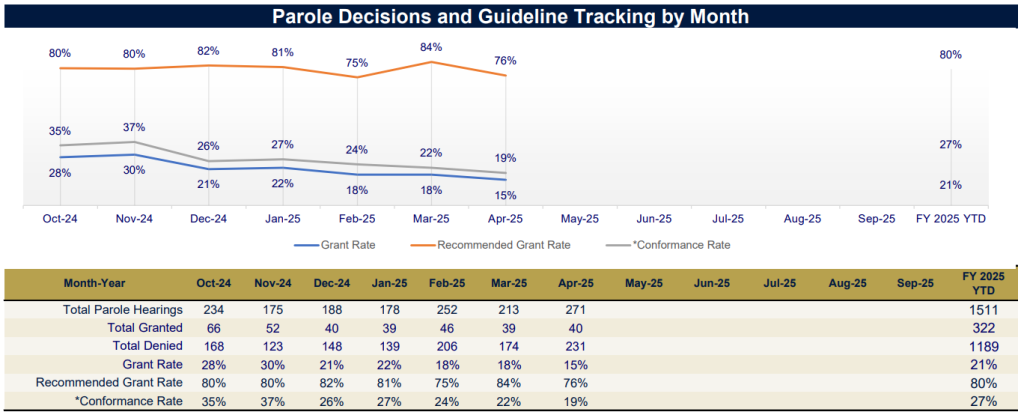
MONTGOMERY, Ala. — Alabama’s parole grant rate fell to 15% during the month of April according to a new report from the Alabama Board of Pardons and Paroles, marking the board’s lowest monthly parole grant rate since November of 2023.
The rate at which the ABPP grants parole has drawn increased scrutiny in recent years amid the state’s crowded prisons and the board’s failure to comply with its own guidelines, which recommend either for or against an inmate’s release on parole based on a scoring system.
According to the report, the ABPP granted parole to 40 of 271 eligible inmates during parole hearings held in April, denying 231 for a parole grant rate of 15%, and a conformance rate to their own guidelines of 19%.
The report also shows that conformance rates have been in a steady decline since November of last year. In November of 2024, the ABPP conformed to its guidelines 37% of the time; in December, that dropped to 26%.
The ABPP’s guideline conformance rate has been targeted for years by Rep. Chris England, D-Tuscaloosa, who has filed multiple bills attempting to establish more oversight over the board. While none have yet to be successful, the effort grew bipartisan support this year after Sen. Clyde Chambliss, R-Prattville, filed his own bill to reform the board by both increasing its membership and changing the appointing authority for its chair.
While Chambliss’ bill also failed to pass this year, it gained significant bipartisan support, passing out of a Senate committee, Senate floor and a House committee, but failed to come up for a vote on the House floor. Chambliss told ADN last month that he was “leaning towards” refiling the bill next year.
One measure from lawmakers that proved effective in compelling action on the part of the ABPP was an amendment from Chambliss on the 2026 General Fund budget that made funding for the board conditional on the body revising and adopting new guidelines, which it’s required to do every three years, but hasn’t since at least 2019.
Shortly after the budget was signed into law with the amendment, the ABHPP produced and published a new set of guidelines, which remain open for public comment through July 4. Members of the Joint Prison Oversight Committee, however, expressed skepticism about the proposed guidelines during a meeting last month.
Another concern among some lawmakers and advocacy groups regarding the ABPP’s conduct has been the racial disparity in parole grant rates. For fiscal year 2024 through April, white inmates eligible for parole were granted release at a rate of 26%, and Black inmates, 15%. In the latest monthly report, that disparity has shrunk significantly, with white inmates granted parole at a rate of 23% to Black inmates’ 19%.
Alabama’s parole grant rate was as high as 53% in 2018, though began to decline after a series of reforms were implemented in 2019, alongside the appointment of Leigh Gwathney as ABPP chair. Since then, they have steadily declined every year before reaching an annual low of 10% in 2023. In 2024, however, the parole grant rate climbed to 20% in 2024.