
MONTGOMERY, Ala. — The Alabama Board of Pardons and Paroles has submitted new scoring guidelines for public review amid growing legislative scrutiny over its noncompliance with state law and continued failures to adhere to its current guidelines.
The new guidelines, which are open for public comment through July 4, increase the score required to recommend parole denial, increasing an inmate’s latitude for infractions. But they also broaden the criteria under which inmates can be penalized.
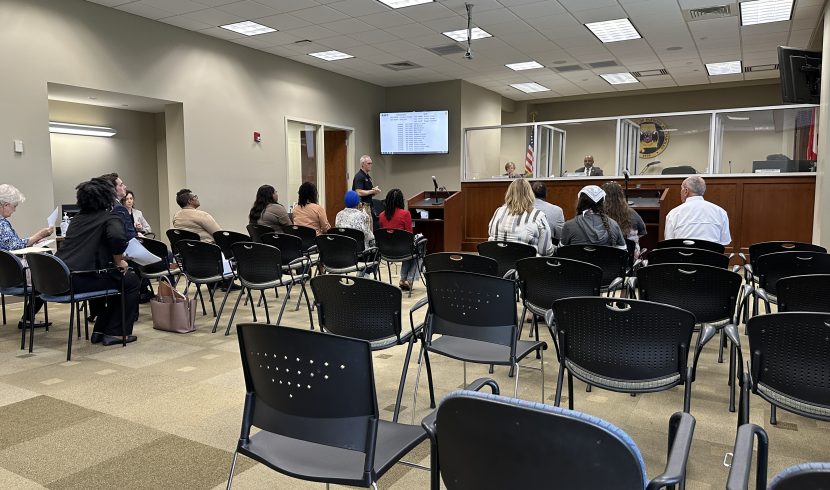
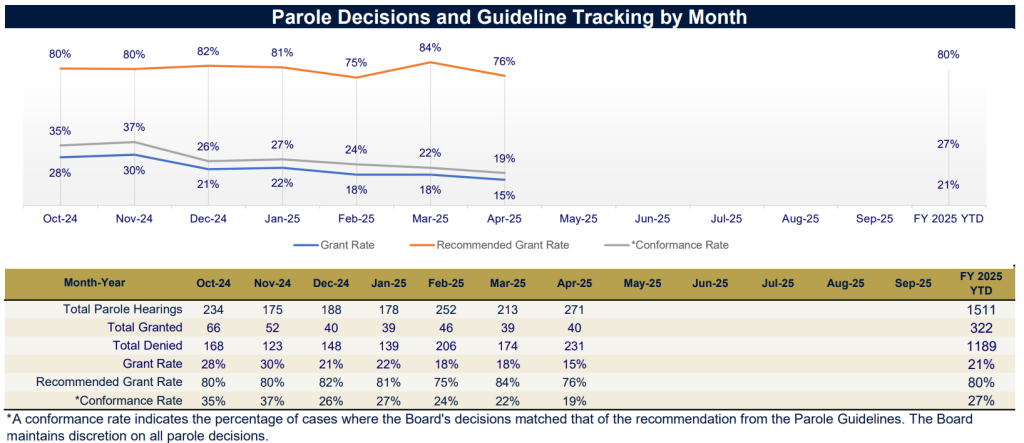
Published this month for public review, the proposed changes come eight months after a tense meeting of the Joint Prison Oversight Committee, where state lawmakers expressed frustration over the parole board’s low conformance rate as it relates to granting parole. In fiscal year 2023, for instance, the board conformed to its own parole guidelines 12% of the time, and this year as of April, about 27% of the time.
The low conformance rate was largely a result of the parole board having granted parole at increasingly low rates, granting parole to 10% of eligible inmates in 2023 compared with the 53% in 2018, though the board has granted parole at a rate of nearly 22% this year as of April.
Even with the proposed changes, however, Cam Ward, Director of the Alabama Bureau of Pardons and Paroles, doesn’t see the parole grant rate increasing by much.
“I think looking at the (prison) population, I really think, historically, you’re probably at a sweet spot around 28% to 30% (parole grant rate),” Ward told Alabama Daily News Tuesday.
“You’ll never get back to 50% again because your (Alabama Department of Corrections) population changed so much due to legislative criminal justice reforms; we got rid of a lot of low-hanging fruit out of the prisons.”
Under a series of reforms made to the parole board in 2019, the body was required by state law to adopt a new set of parole guidelines every three years based on public feedback and past data. However, more than five years later, the board has yet to adopt new guidelines, which are used to score parole-eligible inmates and help members decide whether to grant an inmate release or not.
Adopted in 2020, the board’s current guidelines score parole-eligible inmates in six categories; offense severity, reoffense risk, institutional behavior, treatment program participation, reentry plans and community support or opposition.
Inmates are given a base score of zero, and anywhere from one to five points for marks against the inmate, such as not having a post-incarceration plan or any community support at a parole hearing. A score of eight or above would suggest the inmate be denied parole, though the decision is ultimately at the discretion of the three-member board.
Under the proposed changes, the guidelines would only recommend parole be denied were an inmate to score nine points or more, granting more leeway for negative marks. The proposed changes also include more opportunities for inmates to receive marks against them.
The proposed guidelines include a new category of “very high” for offense severity, worth four points. They also would increase the marks against an inmate for some infractions, such as a proposed two points for having been disciplined for an incident involving violence within the past 12 months, which currently only constitutes a single point.
In recent months, state lawmakers have exerted increased pressure on the parole board. Rep. Chris England, D-Tuscaloosa, has filed a bill for several years that would establish more oversight on the board. It advanced out of the House this past legislative session, but failed to come up for a vote in the Senate.
Sen. Clyde Chambliss, R-Prattville, introduced a bill late into the session to totally reform the parole board, expanding its membership from three to five members, and change the chair appointing authority from the governor to the board itself. It ultimately failed to come up for a vote in the House.
Chambliss did, however, manage to successfully amend the $3.8 billion General Fund budget for 2026 to make part of the board’s funding conditional, contingent on the board revising its parole guidelines as is required by state law.
Chambliss leads the Joint Prison Oversight Committee. It meets today at the State House.
Carla Crowder, executive director for Alabama Appleseed, a nonprofit that advocates for marginalized communities, told ADN Tuesday that she found the board’s overdue efforts to update their guidelines “encouraging,” but still noted what she considered to be several shortcomings.
“The proposed guidelines could be greatly improved to reflect the reality of limited programming and lack of services within ADOC, along with factors that have been proven to impact recidivism,” she told ADN.
Crowder suggested that the scoring criteria as it relates to disciplinary infractions was short sighted given it only factors the previous 12 months, and thereby fails to properly incentivize long-term good behavior. She also said that, given the aging prison population, age should factor into the scoring guidelines.
Crowder also criticized the scoring impact on reentry plans, or having developed a plan for employment post-incarceration.
“ADOC provides minimal to zero assistance to incarcerated people seeking employment, and many employers rely on internet-based applications and portals, which are impossible for people in prison to access” she said.