
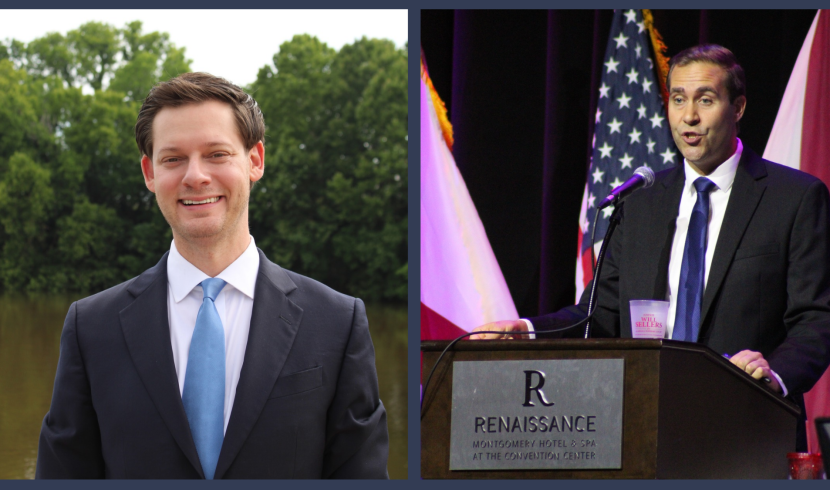
MONTGOMERY, Ala. – The general election is less than a week away, and Democrat Phillip Ensler and Republican John Wahl are finalizing their cases to voters about why they should be Alabama’s next lieutenant governor.
Ensler has pitched himself as an experienced public servant ready to work within the system and across the aisle to pass legislation, while Wahl has emphasized his status as a “political outsider” who will use his small business experience to make government more efficient.
Ensler and Wahl, though they represent parties with starkly different platforms about the policy necessary to better Alabama, both say they are deeply focused on quality-of-life issues like affordability and healthcare. But the position they’re seeking has limited and arguably waning power to address these issues.
The Alabama lieutenant governor’s most public-facing job is to stand in wait in case something happens to the governor. The state’s No. 2 also presides over the Alabama State Senate and has appointing power for various boards and commissions.
The role previously held more authority, but over the past two decades, lawmakers have shifted many responsibilities to the Senate president pro tempore. This move began more than 20 years ago when Democrats controlled the Legislature but has continued in recent years, with the Senate unanimously passing a further limit on the lieutenant governor’s authority in April.
Current Lt. Gov. Will Ainsworth is term-limited and is not running for any public office.
A rarity in this election cycle, Ensler and Wahl have agreed to debate publicly. The pair will face off for a televised debate hosted by Huntsville’s WHNT at 6 p.m. Wednesday.
Why they’re running
Ensler, a public school teacher turned lawyer, has spent the last four years two floors below the chair he seeks as a member of the Alabama House of Representatives.
He said that serving Montgomery-based District 74 has prepared him to be lieutenant governor because he has done a lot of policy work and understands how to work across the aisle. Ensler paired up with Senate Republicans to pass two signature pieces of legislation: Beau’s Law to establish minimum standards of care for dogs and a bill to ban Glock switches.
Ensler defeated Darryl Perryman in the Democratic primary election to make it to the November ballot.
He said he’s running because Alabama deserves better from its politicians and because he wants to bring his record as a legislator to a statewide level.
“Republicans have been in charge for years now, and we are ranked low in so many categories, whether it’s health outcomes, educational outcomes, public safety,” Ensler said. “People are struggling financially, so there is so much more that we can do better. I have a strong record, a bipartisan record of getting things done, working across the aisle to protect our children, to expand access to mental health services and so much more that helps improve the quality of life for Alabamians.”
Ensler said that he knows what it takes to collaborate with both chambers and a governor’s office of another party to work through legislation. He also emphasized the relationships he already has with community groups and lobbyists and how the trust he’s built in the Legislature means he could get things done if elected.
A butterfly farmer by trade, Wahl comes to the race after five years as the head of the Alabama Republican Party, a role he left in January after a surprise endorsement from President Donald Trump thrust him into a seven-way Republican primary. He defeated current Alabama Secretary of State Wes Allen in the runoff election.
Wahl also chairs the Alabama Public Library Service Board after an appointment from Gov. Kay Ivey.
He said he entered the race to move power away from the government and back to the people of Alabama.
“I really think that there are so many things government can do to help people have a better life, and there’s so many areas whether it’s education, whether it’s economic opportunity, whether it’s holding government accountable or defending people’s rights and freedoms,” Wahl said.
“At the end of the day, I want to see Alabama leading the nation when it comes to policies that help people have a better life, that keep our community safe, and make sure that we safeguard the Constitution and the fundamental God-given rights that our country is founded on.”
Priorities if elected
Though the lieutenant governor doesn’t have the power to introduce legislation, the officeholder influences which bills come up for votes and connects the executive branch to the Legislature.
In an election dominated by affordability, both candidates said a top priority if elected would be cutting the remaining 2% state sales tax on groceries.
Outside of that, Ensler’s priorities are Medicaid expansion, the creation of a state lottery, permanently cutting the tax on overtime and farm equipment and increasing the state’s minimum wage.
He said his first steps would be doing things that would put more money in people’s pockets, which partially comes from increasing state revenue. Ensler introduced what he called a “clean” lottery bill during the 2026 legislative session, which would have used lottery funds to support rebate checks, public education and healthcare.
“I would work, especially up in the Senate, on a lottery that came one vote short two years ago, working to get that one additional vote,” Ensler said. “So I see the role of lieutenant governor as someone who can really bring together members from both sides of the aisle to get the necessary votes needed. Also, though dealing with financial, economic issues, cutting the grocery tax. Democrats have been fighting for that for a very long time. I would certainly advocate and work with the Legislature to get that cut.”
Wahl said his three top priorities are returning power back to the people, bettering education and improving the cost of living for Alabamians. On education, Wahl said he wants to improve Alabama’s nationwide rankings, “get social agendas out of our classrooms” and return control to parents and local teachers.
He said addressing affordability through removing the grocery tax and other means would be the most important thing when taking office.
“I’m incredibly focused on the cost of medicine in the state and prescription drugs, as well as rural healthcare because so many families and elderly on fixed incomes are really struggling to just get the basic needs they need right now,” Wahl said. “I think that is something government has got to make a priority as we look at what we can do to help people across the state have a better standard of living and be able to afford just basic critical needs.”
Looking at the role
Wahl said he disagrees with the narrative that the lieutenant governor has been stripped of a lot of its power. He said that the appointment power held by the lieutenant governor is “incredibly important” because more people interface with boards and commissions than their elected officials.
“It’s not a limited position,” Wahl said. “I think it’s almost unlimited when you look at the possibilities of what this office can do to serve the people of the state and be an ambassador for the people, whether that’s in the legislative process or whether that’s nationally, recruiting industry, recruiting good-paying jobs or whatever else our state needs in state government.”
Ensler has taken a different approach, advocating alongside Democratic gubernatorial nominee Doug Jones for formally shifting the lieutenant governor to the state’s executive branch.
Though Alabama is one of 17 states that elects a lieutenant governor separately from the governor, Ensler and Jones are running as a ticket, holding some campaign events together.
Ensler said the lieutenant governor could deliver more for the people of Alabama if the role were formalized in the executive branch.
“Right now, the lieutenant governor does have limited statutory authority and Alabama voters and residents would get more bang for their buck, if you will, if the lieutenant governor were working closely with the governor, where the lieutenant governor was tasked with a policy portfolio, if the lieutenant governor was helping be a top advisor and helping with some of the day-to-day management and decisions for the state,” Ensler said.
Constitutional eligibility
Like Republican gubernatorial candidate Tommy Tuberville, Wahl’s campaign has been surrounded by allegations that he does not meet the constitutional requirements to hold the role of lieutenant governor.
That included a challenge filed with the ALGOP by former state Rep. Gil Isbell and two lawsuit in county courts. All were dismissed.
Ensler has also said that Wahl is not eligible for the office, while Wahl maintains that he meets the requirement and that having a second residence in Tennessee does not disqualify him.
The Alabama Constitution requires both the governor and the lieutenant governor to be residents of Alabama for the seven years preceding the election.
“What he’s pointing to and what some other liberal press have pointed to, is the fact that I had a second residence in Tennessee,” Wahl said. “Nothing in Alabama’s Constitution says you cannot have a second residence, and that’s what they’re missing. This is clearly an attempt to use lawfare and the legal system to disqualify their opponent because they know they can’t win on the ballot. At the end of the day, we’re going to follow the Constitution, and the Constitution very clearly states that all it requires is a residence in Alabama, and I had one.”
Campaign finance
Throughout the course of the race, Wahl has dominated spending and fundraising.
As of Tuesday evening, he has raised $4.2 million since launching his campaign in January and has spent $3.32 million, including high spending in the crowded Republican primary and subsequent runoff. Wahl heads into the final days of the contest with $1.04 million in cash on hand.
Ensler has raised and spent significantly less than his opponent, with a total intake of $492,000 and a total spend of $418,000. He has a war chest of $83,000 for the home stretch.
The general election is Nov. 3.