
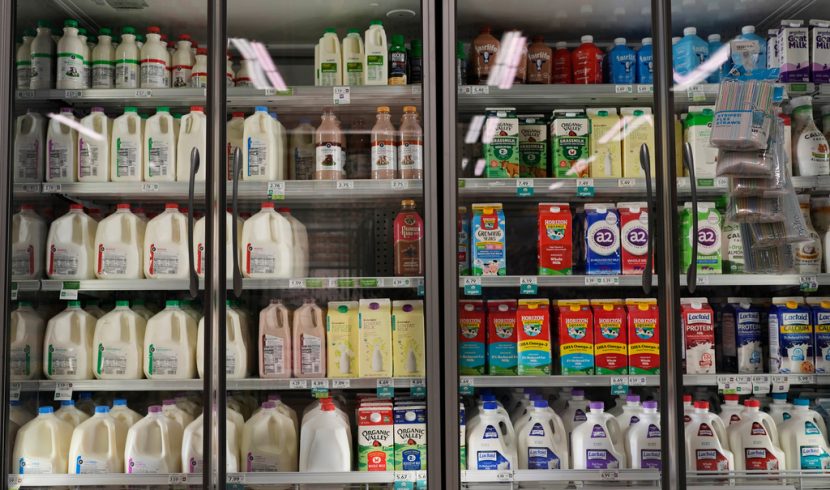
MONTGOMERY, Ala. – One week out from the midterm elections, Republican and Democratic politicians alike are campaigning on ending Alabama’s sales tax on groceries if elected.
It’s rare in Alabama to find a tax policy that both parties agree on, but in an election dominated by affordability, candidates and the state parties are trying to find wins wherever they can.
Eliminating the remaining 2% state sales tax on groceries has emerged as easy fodder on the campaign trail for candidates trying to show they’re serious about addressing affordability. The issue is showing up in ads, campaign mailers and stump speeches across the state, but talk about ending Alabama’s grocery tax isn’t new.
Where the tax stands
The Alabama Legislature passed legislation that lowered the tax from 4% to 3% in 2023 and from 3% to 2% in 2025. Lawmakers also created a group to study the feasibility of removing the tax altogether, but the Legislature hasn’t taken up a complete and permanent removal of the tax in recent years.
During this year’s session, Rep. Mike Shaw, R-Hoover, introduced an amendment to an overtime tax deduction bill that created a two-month sales tax holiday on groceries for May and June. That holiday fell during both the primary and runoff elections.
Other lawmakers wanted a lasting repeal, but such legislation was never considered.
Rep. Penni McClammy, D-Montgomery, filed House Bill 336 to exempt food from sales and use taxes in late January. That bill was never discussed in committee.
Candidates’ and parties’ promises
Republican legislative leadership – including House Speaker Nathaniel Ledbetter, R-Rainsville, and Senate President Pro Tem Garlan Gudger, R-Cullman – held a press conference in Huntsville last week to announce that fully and permanently removing the tax will be a “day one priority” for Republicans during the 2027 session.
Ledbetter said that they have already drafted the legislation and will file it immediately after the Legislature gavels in. He also committed to having the bill on the House floor “within the first few weeks” of the upcoming session.
“Tax relief has been a shared priority among the House and Senate GOP during my tenure as Speaker, and I am proud to say our state has more than $1.5 billion in cuts to show for it,” Ledbetter said in a press release. “Since 2023, the grocery tax has been cut in half, and thanks to our fiscally responsible approach to governing, our state’s budgets are strong enough to finally move forward with its full and permanent elimination.”
Democrats this week accused Republicans of only bringing up the issue around election time.
Members of the House Democratic Caucus, Alabama Democratic Party Chair Bobby Singleton, Democratic lieutenant governor nominee and state Rep. Phillip Ensler and former state Rep. John Knight held a press conference in Montgomery on Monday about affordability.
The group called for a full elimination of the grocery tax as well as an increase in the state’s minimum wage, the expansion of Medicaid, a cost-of-living adjustment for state retirees and a permanent cut on overtime taxes.
McClammy called the timing of the sales tax holiday earlier this year “convenient” but said that Democrats will take any opportunity to cut the tax.
“The cost of living does not take a holiday. Neither should our commitment to (making) life more affordable,” McClammy said. “Now here we are, weeks away before another election, and our legislative leaders have come before you and said we are ready to take the same remaining 2% off taxes this year. So I have a question: What changed? I was ready to eliminate the sales tax in January. I’m ready today. I’ll be ready when it returns to session. There is no question about where we stand, but let’s get the job done.”
Both gubernatorial candidates have also come out to say that they support ending the state’s grocery tax.
Republican gubernatorial nominee Tommy Tuberville lists it at the top of his proposed “Family Affordability Act,” and Democratic nominee Doug Jones lists it high on his plan to tackle affordability.
Looking back
Cutting or phasing out the state sales tax on groceries has been discussed in the State House for almost 30 years. That includes the 2000s when Democrats held a supermajority in the Alabama Legislature.
Former State Rep. John Knight, D-Montgomery, was a fierce advocate for the idea, but was never successful at moving legislation because of the revenue implications. Sales tax revenues flow into the Education Trust Fund, which pays for the range of education spending in Alabama from pre-K to higher education.
That reluctance to pass a tax cut that would reduce education revenue continued after Republicans took over the Legislature in 2010 and has only become a tangible issue in the last four or five years as the ETF has enjoyed record surpluses.
Looking ahead
After decades of advocating for the change, Chris Sanders, communications director of nonpartisan advocacy group Alabama Arise, told Alabama Daily News he’s excited to see bipartisan support for cutting the grocery tax.
Sanders said the two-month holiday was better than nothing, but the organization wants to see lawmakers take advantage of the momentum and “finish the job” in 2027.
“We think those two months should be a start toward forever because we need to eliminate the state sales tax on groceries,” Sanders said. “It is immoral, it’s inhumane, it’s unethical, quite honestly, for our state to tax a basic necessity of life for people who are struggling to make ends meet, to keep a roof over their head, to keep food on the table. There are better, more sustainable, more humane ways for us to raise revenue for public schools and for other vital services than to tax people on the food they need to survive.”
Previous efforts stalled because lawmakers said Alabama’s tight budgets couldn’t sustain the drop in revenue.
Alabama Arise has recommended that Alabama eliminate the state deduction on federal income tax payments to balance out the revenue lost by removing the grocery tax, which Sanders called “a tax on survival.”
In the Monday press conference, Ensler, who proposed lottery legislation during the 2026 session, said creating a state-sponsored lottery could be another way to fund the tax cut.
“There are ways to look at the tax structure and look at where there are exemptions and handouts being given to big corporations, big companies that can afford to do it,” Ensler said. “We also are big proponents of a state lottery and the lottery revenue. We are missing out on hundreds of millions of dollars that would come into the state, so we can cut expenses for working people while bringing in revenue without raising their taxes.”
The general election is Nov. 3. The next legislative session begins on Feb. 2, 2027.