
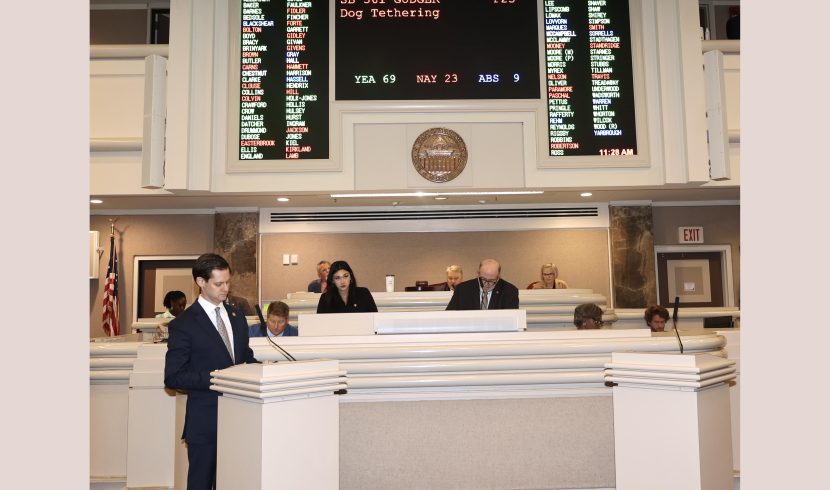
MONTGOMERY, Ala. – After more than 90 minutes of debate and six successful amendments, the Alabama House of Representatives awarded final passage to Beau’s Law, a bill requiring minimum care standards for outdoor dogs.
Senate Bill 361, sponsored by Senate President Pro Tem Garlan Gudger, R-Cullman, would make keeping a dog outside without adequate food, water and shelter punishable by a Class C misdemeanor. The legislation was inspired by the namesake dog, Beau, who was outside in cold weather with only cardboard for shelter.

After it passed in the Senate and a House committee, the bill sat with no action for several weeks. Worried by this lack of action and the few remaining days in the legislative session, animal welfare advocates joined with lawmakers on the State House steps on Tuesday morning to call for a floor vote. The House Rules Committee put it on the special order calendar that night.
Rep. Phillip Ensler, D-Montgomery, sponsored a companion bill and carried Beau’s Law in the House. Ensler said the bill creates “reasonable, responsible and humane” requirements for keeping dogs.
Amendments, amendments, amendments
Beau’s Law was quite controversial on the floor. Lawmakers brought a total of 11 amendments, but only six were successful.
Some were minor, and others attempted to alter the whole scope of the bill. Here’s what all 11 amendments did and how they fared, in the order lawmakers introduced them.
| Rep. Joe Lovvorn, R-Auburn | Defined commercial dog breeder, nested animal control officers under certified law enforcement officers for those able to enforce Beau’s Law | Adopted by a vote of 98-1 |
| Rep. Bryan Brinyark, R-Berry | Reduced punishment to first offense to a Class C misdemeanor | Adopted by a vote of 101-1 after Ensler unsuccesfully moved to table |
| Rep. Phillip Rigsby, R-Huntsville | Changed language about requirements for a shelter to be adequate, downgraded shelter requirement for dogs to be able to run to dogs being able to move freely around | Withdrawn to add language requested by Ensler |
| Rep. Matthew Hammett, R-Dozier | Specified that the bill would “supersede and preempt” any local or municipal laws/ordinances about dogs | Tabled by a vote of 56-42 |
| Rep. Phillip Rigsby, R-Huntsville | Changed language about requirements for a shelter to be adequate but specified the requirement of a solid floor, downgraded shelter requirement for dogs to be able to run to dogs being able to move freely around | Adopted by a vote of 101-1 |
| Rep. Joe Lovvorn, R-Auburn | Specified that the bill would not prevent or limit a law enforcement officer from seeking a warrant if lacking probable cause | Adopted by a vote of 103-0 |
| Rep. Rick Rehm, R-Dothan | Required officers to obtain a warrant to enforce the law | Withdrawn after Ensler unsuccessfully moved to table |
| Rep. Brock Colvin, R-Albertville | Specified that property or dog owners are not responsible for unintentional harm caused to officers enforcing the law | Adopted by a vote of 100-0 |
| Rep. Ivan Smith, R-Prattville | Removed all language about tethering requirements except for banning the use of logging chains | Tabled by a vote of 49-36 |
| Rep. Jennifer Fidler, R-Silverhill | Applied the requirements only to areas that opt in to the bill with a resolution or ordinance | Tabled by Rep. Ellis by a vote of 50-43 after Ensler’s motion to table failed |
| Rep. David Faulkner, R-Birmingham | Set up increasing punishments of Class C misdemeanor for first offense, Class B misdemeanor for second and Class A misdemeanor for third | Adopted by a vote of 92-3 |
Despite the many changes to the bill, Ensler said its core and intent remained intact.
“The amendments cleaned some things up, made some changes, and that’s part of the legislative process,” Ensler said. “I appreciate colleagues bringing different amendments, and the ones that we brought on don’t in any way weaken the bill. I’m really glad and proud that we got it finally passed.
Other floor debate
Debate lasted for more than an hour-and-a-half. Most of the speakers on the floor were Republicans, but the numerous votes on amendments exposed a serious difference of opinion within both House caucuses.
Rep. Brett Easterbrook, R-Fruitdale, expressed that the bill goes too far. He said he didn’t like the idea that someone could go to jail because of how they feed their dog.
“I think it is ridiculous that with all the crime that we have on the human side, here we are talking about putting people in jail over a damn dog,” Easterbrook said. “It’s ludicrous to me, and the idea that they have to have a wooden floor…are we gonna build condominiums for dogs?”
Others opposed the bill on the floor because they worried it could unintentionally hurt farmers and their animals.
Ensler and others attempted to assuage these concerns, but members from both parties who represent rural areas ultimately voted no.
Rep. Matt Simpson, R-Daphne, said he didn’t understand the opposition and called the comments about it hurting farmers “fear-mongering.”
“If you look at what the four corners of the bill says, in itself, it is simply about making sure that you don’t mistreat dogs. It’s not about livestock,” Simpson said. “It’s not about any other animals. It’s saying, how are you going to tether dogs? How are you going to treat dogs? How are you going to have them?”
Two agricultural organizations with powerful lobbies in the State House – the Alabama Farmers Federation and the Alabama Cattlemen’s Association – have publicly opposed Beau’s Law. Both organizations encouraged their members to contact their representatives to share their opposition to the bill.
Ensler did not name any groups, but he alluded to powerful interest groups opposing the bill.
“This is a quintessential example where there have been powerful special interests that have fought this, that have killed it,” Ensler said. “People told me, ‘Don’t bring this bill. It is not going to go anywhere. It can’t get passed.’”
Though it faced an uphill battle, Ensler said the bill passed because of the advocates making their voices heard by contacting their representatives.
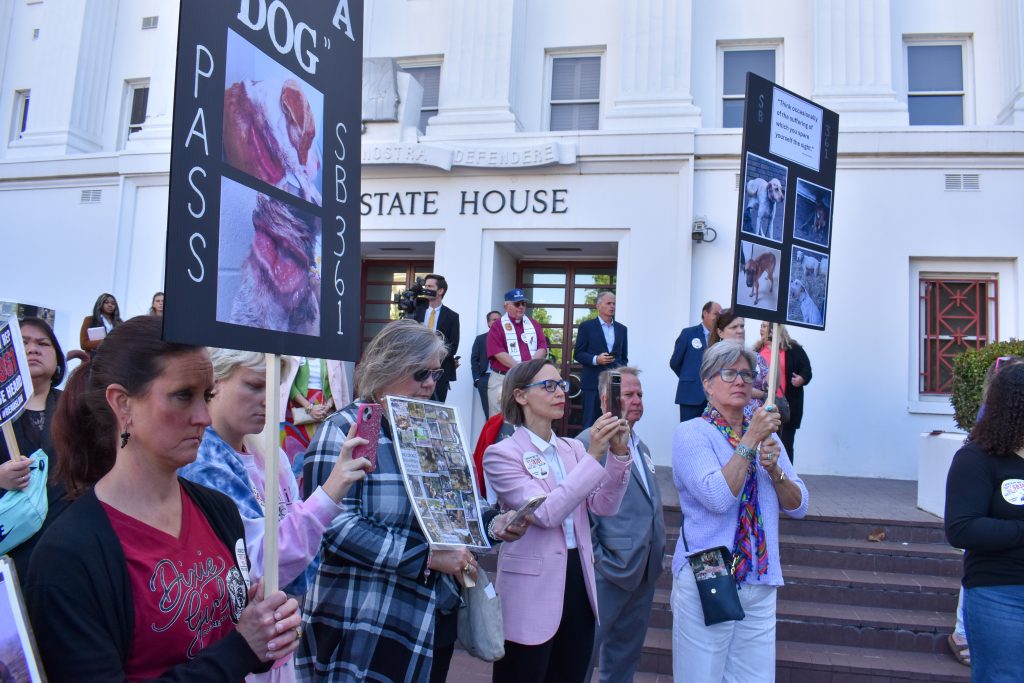
“That’s what this process should be about, not listening to special interests, not listening to those who are going to just throw out endorsements or lots of money in elections,” Ensler said. “This is about doing what the people of Alabama want, and that’s why I stood by this, and I’m really grateful for them.”
The House approved the bill by a vote of 69-23, with 9 abstentions.
The Senate voted to concur with the House’s amendments later on Wednesday evening. The bill now heads to Gov. Kay Ivey’s desk.