
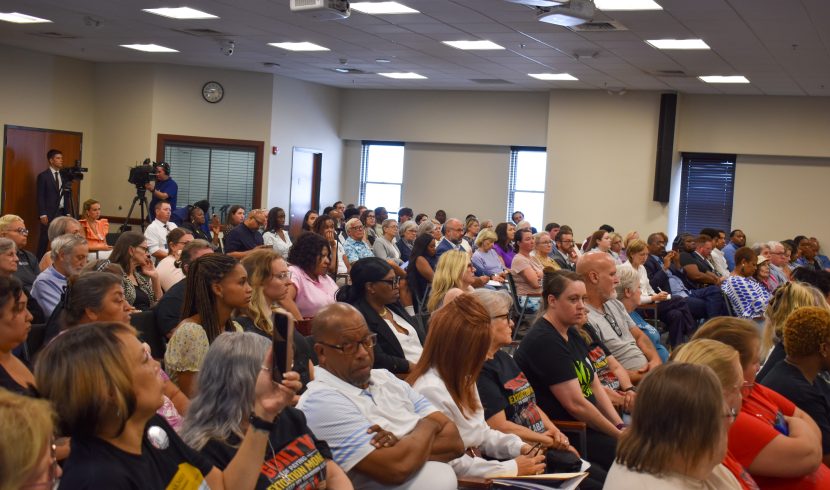
MONTGOMERY, Ala. – In an emotionally charged hearing, criminal justice advocates and family members of inmates in Alabama prisons detailed the mistreatment, drug problems and unexplained deaths within the system at the Alabama State House Wednesday.
The Legislature’s Joint Prison Oversight Committee held its fourth annual public hearing to get feedback about the Alabama Department of Corrections. Some families shared stories about loved ones who died under ADOC custody, while others relayed personal experiences they had when they were behind bars.
Committee Chair Sen. Clyde Chambliss, R-Prattville, encouraged speakers not to share specific details about incarcerated people like their names or incarceration location.
“That is for their safety, for your safety, and please just refrain from announcing names and AIS numbers or anything like that,” Chambliss said before speakers began. “We just want to do this to prevent any negative repercussions.”
Retaliation for speaking up about poor conditions was a common theme among the testimonies.
Colleen Howell, whose son was previously in jail, said verbal abuse and provocation are a regular part of life within Alabama’s correctional facilities. She said that when inmates try to speak up, officers not only ignore them but target them too.
“When an inmate reports wrongdoing, the officers will announce it publicly in all the dorms, the yard, everywhere,” Howell said. “That gives retaliation to the inmates. It weaponizes the staff for anyone to speak up about anything.”
Deaths under ADOC custody
Loved ones telling committee members about the unexplained deaths of their incarcerated family members has been a common occurrence at these public hearings.
Family members asked for help getting answers about the circumstances of loved ones’ deaths on Wednesday, with several sharing gruesome photos of their family members’ appearances upon visitation with their bodies.
Kim Baker told the story of her brother who died in a mental health unit in an ADOC facility. Baker said that when she was finally able to see her brother’s body, it was clear he did not die of natural causes.
“I was in shock when I seen him,” Baker said. “He was wrapped in bubble wrap and covered with a sheet up to his neck without any belongings sent with him. His face had been beaten, the top of his head was cracked open. He had dried up blood in his nose, a blood stain under his nose and dried feces still on his scalp after someone attempted to clean him up.”
Baker said that despite his condition at death, the department did not perform an autopsy, only a toxicology report. She said she still hasn’t been able to get a copy of this report.
Her brother was mentally ill, and Baker said she also believes the ADOC violated his Eighth Amendment rights. She said he would have received better care at an animal shelter.
“He was mentally ill and put in a confinement cell in a mental health care unit for 24 hours a day,” Baker said. “For 72 days without a shower, without the right medication, he was tortured and beaten to death and left to die alone. He endured horrific pain and conditions. If my brother could have called me, he would have. He wasn’t able to.”
Medical care in prison
Others spoke about the lack of medical care within facilities and how inmates have to step in to fill the gaps.
Carl Green was incarcerated for 36 years on a life without parole sentence. Amid rampant violence, Green said he became a “surgeon” and learned from fellow inmates how to stitch up patients after stabbings.
“I spent 20 years in Alabama’s prisons, being a medical doctor, actually sewing people up, actually patching people up, actually stopping people from bleeding, actually stepping in and keeping people from dying, negotiating, bringing money out of my pocket, out of my box, food items to keep these people from being killed,” Green said. “This is just ridiculous, it’s just an ongoing system. This is no game. These people are 65 to 70 and 80 (years old.) This is in prison.”
Green said he would use paper clips and other makeshift items in sewing kits to perform surgeries.
“There’s nobody to help us. There’s nobody,” Green said. “The medical staff is so short. The security is so full.”
When asked about whether his patients would get care from prison doctors in the end, Green told committee members that doctors refused to see patients because someone else had already helped them.
Healthcare within Alabama’s prisons is a topic at the top of mind for many lawmakers after Yes Care, Alabama’s previous prison healthcare provider, filed for bankruptcy and left thousands of workers unpaid earlier this year.
Committee members Rep. Chris England, D-Tuscaloosa, and Senate Minority Leader Bobby Singleton, D-Greensboro, wore bright yellow shirts with the phrase “#prosecuteYesCare” to the meeting.
Earlier this month, England called for the attorney general to try YesCare for fraud and held a legal contract up related to the company’s bankruptcy filing.
Though there are still large issues looming with ADOC, England said there has been progress because of what advocates have shared in the meetings over the past few years.
“Years ago, when everybody had issues with the Department of Corrections, they were basically reaching out into a void in hopes of getting an answer,” England said. “So, as a result of these meetings and all this advocacy, we created a Constituent Services Office that now has to do something. You have a contact person who has to respond. Now has that response been adequate? Hell no, because there’s a lot of work that needs to be done. But in order to take steps, you got to take one, and that’s a big step in the right direction.”
Audit pilot program update
Before the hearing began, Chief Examiner Rachel Riddle of the Department of Examiners of Public Accounts briefly updated committee members about her progress on the first audit of the pilot program.
The program came to be after Sen. Larry Stutts filed a bill to create a new oversight coordinator position and office in the examiners’ department during the legislative session.
His bill passed out of the Senate Judiciary Committee during this year’s session. Instead of bringing it to the Senate floor, Stutts struck a deal with ADOC to create a pilot program without legislation.
Riddle’s team was going to start with an audit of one prison, but they realized any comprehensive audit has to start with the executive structure of the department, she said.
“What I learned real quickly is we cannot do a pilot program of one prison without looking overall at DOC first because we might be going to a prison and say what’s wrong with that prison, but that’s not going to do any good if everything at the top isn’t meshing,” Riddle said.
She explained that her department has conducted 14 interviews with DOC officials and has filed numerous document requests to better understand the department’s costs and politics.
Riddle said the DOC has slowed down the auditing process by refusing to release information it deems privileged and confidential.
“We have run into some issues getting certain documents, and we are trying to be sensitive to that,” Riddle said. “We have got the attorney general’s office involved in us trying to work through that. I’ve never had a state agency not give any documents, even confidential ones, and so this is new territory for me.”
The Legislature gave Riddle subpoena power through previous legislation establishing prison oversight, but she said she rarely has to use it in her role. Riddle said she hopes her team and ADOC can reach an agreement and avoid the subpoena process.
Even with the delays, Riddle said she believes the program can produce its first report by the October deadline.
Rep. Chris England, D-Tuscaloosa, said the auditing process of the DOC is one of the most important results of the committee holding public hearings and other meetings every year.
“I hope that once that’s done, it will compel us to go ahead and ask for a forensic audit for the entire Department of Corrections…” England said. “I think we wait for the results of that audit, but those audits are going to come and give us the momentum and the evidence necessary to overhaul the Department of Corrections.”