
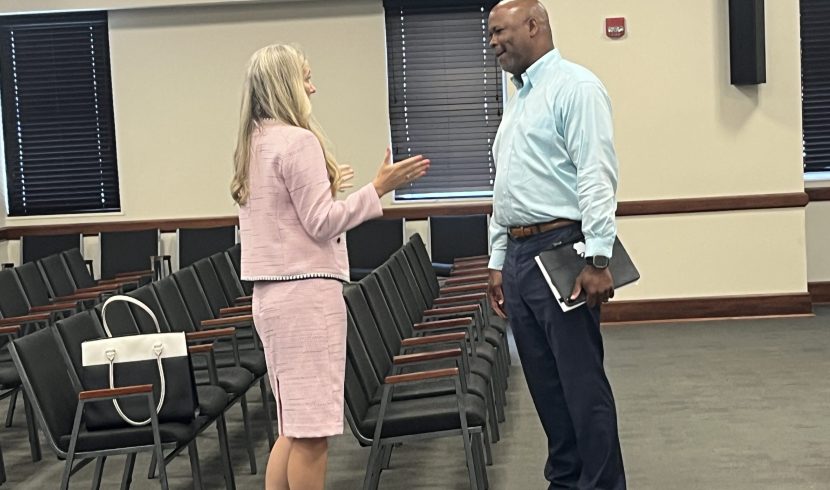
MONTGOMERY, Ala. – Rep. Chris England, D-Tuscaloosa, held up Department of Corrections contract Thursday in an attempt to shine a light on what he called a bad deal for the state.
At the Legislative Contract Review Committee’s meeting, lawmakers reviewed ADOC’s proposed $200,000 contract with attorney Jack Crawford from the Huntsville law firm Butler Snow. The department says it needs help recouping funds from YesCare, ADOC’s former healthcare provider for inmates, as the company goes through bankruptcy proceedings in the U.S. Bankruptcy Court for the Middle District of Florida.
Mandy Speirs, assistant general counsel for ADOC, said it was originally a contract termination but has “blossomed” into a bankruptcy and bond matter, which is much more complicated.
“I am not a bankruptcy expert nor am I a bond expert, nor do we have anyone on staff at the DOC who are experts in this matter,” Speirs said. “We are pursuing what legal avenues may be available to the department under the breach of contract of YesCare to recoup any money that the department may have for that breach of contract.”
Speirs said YesCare also had a $15 million performance bond, which the counsel would also look into getting back. ADOC General Counsel Mary-Coleman Roberts later said that YesCare owes the state “several million” dollars.
The state entered into a four-and-a-half-year, $1.05 billion contract with YesCare for inmate care in 2023. YesCare faced financial issues throughout that contract and filed for bankruptcy earlier this year, making the state scramble to find a new provider.
The company also failed to pay its employees on time more than once, and employees have still not received paychecks for the last pay period.
Before it filed for bankruptcy, YesCare explicitly asked the state for an advance on disbursements to help pay employees, ADOC representatives confirmed at the meeting.
“YesCare asked us to expedite (their last payment in April) with the understanding that they needed it expedited to make payroll, particularly on April 24 and then that would also cover the May 8 payroll,” Roberts said at the meeting.
YesCare sent out paychecks to employees on April 24 but did not make payroll on May 8, Roberts said. She said that when asking what the company used the money for, a YesCare representative said “other things.”
With this in mind, England called on the attorney general’s office to investigate YesCare for fraud.
He also asked the state to pay the employees what YesCare owes them and go after the money in the bankruptcy case instead of making individuals do so. He said that the likelihood of an individual being able to get back a sum of money as small as a single paycheck is “slim to none.”
England said it’s important to prosecute YesCare to send the message that Alabama holds companies who break the law accountable.
“A company made false material misrepresentations to a state agency to get money based upon promises that they made to do things that they ultimately did not do, and they filed bankruptcy,” England said after the meeting. “To me, that sounds like fraud, and we have a criminal statute for that and YesCare should be prosecuted.”
Roberts said that ADOC is “evaluating all steps.”
“Without saying publicly what our legal strategy is, I will just say simply that conversations have been had, though there has not been a formal request yet from our office because we felt like we are still in the investigative stages of what we need to do next,” Roberts said.
YesCare did not immediately respond to a request for comment.
Concerns about attorney selection
England also took issue with the ADOC’s selection of the Butler Snow law firm for the contract. The $200,000 contract is at a rate of $345 per hour.
Butler Snow has represented the state in corrections-related matters in the past but came under fire when a judge discovered one of the firm’s attorneys using artificial intelligence to write legal briefs for the state.
England also mentioned a past conflict of interest with a private practice attorney who defended the ADOC in a lawsuit over inmate medical care after being named to YesCare’s advisory board. That situation ultimately led ADOC to redo the selection process for an inmate healthcare provider in 2023, but it still decided to contract with YesCare. The attorney, Bill Lunsford, did not ultimately join the board. He now works for Butler Snow.
“It’s almost like it’s an insular system where only certain people get business, and we all end up paying the bill,” England said. “Up until this point, if I’m not mistaken, I think we may have given Butler Snow $40 (or) $50 million (for prison litigation), possibly more than certain government agencies. I think it’s fair for the public to start asking questions about what sort of legal services we are getting if the only thing that we’re getting is more bills.”
England said he was holding the contract because there needs to be accountability. The committee can hold the contract for a maximum of 45 days.