
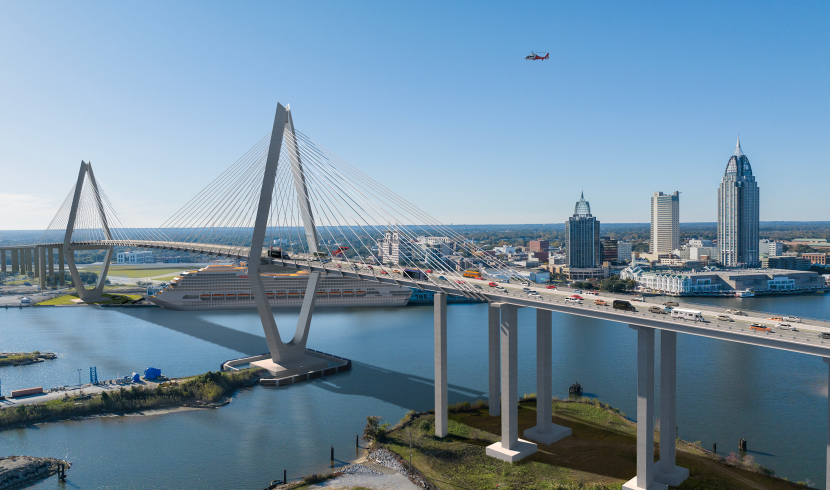
WASHINGTON — A newly secured $2.52 billion federal loan will help kickstart construction of the Mobile River Bridge, closing out the final chapter in a years-long effort to finance the massive infrastructure project.
The U.S. Department of Transportation announced Friday that Alabama will receive up to $2.52 billion in a Transportation Infrastructure Finance and Innovation Act (TIFIA) loan through the Build America Bureau for the I-10 bridge and Bayway project.
“The Mobile River Bridge and Bayway project will ease traffic congestion, boost the flow of freight, and enhance safety for drivers,” Transportation Secretary Sean P. Duffy said.
Construction on the first phase, a six-lane cable-stayed bridge, is expected to start next month, the Alabama Department of Transportation said in July. The state will also restripe the existing 7.5-mile bayway to make six lanes.
The TIFIA loan is the final funding piece to unlock the first phase of construction for the $3.2 billion project. Additional financing has come from a $125 million Infrastructure for Rebuilding America (INFRA) grant, a $550 million federal Bridge Investment Program grant and at least $250 million in state funding.
Gov. Kay Ivey said the project will bring “monumental improvements for travel” along the Gulf and lead to greater “commerce across the region.”
“This advancement marks the final piece needed for the decades-awaited Mobile River Bridge and Bayway project,” Ivey said. “Once it is completed, this project will finally alleviate our traffic gridlock across Mobile Bay.”
Drivers will not have to pay tolls until the new bridge is complete, likely in 2031. The tolls will help the Alabama Toll Road, Bridge, and Tunnel Authority pay off the $2.52 billion federal loan. Toll fees will depend on the driver crossing the bridge, as those with an ALGO Pass will pay $3 per trip while those with interoperable transponders will pay $7.70.
The causeway, Wallace Tunnel, Bankhead Tunnel and the Africatown Bridge will remain toll-free routes.
The Trump administration allowed Alabama in July to become the first state to implement the Interstate System Reconstruction and Rehabilitation Pilot Program, which will allow it to collect tolls on the interstate for reconstruction and rehabilitation purposes.
U.S. Sen. Tommy Tuberville, R-Ala. who credited President Donald Trump for speeding up the process, said the Mobile River Bridge will be a “game-changer for the Gulf” to help ease traffic congestion and “expand freight access to the Port.”
One part of the project’s financing, the $550 million loan, was originally awarded under the Biden Administration in 2024 as part of the 2021 Infrastructure Investment and Jobs Act.
Other than U.S. Rep. Terri Sewell, D-Birmingham, however, all of Alabama’s congressional delegation voted against the 2021 Bipartisan Infrastructure Law. U.S. Sen. Katie Britt, R-Ala., and Reps. Shomari Figures, D-Mobile, and Dale Strong, R-Huntsville, were not in office at the time.
“This investment will mitigate ongoing safety concerns, strengthen our hurricane evacuation routes, and keep our economy moving for generations to come,” Britt said, thanking Trump and Duffy.
The Mobile River Bridge and Bayway project along 1-10 aims to eliminate “the state’s primary bottleneck,” enhance “hurricane evacuation capabilities,” and expand “freight access to the Port of Mobile,” according to the Department of Transportation.
The price tag of the new Bayway structure, which will come in the second phase, has yet to be determined. Tolls will help finance it.
The project will be the state’s largest transportation infrastructure project ever, according to ALDOT.