

MONTGOMERY, Ala. – The Alabama Department of Transportation expects construction on the Mobile River Bridge project to start in early October, spokesman Tony Harris said on Wednesday.
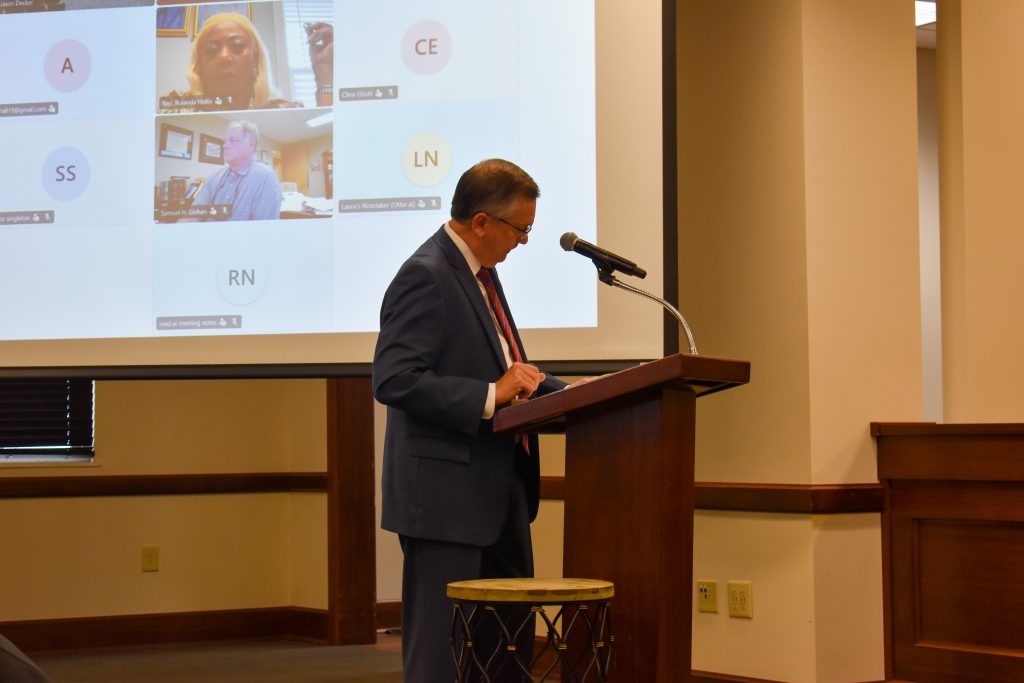
Briefing members of the Legislative Joint Transportation Oversight Committee about the construction, Harris shared that the state is currently solidifying funding to meet that deadline for the project announced earlier this month.
Harris said the project is ALDOT’s largest transportation infrastructure project ever.
“For a project whose life has been hurry up and wait, hurry up and wait, we believe we’re at a place where we have a path forward, and we can actually begin soon,” Harris said. “We expect a groundbreaking date to be set in the next few weeks, and we anticipate significant participation from our federal partners in that groundbreaking.”
The state is splitting the project into two phases to ease costs. The first phase is the construction of a new, six-lane cable-stayed Mobile River Bridge. The state will also update the existing bayway by restriping it to include six lanes of capacity during that period.
Phase two will be the construction of a new bayway.
“USDOT has not released us from the original federal requirement to replace the bayway,” Harris said. “They’ve simply allowed us to phase the work so we can build what is financially achievable today and complete the remainder later. Quite frankly, that’s becoming the new reality for transportation mega projects around the country.”
The project’s phase one funding pulls from many state and federal sources. It will come from a $125 million Infrastructure for Rebuilding America (INFRA) grant, a previously awarded $550 million federal Bridge Investment Program grant, a federal Transportation Infrastructure Finance and Innovation Act (TIFIA) loan and at least $250 million in state funding.
Phase one is expected to cost $3.2 billion. The state will finance the remainder of the money through bonds in coordination with the U.S. Department of Transportation, Harris said.
“We’re now working toward financial close on the TIFIA loan and the bond financing by the end of September, by the middle of September, actually, that would put us at a place where we could authorize full construction in early October,” he told lawmakers.
ALDOT expects construction to take five years, Harris said.
The project to ease congestion on Interstate Highway 10 has been in the works for decades, with previous attempts stalled by disagreements over toll prices.
The new bayway will only collect tolls when the new bridge is complete, which ALDOT expects in 2031. The tolls will then help fund phase two of the project.
The toll price will depend on the driver crossing the bridge. There will be:
- a $60 unlimited monthly commuter pass, which is roughly $1.36 per trip for daily users;
- a $3 per-trip ALGO Pass rate;
- a $7.70 rate for users with interoperable transponders;
- and drivers without a transponder will be billed through a pay-by-plate process.
The ALGO transponders will be widely available and free of charge initially.
The causeway, the Wallace Tunnel, the Bankhead Tunnel and the Africatown Bridge will remain toll-free routes indefinitely.