
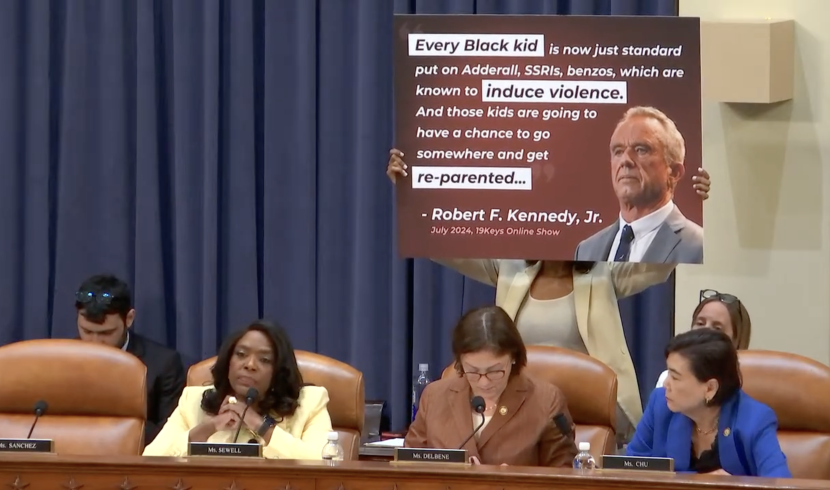
WASHINGTON — In a heated exchange, U.S. Rep. Terri Sewell sparred with Health and Human Services Secretary Robert F. Kennedy Jr. Thursday over his past remarks that Black children who are on mental health medication should be “re-parented.”
During a budget hearing in the House Ways and Means Committee, Sewell said the secretary has made several “outlandish and frankly disturbing” comments in the past, including referencing on a 2024 podcast that Black kids who take ADHD medication need to go to a “wellness farm” to be “re-parented.”
“There is a lot to unpack in that comment,” Sewell, D-Birmingham, said.
Kennedy denied that he ever made those statements.
“I don’t even know what that phrase means,” Kennedy said in response. “And I doubt that I said it. I’m not going to answer something that I didn’t say.”
But a recording of Kennedy in 2024, appearing on a podcast show, 19Keys, reveals that he did.
“Every Black kid is now just standard put on Adderall, on SSRIs, benzos, which are known to induce violence, and those kids are going to have a chance to go somewhere and get re-parented, to live in a community where there’ll be no cellphones, no screens,” Kennedy said in the June 2024 podcast. “You’ll actually have to talk to people.”
Sewell said Kennedy’s racial comments were “deeply offensive” and referenced the connection to slavery.
“For Black families in the United States, the issue of family separation is not new,” Sewell said during the hearing. “Our nation has a long and painful history of separating Black children from their families.”
In the tense back-and-forth about “re-parenting” Black children, Sewell also called out Kennedy’s vaccine skepticism.
“When you so doubt about the safety of vaccines and when you promote unproven statements that have no basis in science, you endanger the lives of everyone across this nation,” Sewell said.
Thursday’s hearing was centered around the Department of Health and Human Services budget for 2027, but Sewell and other Democrats used their questioning to grill Kennedy on his plans for the agency, including changing the childhood vaccine schedule and the rise in measles cases.

During his opening testimony, Kennedy defended his agenda and detailed his focus on chronic disease, Make America Healthy Again reforms and rural health needs.
“We can reverse chronic disease, improve public health and lower costs,” the secretary said.
House hearing, Aderholt discusses wage index
In a separate budget hearing Thursday afternoon, Kennedy appeared in front of a House appropriations subcommittee led by Rep. Robert Aderholt, R-Haleyville.
The Alabama congressman opened the meeting with praise for Kennedy’s “new” approach to public health. During his questioning, Aderholt raised the “flawed” wage index system issue, a complicated formula used to determine Medicare reimbursements for hospitals based on regional labor costs.
Alabama has the lowest reimbursement rate in the continental United States, severely straining rural providers.
“It creates a self-perpetuating disadvantage for low wage and rural states,” Aderholt said. “And that results in Alabama alone, hospitals being paid substantially less for providing the same care.”
He then asked Kennedy how HHS is evaluating labor costs today to determine the reimbursements.
“Ultimately, it’s a problem that, as you say, is destroying rural hospitals,” Kennedy responded. “It’s something that we can’t fix at HHS. We need Congress to intervene and we are here to provide technical advice and work with you to make sure that we get something that works.”
But because the system has to be budget-neutral, finding a legislative solution in Congress has been difficult. Aderholt asked the health secretary to study the true labor costs in different areas and the methodology used to determine that, to inform Congress’ work on the issue.
“Happy to work with you and to bring Dr. Oz in to work with you on possibly developing that kind of study,” Kennedy said.
Recently, Sewell introduced a bipartisan bill to codify changes to the wage index to boost the reimbursements for low wage hospitals in the bottom quartile.
HHS budget
President Donald Trump’s budget request for fiscal year 2027 proposes $111.1 billion for the department, a 12% decrease from last year.
The proposal also includes cutting National Institutes of Health funding by $5 billion, but lawmakers wholly rejected a similar cut last year.
“Congress has a lot of support for NIH…and I will probably reiterate to him the fact that Congress does have a lot of support for NIH,” Aderholt told Alabama Daily News before the hearing. “I know they have to cut, and they’re looking at ways to cut. So I understand.”
Kennedy will also testify in front of several other committees next week as Congress crafts next year’s budget.