
BIRMINGHAM, Ala. – A lawsuit that began over whether students using CHOOSE Act education savings accounts can play sports after transferring schools has been settled, according to court filings in Montgomery Circuit Court.
Gov. Kay Ivey, House Speaker Nathaniel Ledbetter and Jaclyn Hall sued the Alabama High School Athletic Association last year after the association said students transferring to a new school with CHOOSE Act funds would be ineligible to play sports for one year.
The case had been scheduled for a June 9 hearing, but the hearing was canceled in light of the settlement.
The settlement agreement specifically applies to Hall’s son. It says the AHSAA will not “limit or impede” Z.H.2 from participating in athletics because he is a CHOOSE Act student or because of his participation in the lawsuit. The agreement also says all other eligibility rules still apply to him.
The CHOOSE Act, approved by lawmakers in 2024, created state-funded education savings accounts that parents can use for tuition, fees, textbooks, homeschooling curriculum and other educational services.
The AHSAA’s transfer rule imposes a one-year ineligibility period on most transferring athletes.
In July 2024, the AHSAA classified CHOOSE Act funds as financial aid, meaning the transfer rule would apply to student athletes who transferred to new schools using those funds.
Ivey and Ledbetter filed the lawsuit in September, arguing the AHSAA rule conflicted with language in the CHOOSE Act and that using education savings accounts is not financial aid. The suit was later amended to include Hall, whose son was impacted by the rule.
Gaines issued a temporary restraining order Sept. 5 allowing impacted students to play while the case proceeded. In November, he ordered the parties into mediation.
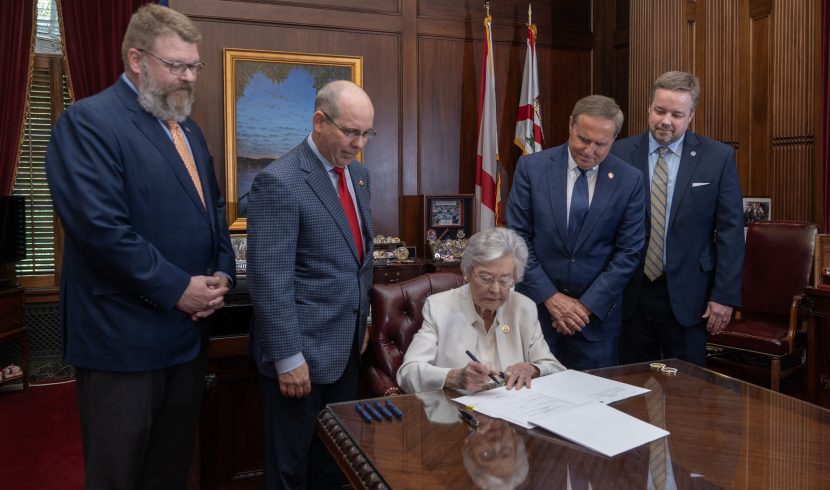
In April, Ivey signed the Let the Kids Play! Act, legislation aimed at protecting CHOOSE Act students’ athletic eligibility. The next day, AHSAA Executive Director Heath Harmon said the association had removed CHOOSE Act funds from the definition of financial aid.
“No student will be ruled ineligible based solely on his or her receiving Choose Act funds,” Harmon said in an April 15 statement. “However, as stated in the new law, all AHSAA rules on eligibility with transfers and residency still apply.”
The settlement resolves Hall’s claims. Attorneys for both sides asked the court May 29 to dismiss the case. Circuit Judge J.R. Gaines dismissed the case with prejudice June 2, meaning the same claims cannot be refiled. Each side is responsible for its own costs.
Read more about the CHOOSE Act:
CHOOSE Act applicants show how ESA demand is changing in year two
Alabama public schools join CHOOSE Act marketplace
Alabama’s CHOOSE Act draws record 49,000 student applications