
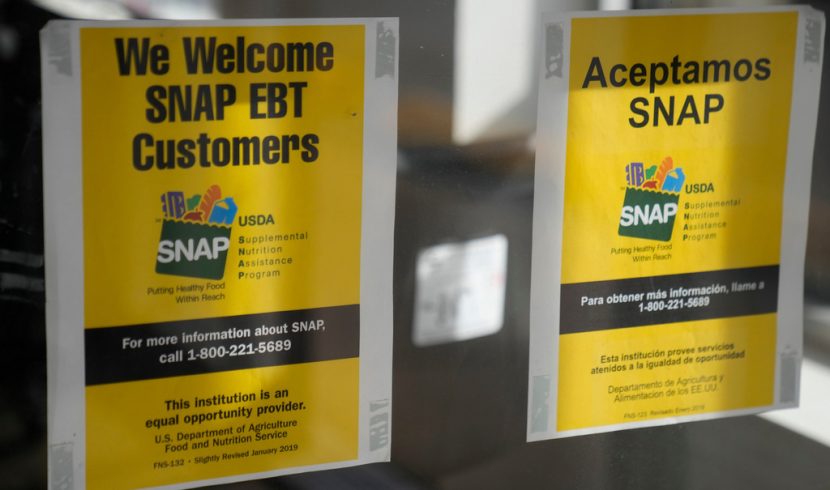
MONTGOMERY, Ala. – The Alabama Contract Review Committee on Tuesday approved an $8.5 million contract from the Department of Human Resources to help mitigate food assistance fraud in Alabama.
The one-year contract with New Jersey-based Conduent State and Local Solutions Inc. will identify and mitigate Electronic Benefit Transfer cardholder losses and “improve cardholder control of EBT account activity.” The partnership with Conduent will also help Alabama’s EBT cards meet “industry standards.”
Brandon Hardin, who manages Alabama’s Supplemental Nutrition Assistance Program for DHR, said the department has already updated cards to be chip cards and started processes to allow users to control their cards with their phones. Cards now default to lock out of state and online purchases, he said.
The contract with Conduent comes two months after the committee approved a more than $12 million contract for a company to provide “quality assurance” on the system that administers SNAP and the Temporary Assistance for Needy Families program. Having a quality assurance program to oversee the computer systems is a federal requirement, and the $12.1 million was funded in equal parts by the state and the U.S. government.
Theft of SNAP benefits was rampant in 2024 and 2025, with more than $11 million in SNAP benefits reported stolen from Alabama recipients during the first six months of 2025, according to USDA data.
Hardin said that under the leadership of DHR Commissioner Nancy Buckner, the department is going after fraud committed by both individuals and stores. He said in 2025, the department’s fraud integrity unit recovered over $7.7 million worth of fraudulently obtained benefits.
Previous reporting from WAFF showed that DHR received nearly 40,000 stolen SNAP benefit claims between 2023 and 2025, totaling more than $16.5 million.
Hardin said the Conduent contract is related to theft.
Committee Chair Sen. Dan Roberts, R-Mountain Brook, then asked Hardin to address concerns about the state’s payment error rate.
Hardin said the payment error rate is about “common mistakes” that are procedural. “Like changes in house or circumstances,” he said, which could change the amount of benefits a SNAP recipient receives.
The payment error rate has become a measure that could cost Alabama hundreds of millions of dollars due to changes to the SNAP program mandated by the One Big Beautiful Bill Act.
Those changes are looming over Alabama and any discussion of the state’s food assistance program.
The federal government is now shifting up to 15% of SNAP benefit costs to states, depending on how accurately they administer the program.
In fiscal year 2025, Alabama’s SNAP error rate was 9.52%, placing it in the 10% cost-share bracket. Based on that rate and Alabama’s $1.77 billion in SNAP benefits paid out last year, the state would be responsible for about $177 million in additional costs in fiscal year 2028.
But if the state lowers its rate below 6% during the fiscal year 2026, it will not have to pay any additional costs. Reducing it to between 6%-7.99% would mean only having to pay 5% of benefit costs.
Under a separate change in the law, the federal government’s share of SNAP administrative costs will drop from 50% to 25% beginning in fiscal year 2027, meaning Alabama must also cover an additional $39 million in administrative spending annually. That cost is coming regardless of what happens with the error rate.
Following calls from several lawmakers and advocacy groups, the DHR Board voted unanimously in July to ask Alabama’s congressional delegation to seek the same two-year delay already granted to states with the nation’s highest SNAP payment error rates. OBBBA gives the states with the highest error rates two additional years before they must begin paying part of the cost of SNAP benefits.
DHR officials have also warned that these cost-share obligations could lead to drastic cuts to the program that provides food assistance to about 648,000 Alabamians. The average monthly benefit is about $194 per person and $392 per household.
Recognizing that the state’s impending SNAP cost share is at the top of mind for many lawmakers, Hardin underscored to committee members the “significant difference” between fraud and the payment error rate.
“It sometimes gets confused, but payment error rate is just potentially mistakes in the benefits that are paid,” Hardin said. “It’s not theft, so the contract that is in front of you today is about theft, it’s about folks stealing the benefits. The payment error rate, which we are working really hard on to drive it down, is about mistakes that are within the cases.”
Hardin said that the department has instituted more than 15 initiatives to drive the error rate down.
Alabama’s unofficial error rate for fiscal year 2026, which ends on Sept. 30, is 8.64%, he said. But with these initiatives, DHR was able to lower the state’s rate to 4.97% in April, the most recent month with data available.
“What you’re currently looking at in the error rate is things that happened in the past. It’s just now starting to see things that we’ve made our changes on…” Hardin said. “Anything we can do to kick the can down the road is a good thing, but we want to make sure that we get (a delay) to be able to show you all that we can drive our error rate down and we can use current statistics to do that. That gives not only Alabama a fair shot but the whole country a fair shot at it.”
Passing an updated farm bill, which is likely to include some sort of revision to the SNAP cost sharing, is a top priority for lawmakers as Congress returns to session after its August recess.