
MONTGOMERY, Ala. — The Alabama House advanced with little discussion and strong bipartisan support Tuesday a four-bill tax cut package, including a reduction on the state sales tax on groceries, that would represent an annual savings of $192 million for Alabamians.
“With the passage of this tax cut package, the Alabama House of Representatives has now passed 15 tax cuts since the current quadrennium began in 2022,” said House Speaker Nathaniel Ledbetter, R-Rainsville, in a statement Tuesday.
“As shopping carts get lighter and grocery bills continue to rise, I am particularly proud that we were able to double down on the grocery tax cut, which is the largest cut in state history and will save Alabama families a minimum of $236 per year.”
With the package’s passage, however, extending the state’s income tax exemption on overtime pay – a key priority this year for House Democrats – now becomes unlikely given its price tag of more than $300 million per year, which came as a surprise to lawmakers after the initiative had originally been projected to cost $34 million.
 The tax cut bills were all introduced by Rep. Danny Garrett, R-Trussville, who chairs the House Education Budget Committee, and would apply to a broad base of Alabamians, though target middle- and lower-income earners and seniors. The most costly of the four bills would see the state sales tax on groceries be reduced from 3% to 2% for a total cost of $132 million, and was the first to be brought to the House floor.
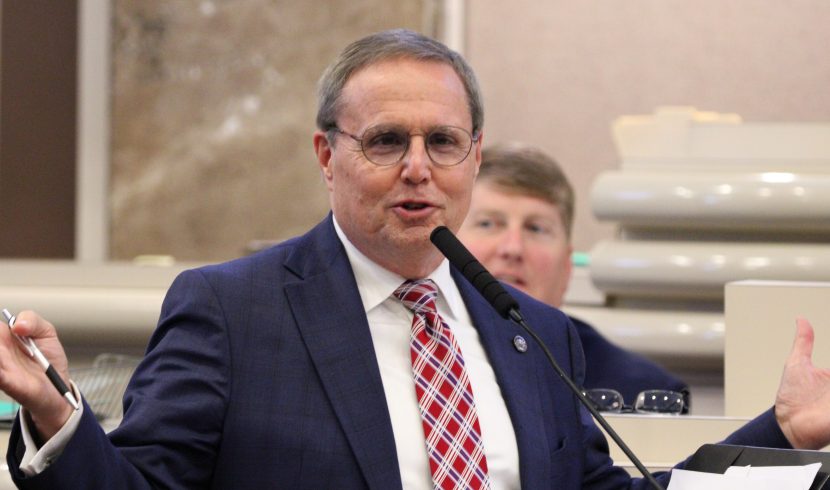
“Today, we have the opportunity to reduce taxes on just about everyone in the state of Alabama,” Garrett said introducing House Bill 386.
Alabama Democrats have long called for the state tax on groceries to be eliminated entirely, with Alabama being among just ten states to issue any state sales tax on groceries. That effort culminated in 2023 when lawmakers passed a bill cutting the state sales tax on groceries by 1 cent, with a provision for additional cuts so long as revenue to the state Education Trust Fund saw a growth of at least 3.5%.
While the ETF has yet to see 3.5% annual growth since the passage of the initial state grocery tax cut, Garrett, citing the state’s strong financial position, made his case for advancing the additional one percentage point tax cut, and also spoke to calls from House Democrats to completely eliminate the state grocery tax.
“We’re one of the few states that taxes groceries, but (with this proposal we will) have now cut it 50%, so I believe this is a step toward (completely eliminating the state sales tax on groceries),” Garrett said. “But also, we’re providing relief in other areas to a broad base of people and not jeopardizing our education budget process.”
All the proposed cuts would reduce revenues to the state’s Education Trust Fund, which supports K-12 and higher education.
With no opposition, the bill sailed through the House and passed unanimously, while also receiving 97 cosponsors.
The three other tax cut bills, which also all passed unanimously, included House Bills 387, 388 and 389, which would grant municipalities the full discretionary authority to lower their own sales tax on groceries, increase tax exemptions for seniors drawing from retirement, and increase tax exempt income for those making under $60,000 a year, respectively.
Some concerns were raised about HB388, which would increase tax exempt retirement income for Alabamians 65 and older from $6,000 to $12,000. Its fiscal impact is estimated to be estimated to be $44.8 million annually.
“When I look and see the $45 million fiscal note, that kind of hurts me,” said Rep. Thomas Jackson, D-Thomasville. “How are we going to replenish this Education Trust Fund budget when we’re taking so much from it?”
Garrett, reiterating his past comments on the state’s finances, argued Alabama was in a fiscally secure position to sustain the cuts.
“I would submit that we’re not taking a lot from it because what we’re doing is actually making investments that are actually yielding returns that are helping grow the budget,” Garrett said. “We’ve seen budget growth, we’re not spending all the money that comes in the door, we’re setting reserves aside. What we are presenting today, we feel through growth of the budget and continued fiscally-responsible budgeting practices, we can sustain these cuts.”
Despite his concerns, Jackson, along with nearly every other member of the chamber, voted in favor of HB388.
With the passage of the tax cut package in the House, the four bills now head to the Senate, where Garrett said he had “no reason to think it wouldn’t pass.”
On the prospect of extending the state’s tax cut on overtime pay, established in late 2023 and set to sunset in late June, Garrett said it was unlikely given its estimated cost of $230.7 million over nine months.
“It has created a $300 million hole in the education budget, which we could sustain, but it would prevent us from doing other things,” Garrett told Alabama Daily News.
“That overtime tax cut is going to a subset of Alabamians. The tax cuts we did today exceed $300 million in total (when including the previous 1% state grocery tax cut), and they go to a broad range; everybody who buys groceries, retirees, working families who make less than $60,000, so they’re more broadly recognized.”
Ledbetter, while acknowledging the difficulty of extending the overtime pay tax cut while also instituting the $192 million in new tax cuts just advanced by the House, said he was still hopeful that the tax cut on overtime pay could be extended in some form, telling ADN he believed “there’s always opportunities” to extend the tax cut, and would entertain further discussion on the matter.