
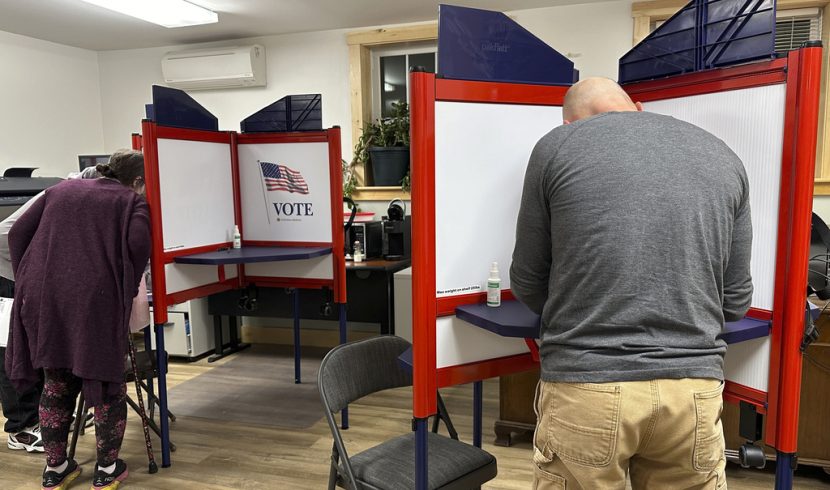
Ask most people what a poll is for and they’ll say it tells you who’s winning. In a low-turnout election, that’s the easy part. The hard part – the part that decides whether the poll is any good – is figuring out who’s actually going to vote. Get the electorate right and the question nearly answers itself. Get it wrong, and the most careful arithmetic in the world won’t save you.
The people who tell a pollster they’ll vote and the people who actually show up aren’t the same crowd, and the smaller the turnout, the wider that gap grows. That’s the real work of polling a runoff, and in Alabama this year it’s never mattered more.
The numbers tell the story. Alabama Republicans have been walking down a staircase all year. The May 19 primary drew about 23 percent of registered voters. The June 16 runoff pulled fewer than 11 percent. Two weeks ago, a special congressional primary in four districts drew 5.24 percent. Twenty-three, to eleven, to five. Ask yourself who’s still standing at the bottom of that staircase, because those are the people choosing our nominees.
They’re what I call super voters – the Alabamians who turn out when almost no one else does. You find them not by asking, but by looking at what they’ve already done: they voted in the last primary, and the one before that, and the one before that. In my May survey, voters with a perfect three-for-three record in recent Republican primaries made up nearly half of the likely electorate. In a runoff that draws one voter in ten, their share is larger still. A few thousand of them can outweigh a much larger, softer group that tells a pollster it intends to vote and then stays home. That’s the hinge on which every low-turnout race swings, and it’s the hardest thing in my business to model – because the electorate that shows up looks nothing like the electorate on the registration rolls or even the one that tells you they’ll be there.
Which brings me to my own numbers. On May 28, The Alabama Poll surveyed 600 likely runoff voters. The topline in the U.S. Senate race showed Jared Hudson ahead of Barry Moore by nine and a half points. But a topline isn’t the whole story, and that story can hide behind a boatload of numbers. When I sorted the same respondents by how reliably they actually vote, the race changed shape. Among those who merely said they were definitely going to vote – stated intention – Hudson led by about nine, mirroring the topline. But among the three-for-three super voters – demonstrated behavior – the race was a dead heat, inside a single point. Among voters 65 and older, the most reliable age group in any runoff, Moore was already ahead. The topline said one thing. The numbers in the crosstabs that described the people most certain to show up said another. Moore won the runoff, 55.8 to 44.2. Seems like it should have been a no-brainer, doesn’t it?
I want to be precise, because it’s not that my poll was wrong. The poll saw this clearly – the reliable-voter signal was right there in my own crosstabs. The pull, always, is to trust the topline that averages everyone – they said they’d vote, after all – over the smaller number who actually show up. With my Senate call from the May poll, I chose poorly. A projection is only as good as the analysis a pollster brings to that choice.
If you want to watch this play out in real time, look at that 5 percent special two weeks ago. The story, in the words of one account, was “few voters and few surprises.” Familiar names and established candidates won, comfortably. That’s exactly what a super-voter electorate does: when the casual voters stay home, the people left are the most habitual, the most attentive, and the most likely to reward a known quantity. Turnout didn’t merely shrink the electorate; it changed its character. The smaller the turnout, the more the outcome belongs to the voters who never miss.
There’s real value in understanding these voters, even in – maybe especially in – their small numbers. They decide nominations that shape Alabama for years. Identifying them isn’t guesswork; it’s the patient work of matching demonstrated turnout history to a likely-voter model, cycle after cycle, and resisting the temptation to let a comfortable topline stand in for that work.
The principle isn’t complicated, and it isn’t new. In a low-turnout race, the voters who’ve shown up before are a better guide than the ones who only say they will – and when the full sample and those reliable voters disagree, the reliable voters are usually closer to the truth. A topline number is a starting point, not a verdict. The gap between what everyone says and what the super voters say is the most telling number on the page, and reading it right is the difference between calling a race and missing one.
The deepest problem in polling has never been the math. It’s assuming the electorate you expect instead of measuring the one that’ll actually turn out. The antidote is turnout history and the willingness to follow it no matter how deeply it’s buried in the numbers. In an election decided by one voter in ten – or one in twenty – the whole game is figuring out who walks through the door. Get that right, and the arithmetic takes care of itself.
Michael T. Lowry is the founder of The Alabama Poll and Backstop Strategies, a Washington, D.C.-based government affairs firm. A native Alabamian, he has spent more than 30 years in politics and government, most recently as chief of staff to U.S. Rep. Robert Aderholt.