

MONTGOMERY, Ala. — Alabama officials are challenging a federal court’s ruling that deemed the congressional district maps adopted by state lawmakers in 2021 and 2023 to be racially discriminatory, having filed an appeal over the weekend to request the U.S. Supreme Court to review the lower court’s decision.
The appeal is part of an ongoing legal battle between Alabama and civil rights organizations over the state’s 2021 congressional district map, which plaintiffs alleged to have been racially discriminatory by arbitrarily cramming a majority of the state’s Black voters – enough to constitute a majority in two of the state’s seven districts – into a single district.
Filed on Friday in the U.S. District Court for the Northern District of Alabama, the appeal was signed by Alabama Secretary of State Wes Allen, Alabama House President Pro Tem Chris Pringle, R-Mobile, and Senate Majority Leader Steve Livingston, R-Scottsboro.
Allen told Alabama Daily News Monday that he was unable to comment on ongoing litigation in which he was named a defendant, and referred ADN to Alabama Attorney General Steve Marshall, who did not immediately respond to a request for comment.
Marshall has, however, previously championed the Legislature’s map it adopted during a special session in 2023 as being reflective of Alabamians’ values.
Lawmakers were ordered by the federal court to adopt a new map in 2023 with a second opportunity district for Black voters, a decision upheld by SCOTUS, but failed to follow the court’s instructions, and ultimately had a map drawn by a court-appointed special master.
The lower court affirmed its decision last month in a ruling that explicitly labeled the Legislature’s failure to follow instructions as having “amounted to intentional racial discrimination,” finding that the 2023 map violated both the Voting Rights Act and the Fourteenth Amendment’s Equal Protection Clause.
“We cannot understand the 2023 Plan as anything other than an intentional effort to dilute Black Alabamians’ voting strength,” the federal court wrote in its ruling.
Alabama officials, however, are continuing to push back on the court’s ruling, and are now hoping SCOTUS will take the issue up once again.
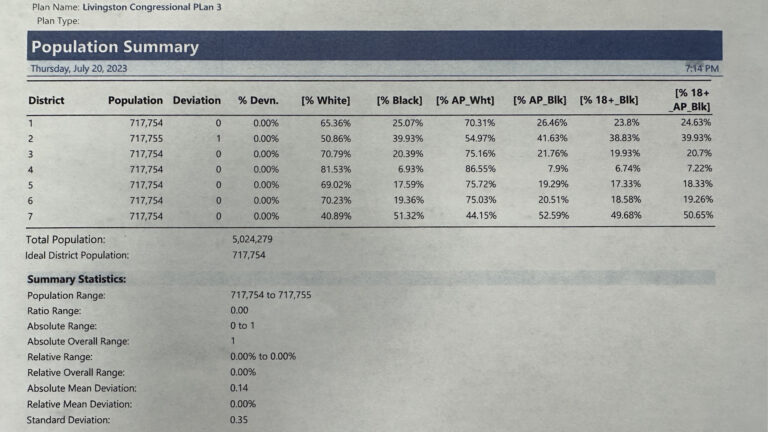
Livingston was the sponsor of the map lawmakers adopted in 2023, dubbed the Livingston Congressional Plan 3, the map ultimately tossed out by a federal court. A revised version of the Communities of Interest plan proposed by Pringle, Livingston’s map preserved Alabama’s sole Black-majority district, District 7 in West Alabama, but failed to create a second opportunity district for Black voters, with District 2 drawn to include less than 40% of voting-age Black voters.
The state’s filing does not elaborate on legal arguments, but does signal that it would like SCOTUS to reevaluate how Section 2 of the Voting Rights Act – which prohibits racially discriminatory voting policy – should be applied in matters related to redistricting. Alabama House Democrats have argued that these efforts are an attempt by Republicans to prompt the courts to declare Section 2 of the Voting Rights Act unconstitutional, similar to how SCOTUS overturned Roe v. Wade in 2022.
In the meantime, the lower court’s May ruling bars the state from using the 2023 map in future elections.