
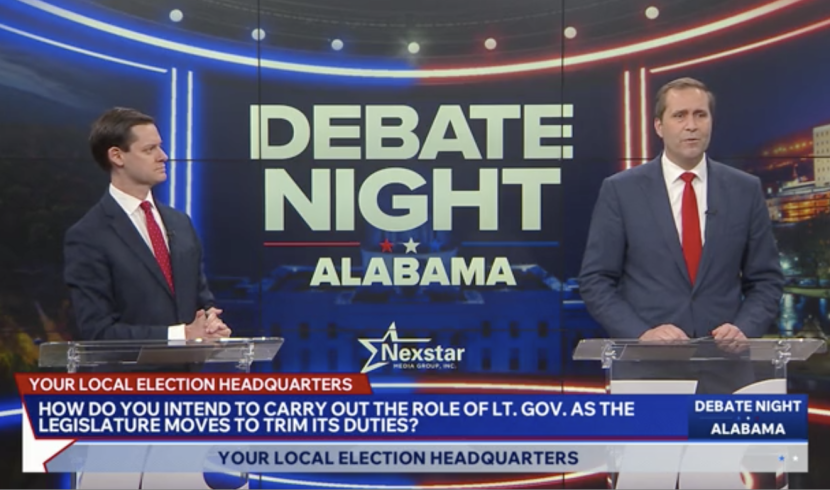
In a rare scene for modern Alabama politics, lieutenant governor nominees Democrat Phillip Ensler and Republican John Wahl met for a debate in Huntsville on Wednesday night.
Though the debate introduced lots of policy questions, the lieutenant governor’s power to effect change is limited and has been reduced in recent years. Despite this, Ensler and Wahl offered their recommendations on big issues facing the state of Alabama and engaged in the face-to-face dialogue that is often missing from Alabama campaigns.
The 58-minute debate also featured opening and closing remarks from each candidate as well as viewer-submitted questions.
Here are some of the highlights.
Affordability
Both Ensler and Wahl said they would support removing the final 2% state sales tax on groceries.
Wahl, former chair of the Alabama Republican Party, said that while the government “has to do a better job” on the rising cost of healthcare, it’s important to consider each party’s record on affordability.
“It’s been the Republican leadership in Alabama that have made these tax cuts, almost over $1.5 billion in tax cuts over the last four years,” Wahl said. “And don’t forget the Democrats had controlled the Alabama State Legislature for 130 years and couldn’t get the job done. It was only once Republicans got control of the State House that we were able to go in, balance the budgets, pay out some of the debt and then actually start providing genuine tax cuts for the people of Alabama.”
Ensler, who currently represents Montgomery-based District 74 in the Alabama House of Representatives, listed several policies he would like to see passed to address the high cost of living, including removing the tax on overtime wages for hourly workers, cutting the tax on farm equipment and expanding Medicaid.
Noting that Republicans currently hold a supermajority in the Legislature and the governor’s office, Ensler said that it’s time for a change in Alabama.
“I’ve heard from residents in all 67 counties, and they’re hurting,” Ensler said. “And let’s be abundantly clear: the biggest reason they are hurting is because of Trump’s war overseas, from an agenda that John, that you support, and that’s an agenda that is raising gas prices. It is raising prices of fertilizer and diesel on our farmers. The tariffs and the trade wars supported by the president that got you in this race that you have stood by that is hurting Alabamians.”
Lottery
Not taking a clear position, Wahl said that there are “important moral consequences” to a lottery.
“This is a divisive issue. There’s a lot of debate,” Wahl said. “I think the important thing is that we do listen to the people of Alabama, that we take their concerns into account, and we listen and we give them the chance to weigh in.”
If a lottery were to pass, Wahl said he would want the money to be put toward cutting taxes and returning money to Alabamians’ pockets.
Ensler, who has been a vocal supporter of lottery legislation on the campaign trail, said that establishing a lottery would be an easy way for the state to shore up state revenue for public education, teacher pay raises, cost-of-living adjustments for state retirees, support for farmers and rural hospitals.
Data centers
Wahl called data centers “a necessary evil.” As a farmer in a rural community, he said he shares people’s concerns about the facilities and wants to make sure that they are located only in localities that want them.
“I think it’s incredibly important that if any data center is held to strict guidelines, strict safeguards, that we make sure we protect the people of the state because at the end of the day, that’s what government should be doing,” Wahl said. “Government shouldn’t be looking out for large corporations or data centers; they should be looking out for the average everyday citizen.”
Ensler and Democratic gubernatorial nominee Doug Jones have repeatedly called for a one-year moratorium on data centers to give communities time to set up guardrails for the facilities.
He mentioned his experience talking with residents in communities near data centers and said the issue has brought together people across the political spectrum.
“It’s important to have someone in office that cannot be bought or bossed around by powerful interests, who’s not just going to do the bidding of big corporations, but who’s going to stand with the residents of Alabama,” Ensler said. “I have done that, and I will continue to stand with them to make sure that their communities are protected.”
Other issues
Discussing Alabama’s prison systems, both candidates said it’s important to put in place leaders of the Alabama Department of Corrections who are experienced and will be effective in the role.
Ensler and Wahl also agreed that the state can improve and expand its reentry and rehabilitation programs to help nonviolent offenders. They both said that violent offenders and people who would threaten public safety should stay behind bars.
On education, Wahl said the state should go “back to the basics” and remove all social agendas from Alabama classrooms. He said the control should go to parents and local school systems, not the federal government.
Ensler agreed that there should be no indoctrination in the classroom but said that it is “overwhelmingly not happening.” He said that instead of “fighting social and cultural wars,” Alabama should focus on improving student outcomes and supports.
Wahl said he supports the CHOOSE Act, Alabama’s school choice program, wholeheartedly, while Ensler said that though he wishes public dollars could stay in public education, he wants to see the program become “more fiscally responsible and more morally sound.” The Democrat said he supports reinstating the CHOOSE Act’s income caps, which are set to come off for the 2027-28 school year.
Trading barbs
Wahl several times during the debate reiterated that he is not a career politician and doesn’t want to be one. Painting himself as an “outsider” candidate has become a familiar refrain on the campaign trail.
Ensler pushed back on this statement after Wahl claimed that “the establishment” has driven the country into the current “economy crisis.”
“You’ve been the party chair, so you can say all you want (that) you’re an outsider,” Ensler said. “You’re not. You’re part of the establishment, and you’ve been a part of (an) agenda that is hurting people.”
Because on the debate format, Wahl was not able to respond directly to Ensler’s criticism.
But Wahl found time to take his own jabs at how Ensler markets himself later in the debate, questioning the Democrat’s effectiveness as a bipartisan legislator.
Doubling down on his support for Alabama establishing a state lottery, Ensler brought up a lottery bill he filed this session that was never taken up for discussion in committee. He said that “Republicans have been blocking Alabamians from having a vote on a lottery.”
Wahl called this a contradiction of the legislative record Ensler often touts.
“It’s hard for me to understand the concept of saying you’re able to work across the aisle and you’ve got all this done that you’re now admitting that you sponsor bills that don’t even get brought into a committee,” Wahl said. “That’s two different messages, and I think it’s very hard for me to understand that. I think it’d be hard for voters to understand that. If you’re not able to either get a bill through a committee or onto a committee agenda, how are you going to be effective as lieutenant governor? I think the majority we have in the Legislature is important, and we’re going to get things done for the state of Alabama. You need to actually be successful.”
Legislative committee chairs, who are selected by legislative leadership, decide which bills come up for discussion in their respective committees. Because the Republicans hold a supermajority in both chambers, all committee chair positions are held by Republican members. Fifty-four percent of bills filed by House Democrats during the 2026 legislative session were never considered in committee, compared with 27% of House Republicans’ filed legislation.
Residency
In what has become a familiar conversation in both the gubernatorial and lieutenant governor races, the candidates discussed allegations that Wahl does not meet the constitutional requirements to serve in the role.
The Alabama Constitution requires both the governor and the lieutenant governor to be residents of Alabama for the seven years preceding the election.
Wahl categorically denied any claims that he does not meet this requirement and reiterated that his Tennessee home is a secondary residence, which he says is not prohibited under the Constitution.
He said he has always lived, voted and paid taxes in Alabama.
“The fact that you may have a second residence does not mean you abandon your original residence,” Wahl said. “I’m a farmer. I live near the Tennessee border. I farm in different areas, and the idea that we would criticize someone for just having a second residence when it’s not required in the Constitution, I think, is very foolish. I think it has no legal background, and I think when you look at court precedent over the years, it’s very clear.”
The Tennessee Secretary of State’s office previously confirmed to Alabama Daily News that Wahl registered to vote in Tennessee in December 2020 but that he never cast a ballot.
Wednesday’s debate was a live show of barbs that candidates often trade online, with Ensler pressing on the residency issue.
“John, no one’s saying that you can’t have two residences, but you made a decision to first get your learner’s permit in Tennessee less than seven years ago,” Ensler said. “You then registered to vote in Tennessee. You then swore under oath, which if you lie under oath, that is a perjury, which is a felony crime, that you were a legal resident of Tennessee. You cannot be a legal resident of two different states at once. You can have properties in both. You made that decision less than seven years ago to be a legal resident, and then you proceeded to vote in Alabama with a fake ID. So you either committed perjury or voter fraud.”
Wahl then went on to allege that Ensler voted in his home state of New York in 2014 and 2016 after relocating to Alabama.
“Phil, you should know more than anyone the concept of two residences when it comes to elections because you moved to Alabama in 2012, yet you continued to vote in New York City until 2016,” Wahl said. “You actually have been a registered voter in New York until last year. Look, this is the pot calling the kettle black. You should know this as a lawyer. You understand it. Your record shows that you had multiple residences and continued to vote in a place where you didn’t live.”
Ensler said Wahl’s claims were “absolutely not true,” but he did not directly address the 2014 and 2016 voting allegations.
“I graduated law school, became a member of the Alabama Bar in 2017, which is more than seven years ago,” Ensler said. “I got my license here in Alabama and have voted here in every single election ever since. That is an outright lie.”
Ensler attended law school at Cardozo School of Law in New York City from 2014 to 2017.
The Wahl campaign provided Alabama Daily News with results from New York’s voter registration lookup that show Ensler voted via an absentee ballot in New York in 2013 and in person during the 2014 and 2016 election cycles. The results are dated Jan. 17, 2025, and the system no longer produces Ensler’s voting record with the same information, meaning he is no longer an active registered voter.
The results provided by Wahl show Ensler cast his last vote in New York on Nov. 8, 2016, more than seven years before the 2026 general election.
The general election is Tuesday, and polls will be open from 7 a.m. to 7 p.m.