
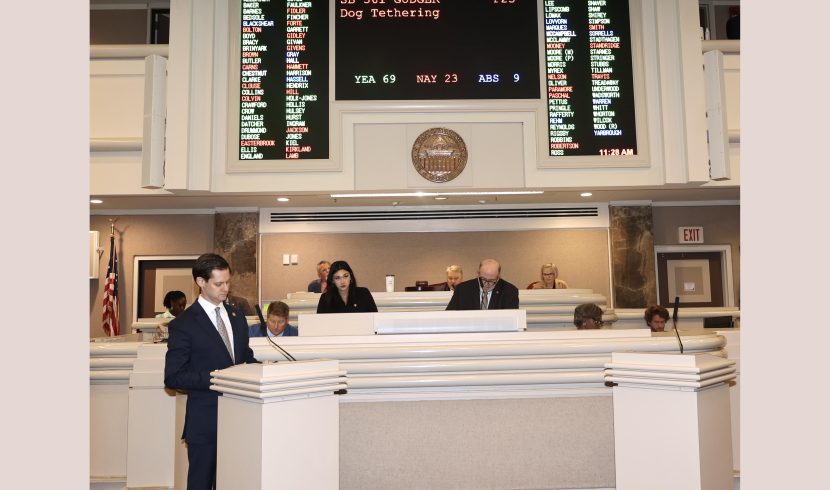
MONTGOMERY, Ala. – With the last legislative session of the term over, Alabama Daily News is taking a look at the more than 1,000 bills filed and see how far they made it.
Republican leadership lauded this year as a productive one. Democrats supported the budgets and some bi-partisan proposals, but bristled at GOP “red meat” bills.
There’s much to be unpacked in the content of the legislation passed and the bills that died, but here’s what the numbers have to say about the 2026 regular session.
Recent record for bills filed in a regular session
Excluding joint and ceremonial resolutions, lawmakers filed 1,046 bills this session. That’s the highest number of bills introduced in the last five regular sessions and is around an 8% increase from last session.
By chamber
Members of the House filed 666, or 64%, of this year’s bills. Senators filed the other 380, or 36%.
The number of bills filed by each party is roughly proportional to their makeup in the Legislature, with 794 coming from Republicans and 292 from Democrats.
The Republican supermajority holds 76 of 105 seats in the House and 28 of 35 seats in the Senate. Democrats hold the remaining 29 and 7, respectively.
By sponsor
On average, each member of the House filed around 6 bills and each senator introduced nearly 11.
Of course, some lawmakers were more prolific.
Sen. Merika Coleman, D-Birmingham, introduced the most bills in the Legislature, trumping all four of the budget chairs, with 25 filed. Senate Finance and Taxation Education Chair Sen. Arthur Orr, R-Decatur, ranks just behind Coleman with 24.
Four members of the House – Rep. Berry Forte, D-Eufaula; Rep. Steve Hurst, R-Munford; Speaker of the House Nathaniel Ledbetter, R-Rainsville; and former House Majority Leader Rep. Scott Stadthagen, R-Hartselle – did not file any bills.
Here’s a breakdown of how many bills each members of the Legislature filed.
What passed this session?
Not all bills are filed with the intention of them becoming law. Some are symbolic in nature, some are placeholders or messaging tools. Only 38% of bills made it to the finish line this year. Out of the 1,046 filed, 402 bills passed in both chambers.
By chamber
Senate bills tended to fare slightly better than their House counterparts this session.
Forty-one percent of bills introduced by senators passed in both chambers, compared to 37% of those introduced by members of the House.
The Legislature passed a total of 246 House bills and 156 Senate bills.
By caucus
Of the four that make up the Alabama Legislature, the House Republican Caucus passed the most bills at 205. Their Senate counterparts passed 124.
Democrats, who fight an uphill battle to get bills passed given the Republican supermajority, passed 41 bills in the House and 32 in the Senate.
Because of the House’s size, it’s no surprise that its members pumped out more successful legislation. But looking at the rate of bills passed to bills introduced, Senate Republicans come out ahead as the most productive.
By member
Sen. Arthur Orr, R-Decatur, sponsored 13 bills passed by both chambers, the most of any member of the Legislature.
He is followed by Sens. Sam Givhan, R-Huntsville, and Greg Albritton, R-Range, at 11 bills each. Rep. Danny Garrett, R-Trussville, sponsored 10 successful bills.
The Democrat with the most enrolled bills, Rep. Napoleon Bracy, D-Saraland, was tied for 7th on the list.
Eighteen members who sponsored bills saw not one come to fruition.
Dead on arrival: bills never considered
There are many hurdles a bill must overcome to become law, but many bills lay abandoned without even making it on a committee’s agenda.
That was the fate of 331 bills this session, nearly one-third of those introduced.
By party
Overall, bills introduced by Democrats were nearly twice as likely to end the session awaiting committee action in the bill’s house of origin than those filed by Republicans.
More than half of all Democratic bills filed, 50.4%, were never considered in any committee. The same was true for only 25.7% of Republican bills.
Because of the GOP supermajority, a Republican chairs every legislative committee and thus controls which bills get plucked from the long list to make it on the agenda.
By caucus
House Democrats’ bills were most likely to end up stuck waiting for committee action at 54% Democrats’ bills from the upper chamber were 10% less likely to die without making it to committee at 44%.
Republicans’ bills in both chambers fared much better. In the House, 27% of Republican bills did not make it to committee, and the same was true for 23% of the GOP’s bills in the Senate.
By sponsor
Coleman, the member who filed the most bills, is also the one with the most bills never considered. Fourteen of her 25 bills never made it on a committee’s agenda.
The runners up are two Republican members of the House: Rep. Ben Robbins, R-Sylacauga, and Rep. Arnold Mooney, R-Birmingham. Robbins had 11, and Mooney had nine.
The average member had more than two bills die without committee action.