
MONTGOMERY, Ala. – Legislative sessions can sometimes be just as well remembered for what didn’t pass as what did. And given that it often takes a multi-year effort to enact legislation, it’s a good bet that those bills that came up short this year are likely to be seen again.
Some died early on, while others missed out on a vote on the last possible day.
Here’s a look at what didn’t pass this session.
Closed primaries
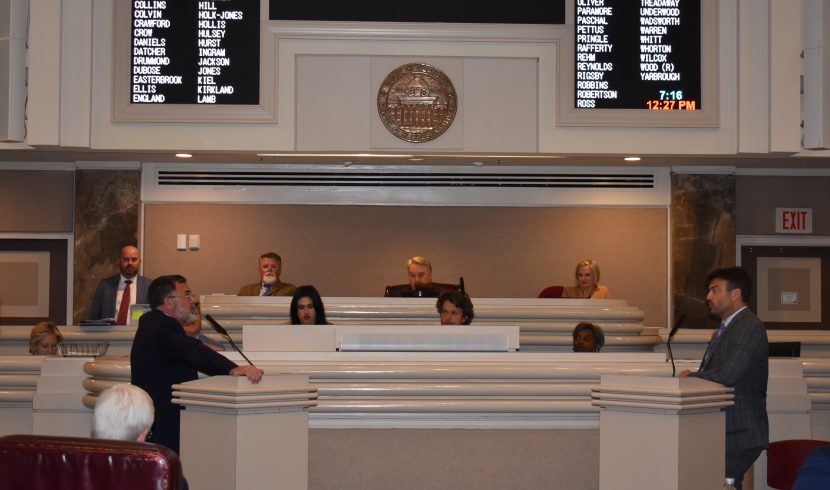
Announced as a legislative priority by the Alabama Republican Party halfway through the session, a bill to close Alabama’s primary elections stalled on the last day of session.
House Bill 541, by Rep. Ernie Yarbrough, R-Trinity, would have limited participation in primary elections to only those registered with a political party.
Under the bill, Alabamians would choose their political party affiliation when they register to vote or when they show up to vote. If they don’t want to register with a political party, voters can remain “unaffiliated” but couldn’t vote in primaries.
Voters could change their chosen political party as many times as they would like between elections, up until 60 days before a contest. This “blackout window” exists so the secretary of state can provide the list of registered voters to county probate judges – the chief election officers in Alabama’s 67 counties – within the legally mandated period before an election, Yarbrough said.
The bill was on the Senate’s agenda for last Thursday, but it included an amendment that would have required the measure, if passed, to go back to the House of Representatives for concurrence.
Senate President Pro Tem Garlan Gudger said that when senators learned the House had adjourned on Thursday evening, the bill essentially died.
“Our decision was easy,” Gudger told reporters after the Senate adjourned. “The House adjourned and we found out about it. I was on the phone in the back and somebody ran in there and said, ‘hey, the House is adjourning.’ So, once that happens, we’re finished, too.”
The House passed the bill by a vote of 63-35 on March 19.
Montgomery Police Department staffing
The House adjourned for the year without considering a controversial bill to force the Montgomery Police Department to increase its staffing ranks or risk a state takeover.
Senate Bill 289, sponsored by Sen. Will Barfoot, R-Pike Road, would have given law enforcement agencies serving Class 3 municipalities five years to employ at least 1.9 full-time officers for every 1,000 residents in the city.
Huntsville and Montgomery are the only two Class 3 municipalities in Alabama. Huntsville already meets the staffing requirements in the bill.
If departments did not meet the quota within five years, the Alabama Law Enforcement Agency could have taken over “operational oversight” of the department. That takeover would last until one year after the department met the personnel benchmark.
Barfoot’s bill was last on the House’s agenda for the final day of session, but the chamber did not bring the bill to the floor for discussion.
Speaker of the House Nathaniel Ledbetter said there simply wasn’t enough time to get through the bill in the lower chamber.
“We couldn’t get it out. We didn’t have enough time to be honest with you because it was going to be filibustered the whole way through,” Ledbetter, R-Rainsville, told reporters. “I hate to cloture on the last day, I mean sometimes we have to do that, but at the end of the day it just wasn’t possible and we could see that.”
Ledbetter said he didn’t know if the legislation had the votes necessary to pass in the House.
Barfoot said he was disappointed the bill didn’t make it across the finish line.
“I’m disappointed for the citizens of Montgomery and those who come and visit here and shop here and work here, and I’m disappointed for the men and women of Montgomery Police Department who risk their life every day,” Barfoot told ADN.
Democrats in the Legislature and Montgomery city and police officials have stood in fierce opposition to the bill since it was introduced in mid-February.
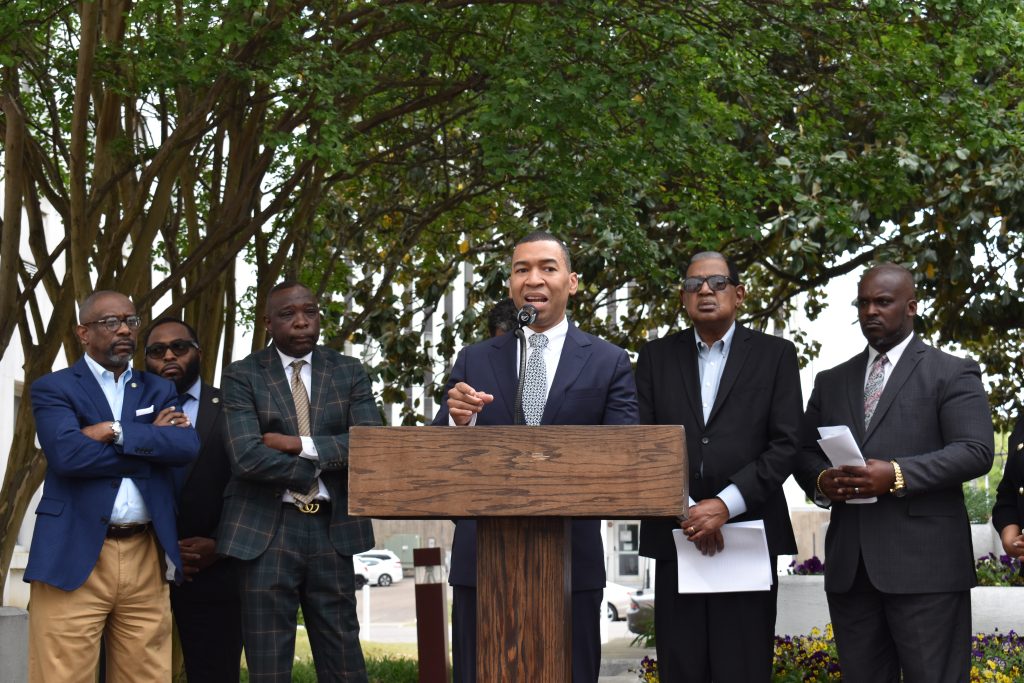
City officials and religious leaders held a press conference in opposition to the bill. They called the legislation an unfunded mandate and unfair state takeover. Montgomery Mayor Steven Reed said the city did not ask the Legislature for help in increasing MPD’s staffing.
The Senate passed the bill along party lines the week before after the Republican supermajority clotured debate from Democrats.
Throughout the process, Barfoot has said the bill would have helped to improve public safety in the Capital City.
People in Montgomery “are tired of turning on the news and hearing about the violence,” he said. Four people were murdered in Montgomery last weekend.
Barfoot said he’s not sure if he’ll bring the bill back next session if reelected.
“My sincere hope is that the Montgomery leadership does everything they can get an adequate number of police in place,” Barfoot said. “I guess they’ve got time to show what they intend to do, but we’ll see. The issue is not going to go away unless the police department is adequately staffed.”
Solar farms
Legislation to put a one-year moratorium on new solar farms in the state and give county governments more authority over their development never made it to the finish line this session.
Senate Bill 354 by Sen. Greg Albritton, R-Range, and its companion House Bill 617, by Rep. Matt Simpson, R-Daphne, were each one page long.
The legislation would have prohibited the development of any solar power facility not currently operating or under construction for one year. The bill defines a solar power facility as a large-scale, ground-mounted installation of photovoltaic panels designed to generate electricity for use off-site or sale to a third party.
Citing several planned or under construction centers in their districts, lawmakers echoed environmental concerns about destroying timberland and wetlands to build the facilities.
“The public is very concerned with what the reclamation requirements are, if any,” Albritton said. “They’re concerned about any ecological matters that come into play.”
He previously said the bill would put a moratorium on the projects until “we can find and get some answers as to those policies and procedures.”
Albritton and Simpson also sponsored Senate Bill 358 and House Bill 618. They would have applied to Baldwin and Mobile counties and allowed their county commissions to adopt “standards, specifications, criteria, and conditions relating to permitting, construction, placement, or operation of solar farms in the unincorporated areas of the county.”
Formal Public Service Commission rate case hearings
Though a major PSC reform bill topped ADN’s review of what passed during the session, the final compromise took elements from several bills that died.
Rep. Chip Brown’s House Bill 392 would have changed the three-member PSC to an appointed panel rather than an elected one. The bill moved quickly through committee but was pulled from a House calendar minutes before debate was supposed to begin.
Brown, a Republican from Hollinger’s Island, started conversations that would headline the rest of session about the oft-ignored board tasked with regulating some of Alabama’s utilities.
Senate President Pro Tem Garlan Gudger, R-Cullman, later declared Brown’s bill dead and worked with Sen. Clyde Chambliss, R-Prattville, to introduce Senate Bill 360 to expand the current three-member PSC to seven members elected from the state’s U.S. congressional districts. Chambliss’ bill also created a governor-appointed secretary of energy position to oversee the administrative duties of the commission and personnel.
Around the same time, Rep. Mack Butler, R-Rainbow City, filed his own PSC reform bill.
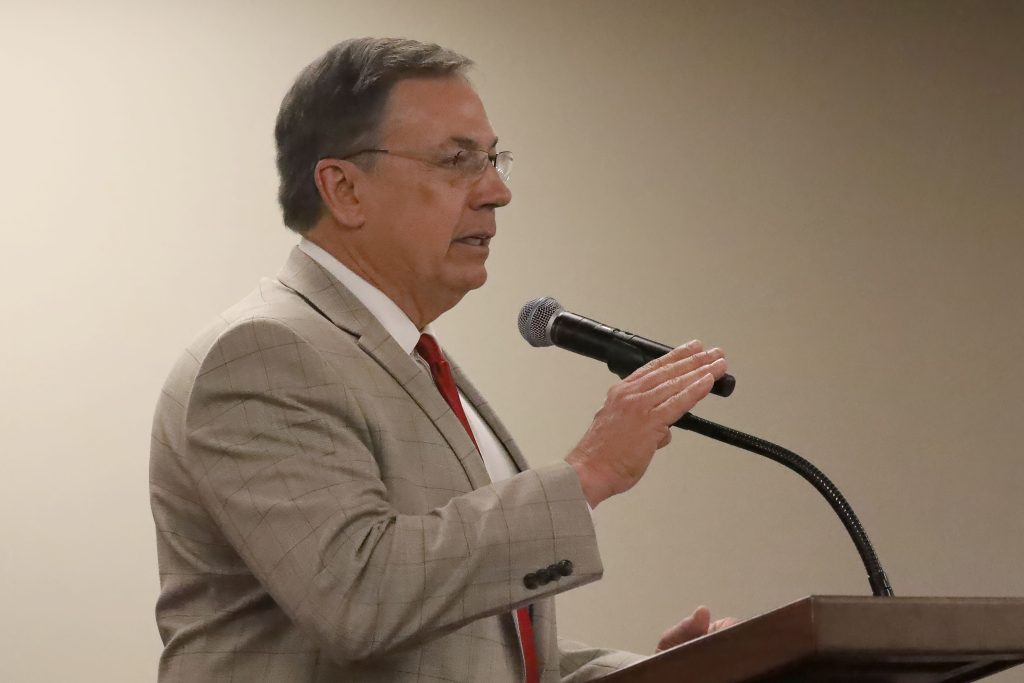
Butler’s bill, House Bill 475, mandated the board to hold formal rate hearings at least every three years, capped utilities’ return on equity and forbade companies from passing on lobbying expenses to ratepayers.
Though House Bill 475 was the one Gov. Kay Ivey signed into law, the compromise between the chambers more emulated Senate Bill 360 and gutted several of Butler’s original points in the bill.
When the bill came back to the House with the Senate’s amendments, Butler moved not to concur. The House voted down his motion, and Butler ultimately voted against a bill with his name.
SSUT population compromise
Going into the session, the state was facing a lawsuit from several cities over the Simplified Sellers Use Tax, the platform that collects taxes on online purchases and distributes the revenue among the state, counties and cities.
The cities, including Tuscaloosa and Mobile, argued that the current distribution formula leaves them shortchanged. Ultimately seeking a legislative solution, the voluntarily dropped the lawsuit in mid-February and began talks with Senate General Fund Budget Chairman Greg Albrittion about a temporary compromise.
Thus was born Albritton’s Senate Bill 347, which update the SSUT law to gather population data from the U.S. Census Bureau Population and Housing Estimates Program every five years beginning in 2027, instead of every 10 years as it currently does
Albritton previously said there was consensus behind the bill, but when some municipalities started studying the numbers, support was lost.
“We don’t have a consensus anymore,” Albritton told ADN as the bill died in late March.
The various groups are continuing their talks in the legislative off season.