
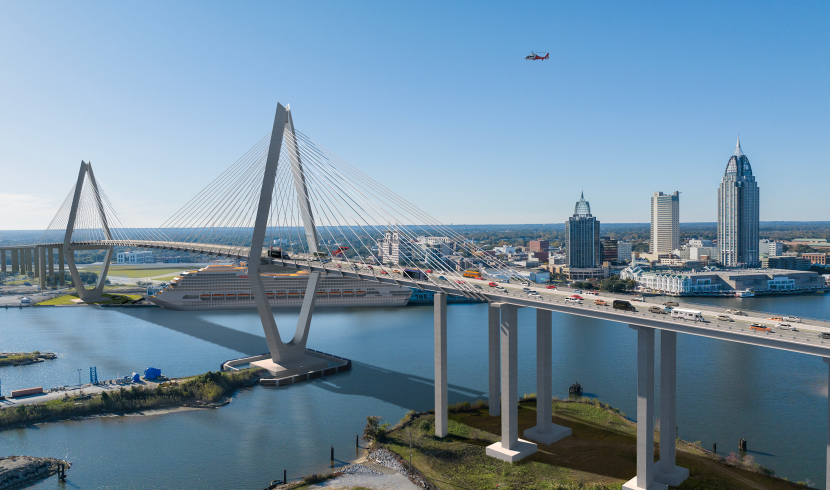
WASHINGTON — The Mobile River Bridge is finally slated to begin construction this year to ease congestion on I-10, the Alabama Department of Transportation and state leaders announced Thursday.
The massive infrastructure project will now be completed in two phases designed to bring down costs, starting with the construction of a new six-lane cable-stayed Mobile River Bridge.
The first phase will cost roughly $3.2 billion.
According to ALDOT, the funding will come from a $125 million Infrastructure for Rebuilding America (INFRA) grant, a previously awarded $550 million federal Bridge Investment Program grant, a federal Transportation Infrastructure Finance and Innovation Act (TIFIA) loan, bonds and the state’s direct investment of at least $250-$300 million.
State leaders hope to break ground later this year, pending the federal TIFIA loan, and aim to complete the first phase of work by 2031.
Alabama expects to use the TIFIA loan to finance up to 49% of the project, ALDOT spokesman Tony Harris told Alabama Daily News.
ALDOT will also restripe the Bayway to allow for six lanes of traffic across Mobile Bay. The state plans to improve interchanges, intersections, and traffic flow throughout Mobile and Baldwin counties to support the project.
“This project is essential to Alabama’s future and represents one of the most important infrastructure investments in our state’s history,” Gov. Kay Ivey said. “This transformative project will strengthen our economy, improve safety and ensure we are better prepared in times of emergency.”
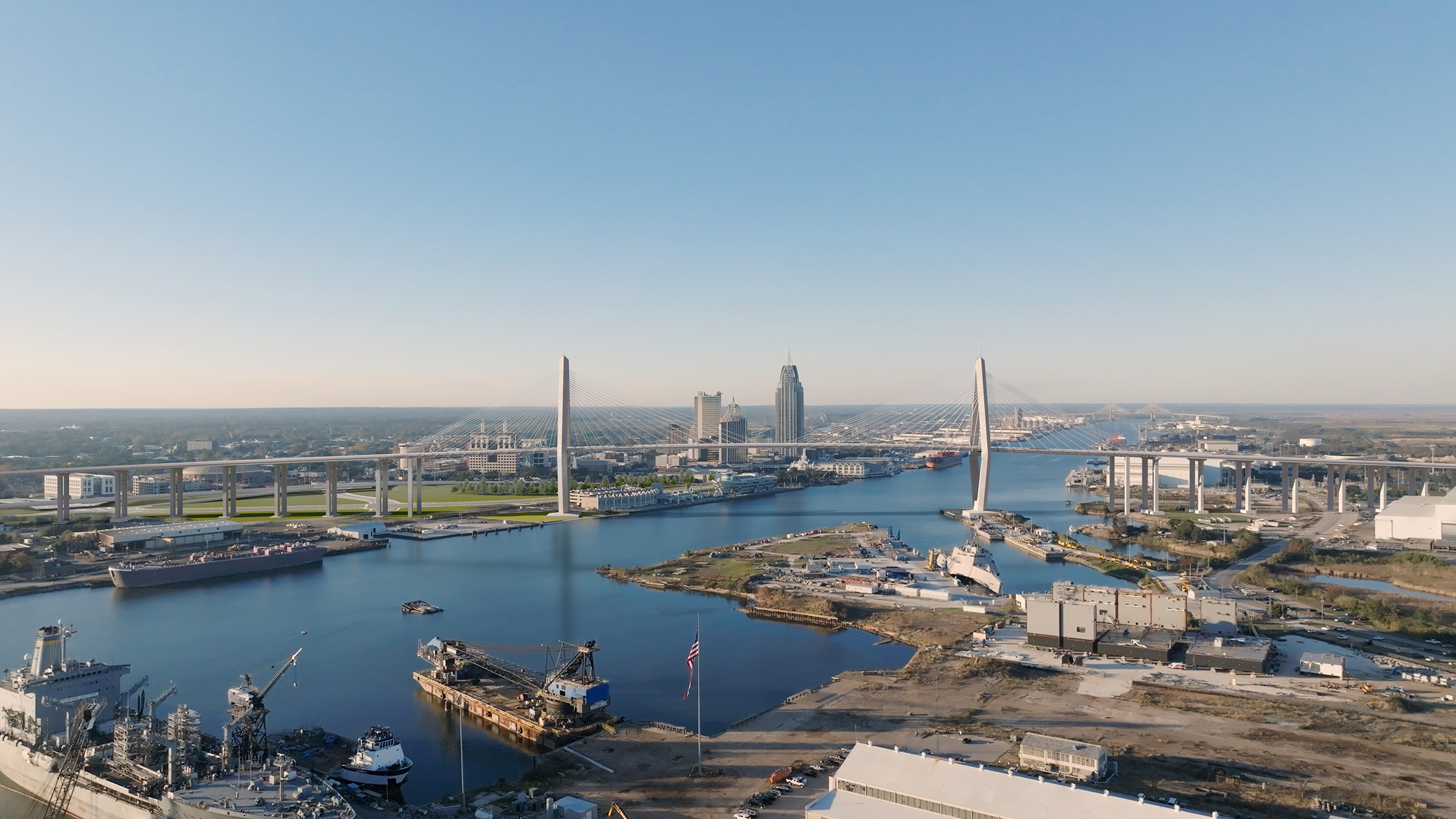
The construction of a new Bayway structure will occur in the second phase, at an unspecified date, and will be paid for by existing toll rates.
Over the past few years, the bridge project has faced significant financial hurdles and delays, but ALDOT said that using a phased approach, combined with “procedural flexibility” granted under the Trump administration, will help it finally move forward.
The project has long been a priority of Alabama’s congressional delegation, with efforts to secure federal funding going back several years.
“This is exactly the kind of strategic infrastructure investment that strengthens our economy, supports our port, improves safety, and benefits every American who travels the I-10 corridor,” U.S. Sen. Katie Britt, a member of the Appropriations Committee, said.
Sens. Britt and Tommy Tuberville wrote in an op-ed Wednesday that the Trump administration is selecting the state to become the first to implement the Interstate System Reconstruction and Rehabilitation Pilot Program.
It will allow the state “to collect tolls on a facility on the Interstate System in order to reconstruct or rehabilitate an Interstate highway corridor that could not otherwise be adequately maintained or functionally improved without the collection of tolls.”
The program does not offer any additional federal funds for the selected projects, according to the U.S. Department of Transportation.
“This project is critical not only for Alabama, but for the entire Gulf Coast and every community that depends on Interstate 10 for commerce, travel, hurricane evacuations and national security,” Tuberville said.
Under the Biden Administration in 2024, the Department of Transportation announced a $550 million federal grant, established under the 2021 Infrastructure Investment and Jobs Act, awarded to the Mobile Bridge and Bayway project.
Other than Rep. Terri Sewell, D-Birmingham, however, all of Alabama’s congressional delegation voted against the 2021 Bipartisan Infrastructure Law. Britt, Rep. Shomari Figures, D-Mobile, and Rep. Dale Strong, R-Huntsville, were not in office at the time.
Last year, the Trump administration said it planned to release the IIJA money. Harris said on Thursday that the state will begin drawing on those federal funds as construction begins.
“I am glad the Trump Administration helped clear some red tape that now allows the State to get the loan to build the bridge, but they can and should provide actual funds like the $550M the Biden Administration gave to us,” Figures said.
Eastern Shore MPO Chairman Jack Burrell said the two-phase plan is the result of years of consistent local work to find a realistic path forward for the infrastructure project.
“While this project has evolved over time, its importance has never changed,” Burrell said. “This revised approach provides meaningful congestion relief, improves regional mobility and creates a path toward delivering a project that many people have waited decades to see.”
Tolling
The issue of tolling has previously stalled the project, but now the causeway, the Wallace Tunnel, the Bankhead Tunnel, and the Africatown Bridge will remain toll-free routes.
No tolls will be collected until 2031, when the bridge is expected to be completed.
The proposed tolls, which will help finance the project, will depend on the driver crossing the bridge. There will be:
• a $60 unlimited monthly commuter pass, which is roughly $1.36 per trip for daily users;
• a $3 per-trip ALGO Pass rate;
• a $7.70 rate for users with interoperable transponders;
• and drivers without a transponder will be billed through a pay-by-plate process.
The ALGO transponders will be widely available and free of charge initially.
Harris said the state will continue to seek out other federal funding opportunities to ensure completion of the massive project.