
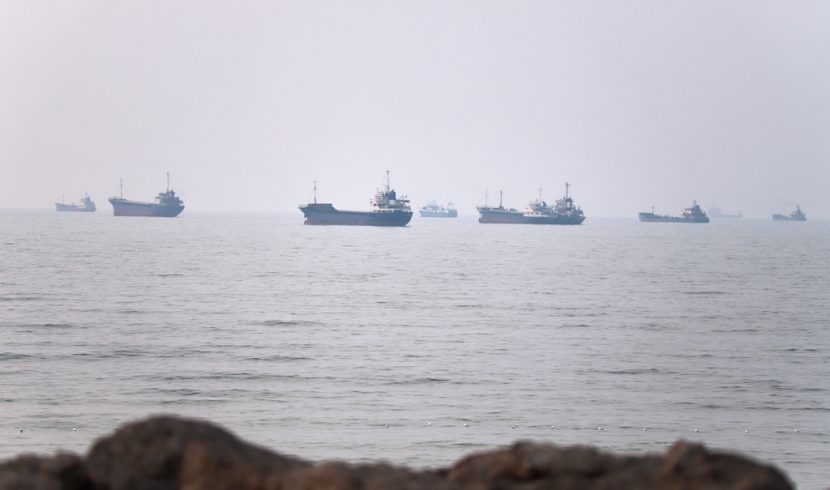
DUBAI, United Arab Emirates (AP) — The U.S. military attacked Iran early Wednesday after it said Tehran struck three ships in the Strait of Hormuz, part of an American effort that also revoked the Islamic Republic’s ability to openly sell crude oil in the world market.
President Donald Trump warned that the U.S. was preparing for another night of strikes, just hours after he said the ceasefire was over following Iranian attacks on American military sites in the Gulf.
Trump threatened to strike Iran’s civilian infrastructure, including electric plants and desalinization plants, and to seize Kharg Island, with its oil infrastructure.
“We hit them very hard last night,” Trump said when asked about a possible return to hostilities. “We’ll probably hit them hard again tonight.”
Trump made the remarks in Ankara, Turkey, on the sidelines of a NATO summit. He said the strikes are continued retaliation for Iranian attacks on commercial ships in the Strait of Hormuz.
Overnight US strikes target Iran
The U.S. military’s Central Command said American forces launched the strikes “to impose heavy costs for targeting and attacking commercial shipping crewed by innocent civilians in an international waterway.”
It said it hit Iranian targets including air defense systems, radars and over 60 small boats used by Iran’s paramilitary Revolutionary Guard. Those boats have been key in harassing ships in the strait.
The U.S. military remains “postured and prepared to hold Iran accountable when the agreement is not adhered to or obeyed,” it added, saying this round of attacks had ended.
Iran acknowledged the strikes, but offered no word on any losses. Iranian state media reported the sound of explosions in Bandar Abbas, Qeshm and Sirik.
Iran’s central military command warned it “will respond decisively to this aggression and terrorist act.”
“Under no circumstances will (the Iranian armed forces) allow interference in the affairs of the Strait of Hormuz, nor will they permit others to manage it,” it said.
A similar spate of Iranian attacks on shipping and U.S. retaliatory strikes occurred late last month — which drew Iranian attacks on Bahrain and Kuwait. Wednesday’s strikes also came as Trump was in Turkey for a summit of the NATO military alliance.
US revokes license for the sale of Iranian oil
The U.S. also revoked a license that authorized the sale of Iranian oil as part of the interim deal. That had allowed Iran for the first time in years to conduct oil sales openly on the international market for U.S. dollars. Iran long had been suspected of selling sanctioned crude oil at below-market prices to China.
A U.S. official said the license was revoked because Iran’s actions in the strait were unacceptable and needed to be met with consequences. The official spoke on the condition of anonymity to share insight into the reasoning behind the move.
The decision came after the strikes on shipping. One tanker was traveling off the coast of Oman when it was hit and caught fire, the United Kingdom Maritime Trade Operations center said. Iranian state television said the liquefied natural gas tanker came under attack after ignoring warnings but did not directly claim the assault.
The other two ships sustained some damage, but no one was injured, and both continued on their way in the Strait of Hormuz, the U.K. maritime agency said. Iran has maintained a chokehold on the Strait of Hormuz since the war, disrupting global energy markets as a fifth of all traded oil and natural gas passed through the channel in peacetime. The ships attacked Tuesday all appeared to be using a route close to Oman’s shore, rather than one ordered by Tehran.
Tehran repeatedly has declared that only its approved route through the strait is safe and is suspected of attacking other ships that have used the Oman route.
Majed al-Ansari, a spokesperson for the Qatari Foreign Ministry, said the Qatari tanker Al Rekayyat was targeted in an “unacceptable attack” on international navigation and global energy security. He said Qatar holds Iran “fully legally responsible.”
Iran and the United States agreed as part of the interim deal to allow ships to pass without paying charges for 60 days. But Tehran insisted it must control the vessels’ routes and later charge fees for passage, which would upend decades of practice in the waterway.
The U.S. and many Gulf Arab states say they will not agree to Iran charging for passage through the strait.
Mourners gather in Qom for Khamenei’s funeral
Authorities flew Khamenei’s body to the Shiite seminary city of Qom, where mourners honored him Tuesday.
Iranian state television aired live images of hundreds of thousands of people walking toward Jamkaran Mosque, just south of Qom, for the funeral service. Shiites believe the mosque once hosted Muhammad al-Mahdi, the 12th and last Shiite imam, who disappeared in the 9th century and is supposed to one day reappear to bring justice to the world.
Khamenei’s son, Iran’s new Supreme Leader Ayatollah Mojtaba Khamenei, has yet to make an appearance at the ceremonies, which began Saturday in Tehran. He is believed to be in hiding after reportedly being wounded in the airstrike that killed his father.
Khamenei’s body arrived late Tuesday in Iraq, where it was received by officials from both countries. Processions are planned for Wednesday in Najaf and Karbala, the two holy Shiite cities.
Khamenei will then be returned to Iran to be buried Thursday at the Imam Reza shrine in Mashhad, his birthplace.