
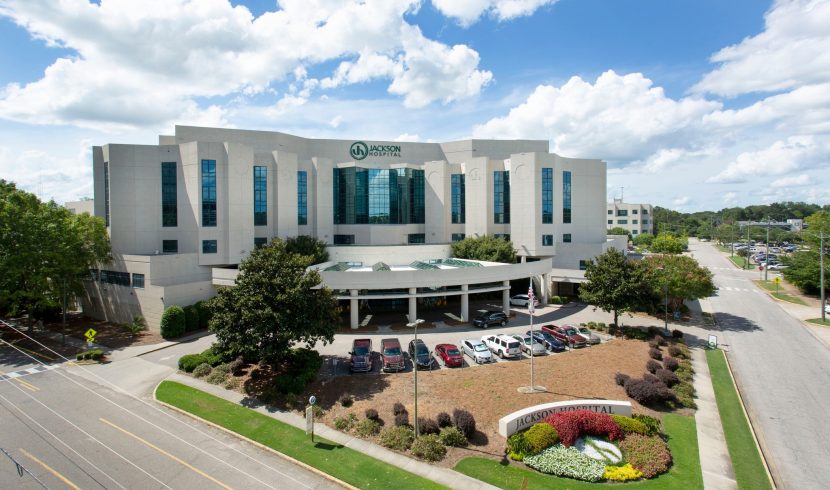
MONTGOMERY, Ala. – Jackson Hospital has signed a deal with Blue Cross Blue Shield of Alabama, ending a dramatic chapter of threatened closures and uncertainty about the hospital’s future.
The four-year deal will allow the Montgomery hospital to emerge from bankruptcy and find a stable path forward, CEO John Quinlivan said at a press conference announcing the deal on Monday.
“The agreement does not give us everything we felt we needed, but combined with the continued support of (BCBSAL), Jackson Investment Group, the city of Montgomery, Montgomery County and the state of Alabama, it enables us to execute our strategic plan,” Quinlivan said.
The deal approved by the hospital’s board of directors will “enhance operational discipline,” improve quality and expand services, he said.
Jackson Hospital currently operates under a $25 million debtor-in-possession loan from Jackson Investment Group, the parent company of Georgia-based Jackson Healthcare. The company’s owner, Rick Jackson, whose name is a coincidence, is the GOP nominee in Georgia’s governor’s race. The Atlanta Journal-Constitution detailed his involvement with Jackson Hospital in a recent article.
Signing a deal with Blue Cross was the hospital’s final requirement to officially emerge from bankruptcy, a complicated legal process riddled with conditions and precedent. Quinlivan said the hospital’s attorneys were making filings in bankruptcy court on Monday to finalize its plan to emerge.
After months of negotiations, Blue Cross Blue Shield of Alabama said it is pleased the hospital can stay open and continue to serve the River Region.
“For months, Blue Cross has worked with hospital leadership and other stakeholders to keep their doors open and provide patients access to the care they need,” the insurer said in a statement. “Throughout this process, our focus has remained on supporting our members and the community. We appreciate the efforts of all parties involved in reaching this outcome and look forward to continuing our partnership in support of the health and well-being of our customers, the River Region and Alabamians.”
The standoff between the state’s largest insurer and the Capital City hospital has been years long, with Jackson claiming that BCBSAL wasn’t fairly compensating the hospital for its services.
The hospital had previously threatened to close on July 1 if Blue Cross didn’t raise its reimbursement rates. Jackson had argued that its rate should match what BCBS pays Baptist South Medical Center in Montgomery.
Blue Cross has repeatedly held that it is the industry standard to have different rates for different facilities in the same area.Baptist South is a level-one trauma center, the highest designation a hospital can get. Jackson Hospital is a level-three trauma center.
A bankruptcy judge earlier this year decried how the hospital has blamed Blue Cross for its financial woes, calling the hospital’s issues “self-harm” and its impending closure “unequivocally avoidable.”
After numerous filings in bankruptcy court, the two parties announced a deal in July, but it wasn’t guaranteed that the hospital would stay open.
Quinlivan on Monday said the two parties had reached a verbal agreement seven weeks ago, but legal considerations delayed signing. He said the “key elements” of the agreement signed this week were reached previously.
Looking ahead
When the court formally releases Jackson from bankruptcy, the hospital will be able to collect a $40 million grant for capital expenses from the state, a lifeline thrown by Gov. Kay Ivey in February.
Ivey called the deal “monumental good news” for Montgomery and all of Central Alabama.
“Only weeks away from its 80th anniversary, Jackson Hospital is reborn today stronger and ever more committed to delivering the most trusted medical care to the Capital City and River Region,” Ivey said in a statement. “Jackson Hospital’s agreement to emerge from bankruptcy and keep its doors open to offer a wide range of care, including emergency services, is the direct result of a resolute partnership between state and local officials and hospital leadership.”
Jackson will also continue to receive money – $15 million over the next three years – from the city and Montgomery County. It has already received $15 million from the city and $10 million from the county.
Montgomery Mayor Steven Reed applauded the deal and doubled down on the city’s support for Jackson in a Monday news release.
“Jackson Hospital’s new agreement with Blue Cross and Blue Shield of Alabama is a major step toward long‑term stability for one of our community’s most critical healthcare institutions…” Reed said. “These combined commitments reflect a unified effort to secure Jackson Hospital’s future and protect essential healthcare access for Montgomery and the River Region. As Jackson Hospital works to finalize its restructuring plan and move toward emergence from bankruptcy, the City will remain steadfast in its support; because a strong healthcare system is foundational to a strong capital city.”
Despite support from all levels of government, regaining financial stability will be a long process, Quinlivan said. The hospital has long struggled financially, at one point operating at a $55 million deficit, he said.
The hospital wants to be independent but needs to rely on government grants for the time being, he said.
“We think we have the wherewithal to do the things that we need to do to put this hospital back onto sound financial footing,” Quinlivan said. “We shouldn’t have to depend on governments for grants, but in the short term we will.”
The CEO said Jackson Hospital’s first step forward is to “stop the bleeding” and better manage costs. After that, the hospital needs to rebuild services and grow revenue to update the aging facility and “invest” in Jackson employees, he said.
Quinlivan estimated that the hospital has over $150 million in infrastructure needs and at least $50 million in capital medical equipment needs.
“That’s where government grants can be extremely helpful and continued support will be extremely helpful because it’s a big number, and for any hospital, even a hospital that is high performing, to take on a debt like that and be able to address it would be a challenge.”