
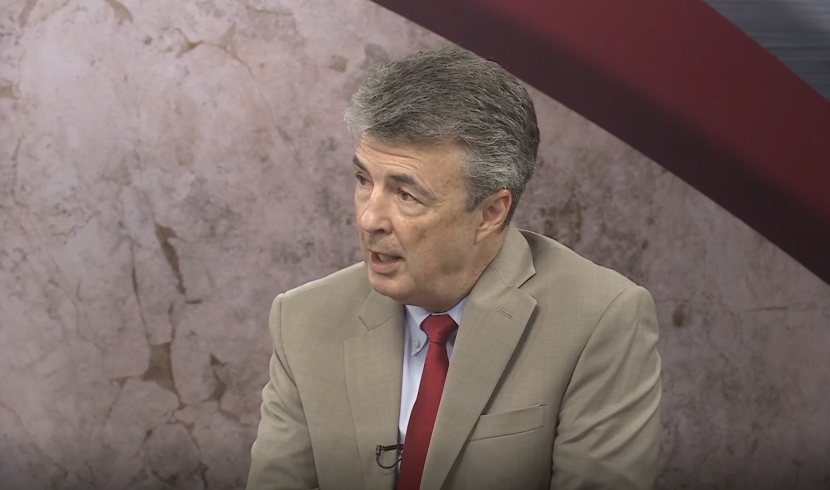
Alabama Attorney General Steve Marshall predicted that the Legislature will not reconvene this year for another special session to create a new congressional map as the state awaits court action on its redistricting case.
Appearing on Alabama Public Television’s Capitol Journal Friday, Marshall shut down the possibility of Alabama creating a 7-0 map that’s favorable to Republicans for this year’s elections.
“I don’t see the court directing (the Legislature) to come back,” Marshall told Todd Stacy, host of Capitol Journal. “I think it’s a question of are we using the (20)23 map that the Legislature adopted, or are we using the special master’s map that the court adopted in this order.”
Some Republicans have urged Alabama leaders to produce a map this year in which the GOP could win all seven of the state’s congressional seats. The push has come in the wake of a recent Supreme Court ruling that limited the use of race when drawing district lines. Even Marshall himself has said he supports a 7-0 map.
But the attorney general said the timing of the Louisiana v. Callias decision made a completely new map in Alabama hard to achieve for this year’s elections.
“Had Callias come out two months before, I think fully being able to draw a new map would have been in play,” Marshall said.
Instead, the Legislature decided to pursue setting up special elections using the 2023 map during its special session. After the special session, Gov. Kay Ivey scheduled special Aug. 11 primary elections for the four congressional districts that will change under the Legislature-drawn map.
But whether the state can proceed with the map that favors six Republican seats and one Democratic seat is still an open question.
On Tuesday, a lower court ruled that the map is intentionally discriminatory to Black people and again blocked the state from using it this year. It ordered the state to continue to use the 2024 court-drawn map, which includes two Black opportunity districts.
“Ultimately, we cannot see our way clear to requiring Alabamians to cast their votes in the 2026 elections under a districting plan tainted by intentional race-based discrimination,” the panel wrote.
The day after, Marshall asked the Supreme Court to intervene for an emergency stay.
“We think again the court inappropriately has determined that Alabama has racial discrimination within its map itself, as opposed to what is the partisanship that you see going on around the country, including New England states, in which they draw a map so that there’s no Republican representation,” Marshall said.
Supreme Court Justice Clarence Thomas ordered that the plaintiffs respond to the state’s request for an emergency stay by Monday afternoon.
Marshall said the state is “watching the clock” to see when the Supreme Court will decide the case. The timing of a ruling could determine how the state’s elections move forward this year, either under the 2023 Legislature-drawn map or the 2024 court-drawn map.
However, Marshall said the Aug. 11 primaries will likely take place for the 1st, 2nd, 6th and 7th congressional districts, no matter what. It just remains to be seen which boundary lines will be used for those primaries.
“We’d obviously love to be able to see a Supreme Court decision sooner than later, but if we’re able to succeed, and I’m confident that we will, when do we get that win? And is it allowing for the secretary of state’s office to have a sufficient amount of time to be able to do what they’re doing?”
Gov. Kay Ivey pushed back a deadline on Wednesday related to the administration of the Aug. 11 special primary election. She set next Wednesday as the new date for when Secretary of State Wes Allen must certify with probate judges the list of opposed candidates on the ballot.