

MONTGOMERY, Ala. – A federal court ruled Thursday evening that Alabama can revert to the 2021 State Senate map previously struck down and replaced by a district court.
The 11th U.S. Circuit Court of Appeals granted the state of Alabama a stay against the district court’s injunction mandating the state use a court-drawn map instead of the one drawn by the Alabama Legislature after the 2020 census.
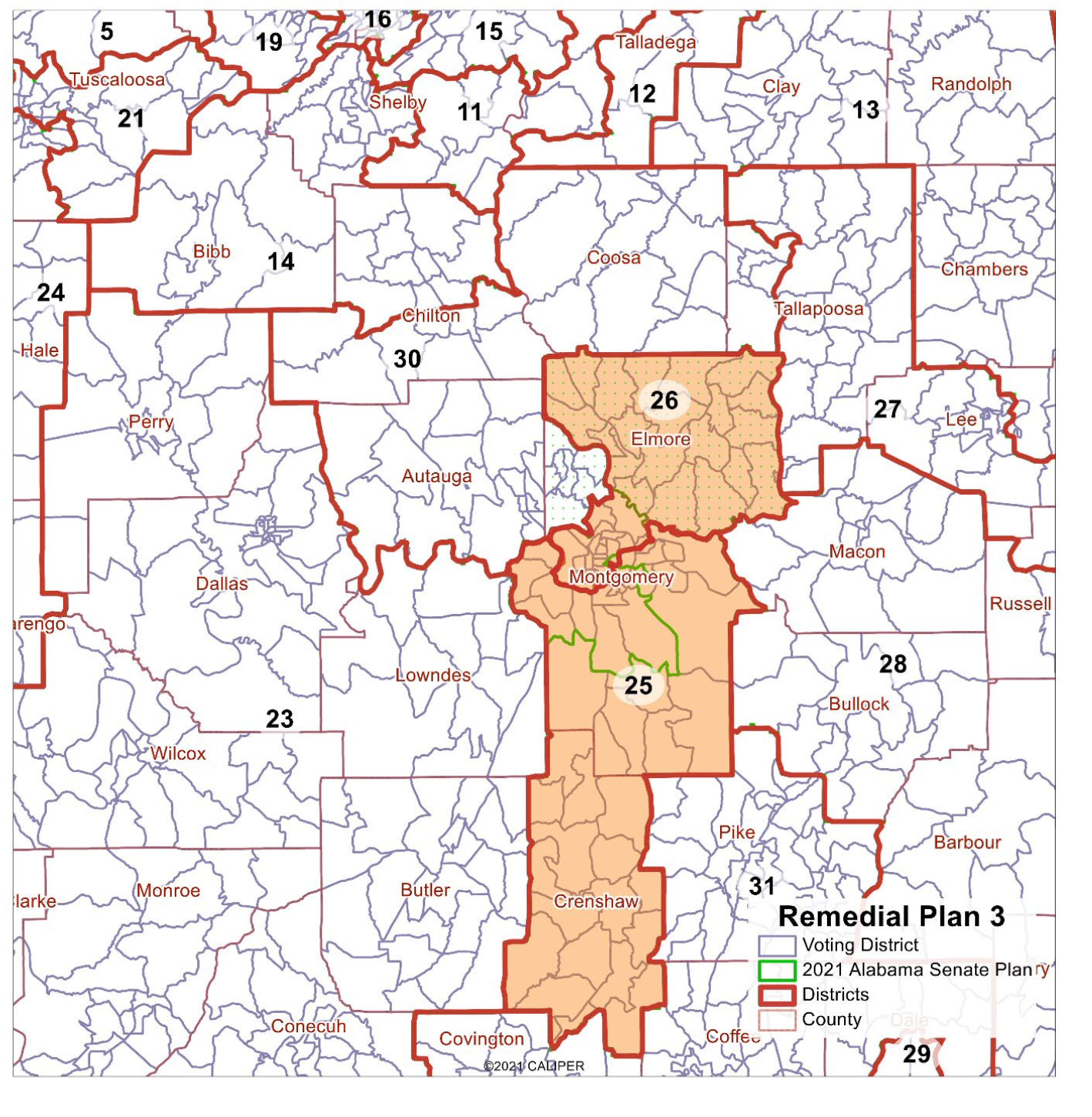
A primary election already took place with the court-ordered map, so there will likely be a special primary for the districts affected. Districts 25 and 26, which are located in and around the city of Montgomery, are the only two districts whose boundaries change between the two maps.
In the majority opinion, the court recognizes that similar injunctions have been lifted in light of the U.S. Supreme Court’s decision in Louisiana v. Callais.
The Supreme Court handed down its landmark decision in that case in April, ruling 6-3 to limit the consideration of race when drawing districts. The case stems from a majority-minority congressional district in Louisiana.
“If anything, the issues in this case more closely match the issues in Callais,” the court wrote on Thursday.
The court also noted that its ruling is not based on whether the evidence of the case supports the plaintiffs’ claims against the state but instead whether Secretary of State Wes Allen would likely be successful in an appeal.
The opinion also emphasizes that the public’s interest lies in electing representatives through a Legislature-approved map instead of a court-imposed one.
“The district court’s injunctions irreparably harm the state because they prohibit it from conducting the senate elections under the 2021 map approved by the people through their elected representatives,” the court said.
Demonstrating that the injunction causes irreparable harm is a requirement for a court to issue a stay.
How did we get here?
Alabama’s State Senate maps have been the subject of legal action for some time now.
It started with a 2021 lawsuit that argued Black voters in Montgomery were unnecessarily packed into a single district, preventing them from influencing elections elsewhere, while white voters in the majority-Black city of Montgomery were “surgically” extracted into another district.
This legal challenge led to a case in federal court. U.S. District Judge Anna Manasco ruled last August that the State Senate map drawn after the 2020 census illegally diluted the influence of Black voters around Montgomery.
Gov. Kay Ivey declined to call a special session for the Legislature to draw new district lines, so a special master appointed by the court did so instead.
One of three options, the map selected by the judge stretched Montgomery-based District 26 into Elmore County, making it whiter and more Republican. District 25 included most of Elmore County but now takes in more of Montgomery and none of Elmore County.
The state challenged both the initial ruling and the chosen map in court, but the latter appeal was stayed in anticipation of the Supreme Court’s decision in Callais. Both of Manasco’s rulings leaned heavily on Section 2 of the Voting Rights Act, which Callais gutted.
Seeing an opportunity to revert to old maps and hearing the calls of Republicans across the country, Ivey called a special session of the Alabama Legislature in early May.
During that session, the House and the Senate approved bills that allow Ivey to call special primary elections if courts rule in favor of Alabama and allow the state to use previously struck-down districts. One bill dealt with the state’s congressional map, and the other had to do with the State Senate districts.
Ivey called a special primary election for the four affected congressional districts in anticipation of a favorable court ruling, which still has not surfaced. The state’s appeal in the case has now been taken up by the Supreme Court.
As of Friday morning, Ivey has called no special primary for Districts 25 and 26.
The governor warned ahead of time that the results for the potentially affected congressional districts – 1, 2, 6 and 7 – would be void. No such announcement was made to the voters of Districts 25 and 26 as they cast their ballots on May 19.
What’s next?
Sen. Kirk Hatcher, the Democrat from Montgomery who currently represents District 26, and Sen. Will Barfoot, the Republican from Pike Road who serves the people of District 25, announced shortly after the court ordered the new map that they were going to switch districts ahead of the 2026 election cycle. The shift would have allowed both men to remain with many of their current constituents.
But Thursday’s ruling means the switch was all for naught. The district shift impacts the incumbents beyond just who they represent in the Legislature.
Hatcher already moved out of the district he currently represents into the one he would have if elected in the new District 25. There is a one-year in-district residency requirement for state senators, but it is set aside under state law when a district is recently redrawn.
“We’re just all in a mess right now…” Hatcher said Thursday. “I’ve already made that move (into District 25) thinking that that’s a settled deal, but here we are.”
The men will now run for reelection in the Senate districts they currently represent.
This is a breaking news story and will be updated with additional information.