
MONTGOMERY, Ala. – After months of campaign ads, mailers, canvassing and those dreaded texts, the 2026 primary has finally arrived.
Alabamians on Tuesday will decide nominees for the November general election for all constitutional offices and state Legislature seats, as well as three Congressional races and the open U.S. Senate seat.
The polls will be open from 7 a.m. to 7 p.m across the state. Around 3.8 million Alabamians are registered to vote, according to the most recent data available from the secretary of state’s office.
Despite the potential shake-ups with congressional maps, the election will operate as planned.
Voters everywhere will cast their ballots as normal, but the governor will void the results for races in Alabama’s 1st, 2nd, 6th and 7th congressional districts. Those would be the districts affected if the courts allow Alabama to revert to a 2023 congressional map.
Those races will instead be decided in a special primary election on Aug. 11 called by Gov. Kay Ivey.
With all the confusion, Ivey and Secretary of State Wes Allen have taken to social media to remind voters to turn out to the polls.
“Here’s what I want every Alabama voter to remember: go vote on May 19,” Allen said in a press conference last week. “Votes for statewide constitutional offices, local races, state legislative and judicial races, as well as statewide constitutional amendments, will count on May 19.”
Several races are ripe for runoffs, which are called when no candidate earns 50% plus one vote. Runoffs will take place on June 16.
Governor, lieutenant governor and attorney general
For the first time in eight years, Ivey is not on the ballot. She’s the longest continuously serving governor in Alabama history and is term-limited.
Republican U.S. Sen. Tommy Tuberville and former Democratic U.S. Sen. Doug Jones are the two front runners to replace Ivey. Two other Republicans are running against Tuberville. Jones will face off with five Democrats in a crowded primary race.
The lieutenant governor’s race is also crowded, with many familiar faces in Alabama politics.
Allen, former Alabama Republican Party Chair John Wahl, Commissioner of Agriculture and Industries Rick Pate and three others are fighting for the Republican nomination.
Representative Phillip Ensler of Montgomery has been leading the two-person Democratic primary.
The three-person Republican primary in the attorney general’s race has been one of the most hotly-contested on the ballot.
Republicans Pamela Casey, Jay Mitchell and Katherine Robertson have spent millions of dollars, but recent polling showed a plurality of voters were still undecided.
Senate and congressional races
Because of all of the map hullabaloo, Alabama’s congressional races are somewhat in flux.
After the Supreme Court ruled against race-based district drawing in Louisiana v. Callais in April, state officials have been working to get the courts to allow Alabama to use a 2023 congressional map. A federal court previously ruled that the map in question illegally diluted the influence of Black voters, but leaders have said the Supreme Court’s Callais ruling means the court should revisit that.
The Supreme Court last week paved the way for Alabama to use the 2023 map by remanding its previous decision to a lower court. The federal court set a hearing for Friday in that case.
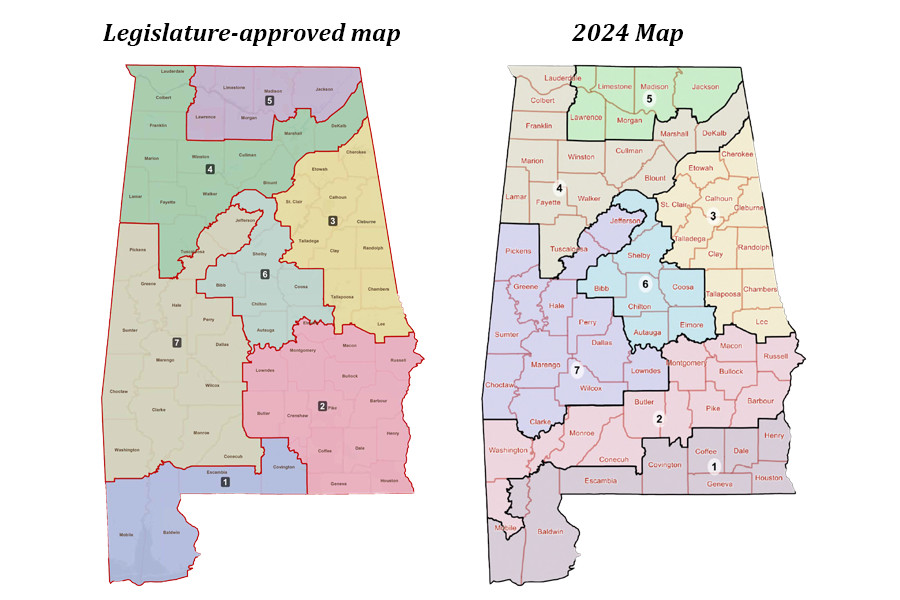
If the courts rule in favor of Alabama officials’ pleas, the state’s 1st, 2nd, 6th and 7th districts will change. That means Alabama will likely send six Republicans and one Democrat to Congress instead of the current 5-2 breakdown.
Some candidates in congressional races will switch districts if the maps change, making Tuesday’s election all the more confusing for Alabamians living in those affected districts.
There will be another primary in those districts on Aug. 11. The Legislature met for a special session earlier this month to grant Ivey the power to call such an election.
Voters on Tuesday will also decide on nominees for Alabama’s open Senate seat. The seat is vacant because of Tuberville stepping down to run for governor.
The six-way Republican primary in that race has been partly defined by undecided voters.
According to recent polling, U.S. Rep. Barry Moore leads former Navy SEAL Jared Hudson and Alabama Attorney General Steve Marshall.
There are also four candidates vying for the Democratic nomination.
Down the ballot: Legislature and constitutional amendments
Though there’s been lots of attention on the races high up on the ballot, there is potential for many shake-ups in state legislative races.
Nearly a quarter of the Legislature is facing primary challengers from their own party. Ten of those 33 incumbents serve in the Senate, and the other 23 are members of the House.
All 140 members of the Legislature are up for reelection. Unless another special session is called, the House and Senate won’t reconvene until January.
In addition to electing representatives, Alabamians will also decide on two proposed constitutional amendments on Tuesday.
The first would expand the list of criminal offenses for which judges may deny bail to defendants. The second would prohibit state entities from lowering district attorneys’ pay during their term.
Candidates on the ballot
Here’s a list of all the candidates on the ballot for most races.
For more information about how and where to vote, visit the secretary of state’s website. You can also view sample ballots at this link.