

U.S. Rep. Barry Moore leads political newcomer Jared Hudson by 4 percentage points in the Republican race for Alabama’s open U.S. Senate seat, according to a new Cygnal poll commissioned by Alabama Daily News and Gray Television.
Out of 500 likely GOP primary voters, Moore leads with 23% of the vote, followed by Hudson at 19% and Alabama Attorney General Steve Marshall at 14%.
Fielded from a statewide survey conducted April 29-30, the poll reveals nearly 40% of voters remain undecided in the race ahead of the May 19 primary. Other Republican U.S. Senate candidates did not garner above 2% of the vote in the statewide survey. The margin of error is ±4.38%.
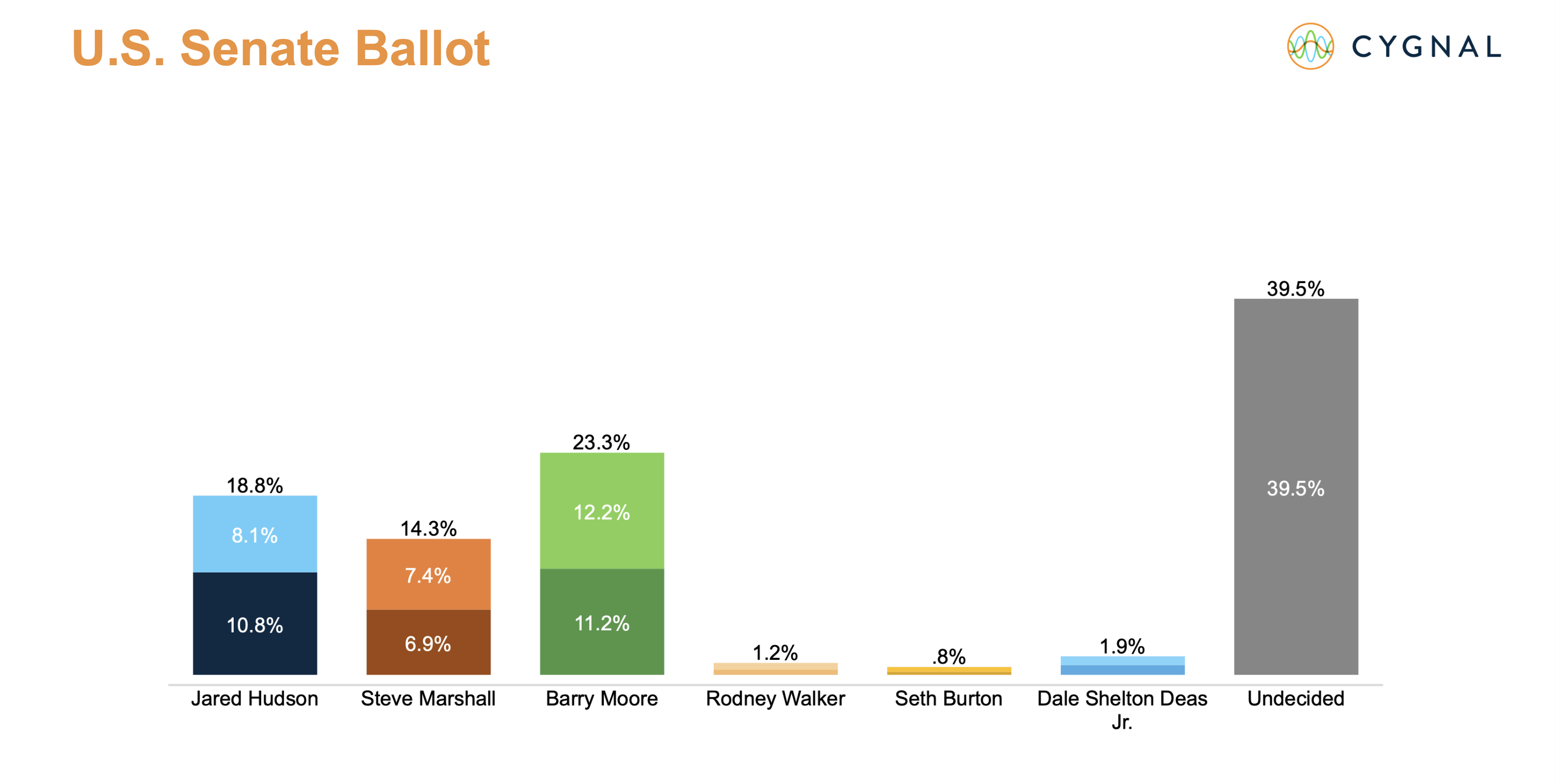
Moore, who President Donald Trump endorsed, has the greatest support among voters who identify as Trump Republicans. Among those voters, 30% support Moore, 19% back Hudson and 13% are behind Marshall.
For those polled who identify as traditional Republicans, Hudson garnered the most support with 20% of the vote, followed by Marshall with 17% and Moore at 14%.
The Republican candidates are vying to replace U.S. Sen. Tommy Tuberville, a staunch Trump ally.
Trump’s endorsement in Alabama remains strong, but is not decisive. About 37% of respondents said they would either definitely vote for or strongly consider voting for the candidate endorsed by Trump. Another 16.2% said they would consider Trump’s endorsement as part of their decision.
But about 32% said Trump’s endorsement would not affect their vote, and 12% said they would vote for a candidate even without Trump’s endorsement.
Trump’s endorsement has given Moore a boost, but it has yet to be decisive enough for him to pull way ahead of the field.
Support is divided across the state
The findings show Alabama’s electorate is split in half by geography. Polled likely GOP voters tend to favor candidates that have ties to the region where they are located. But a good chunk of voters in each of Alabama’s four major media markets have yet to get behind a Senate candidate.
Hudson has made a significant jump in recent polls after starting the race as an unknown candidate. The latest survey shows Hudson, a resident of Gardendale, has a stronghold in the Birmingham media market.
The former Navy SEAL leads Moore by 9 percentage points and Marshall by 3 percentage points in the Magic City. Hudson sits at 23% in Birmingham, compared to Marshall at 20% and Moore with 14% of the vote. But 41% of central Alabama voters are still undecided.
Moore’s stronghold is south of Birmingham, where he holds a commanding lead in the Montgomery-Selma-Dothan Corridor with 38% of the vote. That’s more than double Hudson’s support in the area (15%) and six times Marshall’s support (6%). About a third of Montgomery area voters remain undecided.
Cygnal pollster John Rogers said the voter-rich Birmingham area will be key to the homestretch.
“The Birmingham media market—the largest in the state—will be pivotal in deciding who makes the runoff, with 41% still undecided,” Rogers told ADN. “In a runoff, both Hudson and Marshall would have to work hard in south Alabama, where currently Barry Moore’s support doubles theirs.”
The congressman from Enterprise also leads in the Mobile market, garnering 29% of support in the region. Hudson and Marshall are both far below Moore in Mobile at 7%. But more than half of voters in the region have yet to make up their mind in the race.
Huntsville appears to be the most competitive region for the Senate race, with Moore and Hudson in a dead heat in the Rocket City. According to the survey, Moore recieved 24% of the vote in Huntsville while Hudson garnered 23%. Marshall comes in at 16%. About a third of voters in north Alabama are still undecided.
The findings show Marshall garnered the most support in the Birmingham and Huntsville markets, similar to Hudson, while having much less support in south Alabama.
Combined Senate ballot
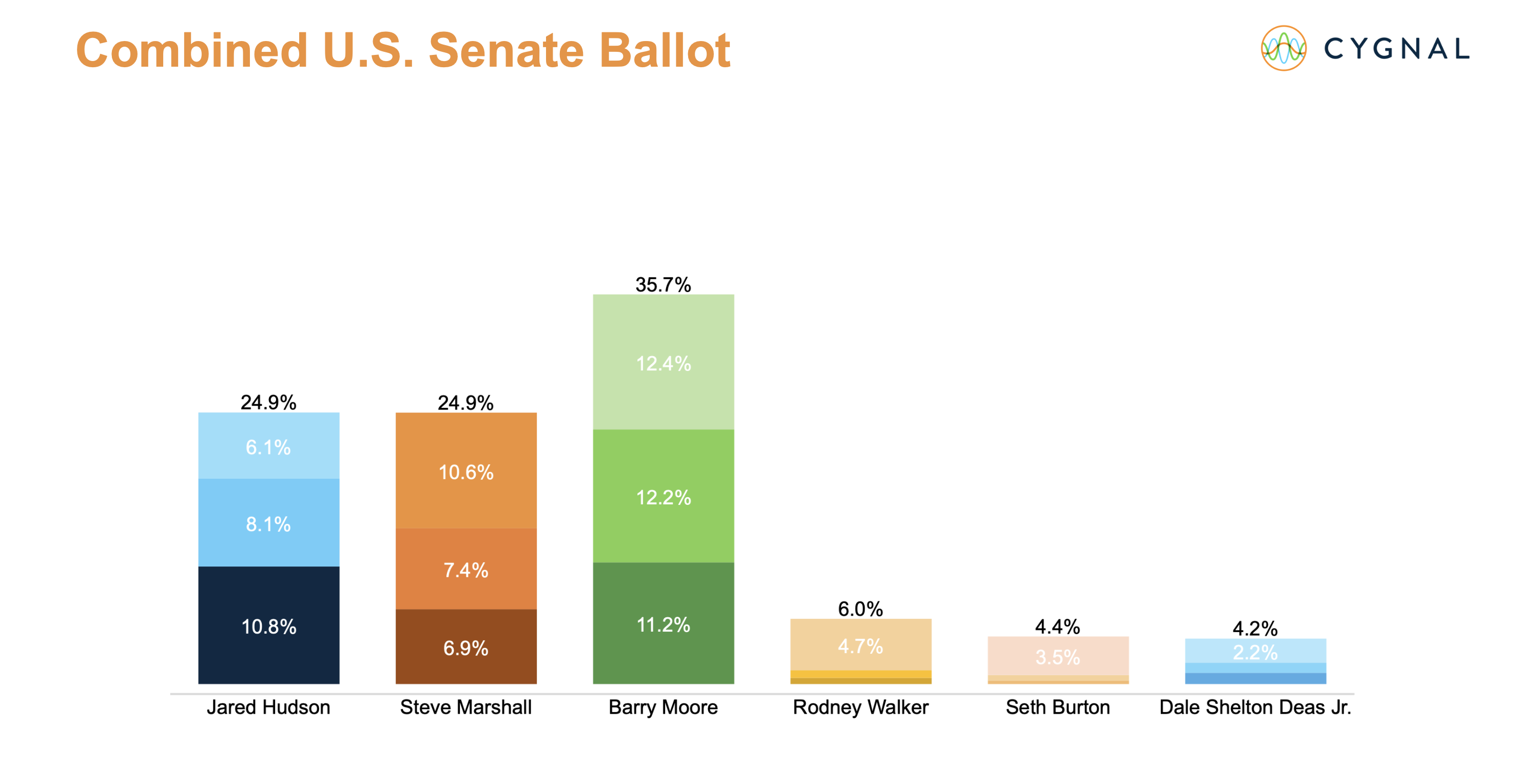
When undecided respondents were asked which way they lean, Marshall’s support rises to tie with Hudson. Moore keeps a lead over the field.
On the combined ballot question, Moore leads with about 36% of the vote. Hudson and Marshall are in a statistical tie, both sitting at about 25%.
The polling shows the primary race is still up for grabs and could likely end in a runoff. The Republican nominee will face off against the Democratic primary winner in November. The Democrats running for the Senate seat are Dakarai Larriett, Kyle Sweetser, Everett Wess and Mark Wheeler.