
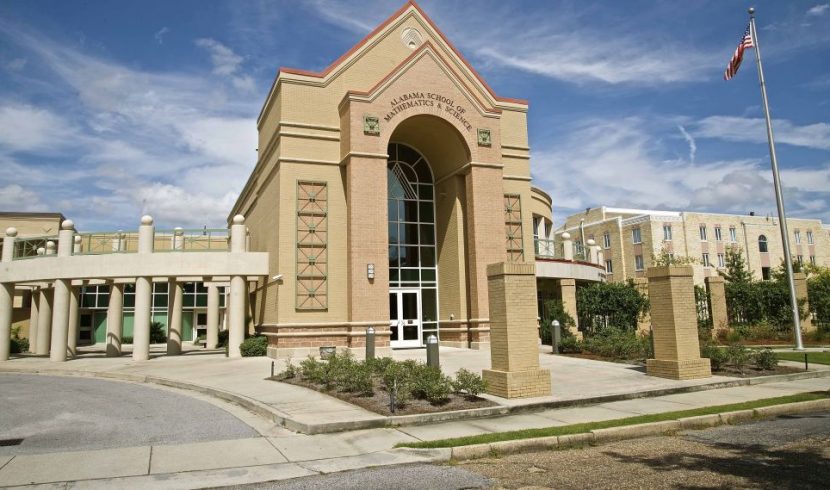
BIRMINGHAM, Ala. — Alabama lawmakers are expected to consider the state’s education trust fund budget this week. The historic $9.9 billion proposal includes $6.7 billion for the state’s K-12 public school students, raising the average amount per student from this year’s $8,700 to $9,200 next year.
But that average obscures the far larger investment Alabama makes in three small, specialty public schools.
The Alabama School of Fine Arts (ASFA), the Alabama School of Mathematics and Science (ASMS), and the Alabama School of Cyber Technology and Engineering (ASCTE) rely solely on state funding and contributions. They do not charge tuition and accept students from across Alabama. Each school offers a residential option, focuses on a specific academic mission and operates as its own state agency with a separate board of trustees.
Unlike traditional public schools, these specialty schools aren’t funded through Alabama’s enrollment-based Foundation Program. Instead, they receive line-item appropriations in the education trust fund budget. Their leaders were recently in Montgomery, discussing with lawmakers how they could grow.
For the current school year, fiscal year 2025, those appropriations are:
- ASCTE: $13 million for 370 students,
- ASFA: $12.6 million for 350 students,
- ASMS: $11.5 million for 275 students
That breaks down to:
- ASCTE: $35,500 per student
- ASFA: $35,900 per student
- ASMS: $42,200 per student
By comparison, the Foundation Program, which funds teachers, principals and basic needs of a school, provided $4.6 billion, or $6,400 per student.
Even when factoring in the state’s entire $6.4 billion K-12 allocation in the Education Trust Fund budget – which includes Foundation Program funding and all other earmarks for K-12 students – the average comes to about $8,700 per student.
Sen. Arthur Orr, R-Decatur, chairs both the Senate education budget committee and ASCTE’s board of trustees. He acknowledged the disparity, and called the specialty schools “a gifted program on steroids.”
Students at the three schools are given a unique opportunity to develop their gifts, he said.
“I want them to understand, and feel, almost, the significant investment we’re making in their education for them to reach their fullest potential.”
“If they’ve got gifts, we need to develop those gifts – be they health care, be they arts, be they math or science or cyber world engineering – we need to develop those as fully as we can.”
While enrollment at the schools comes with no service requirement, Orr said he hopes graduates choose to stay in Alabama.
“We want you, we need you to come back and contribute back to the state that’s contributing to you in a special way to help you realize your particular potential.”
Alabama could be investing significantly more in its traditional public school students next year.
Orr praised a recommendation from the K-12 Funding Task Force that presented its findings in a report for lawmakers in February. The group recommended maintaining the current Foundation Program while adding a weighted student formula (WSF). The WSF would layer additional funding on top of a base amount to address specific student needs.
For example, a student learning English might generate an additional 15% in funding. While lawmakers have not yet set the specific weights or base amount, categories the group discussed include:
- Special education
- English learners
- Gifted students
- Students in poverty
- Charter school students
- Rural school students
- Students in schools with concentrated poverty
Orr’s committee is expected to take up both the education budget and the proposed weighted funding formula this week.
Specialized and selective
There are important differences between traditional and specialty public schools. The specialty schools admit students based on academic fit and interest, while traditional schools must serve all children in their district. They also focus on narrow missions – like cyber engineering or the arts – while traditional schools offer a broad academic program.
Rebecca Sibilia, executive director of EdFund, a research and policy organization focused on public school finance, said Alabama’s per-student investment in its specialty schools exceeds what many high-spending states provide.
Still, she said, her concern isn’t about the funding for these students – but about who else is left behind.
“Nobody would ever suggest taking money away from students for doing well and flourishing in a really robust academic environment,” Sibilia said. “What advocates around school funding reform really focus on is how do we get all students to a place where they can have those kinds of opportunities.”
She said Alabama’s reliance on local tax revenue to fund education has already created funding inequities, and the gap between specialty schools and traditional schools only deepens those divides.
“Here you have a state that is making an intentional investment in a few select schools where they haven’t necessarily even taken the steps yet to equalize for local discrepancies for the general population,” she said. “To me, that’s dichotomous.”
Why the higher costs?
Leaders of the specialty schools say their per-student costs are higher because of their structure: small enrollments, specialized programs and boarding.
ASCTE President Matt Massey told Alabama Daily News that comparing their schools to traditional public schools isn’t an apples to apples comparison. A more appropriate comparison would be private boarding schools, small high schools or career technical schools.
For context, tuition at Alabama’s private boarding schools ranges from $35,000 to $56,500. Day tuition for the same schools ranges from $9,500 to $30,600. At ASMS, all students live on campus. At ASCTE, 35% to 40% do. At ASFA, that figure is 20% to 25%.
Still, even with all revenue sources combined, few Alabama public schools approach the funding levels of the specialty schools.
In 2022-23, the latest year for which data is publicly available, only three public schools in Alabama spent more than $30,000 per student:
- Alabama Aerospace and Aviation High School (charter): $43,219
- Dunbar-Ramer School (Montgomery, now closed): $38,284
- Chapman Elementary (Huntsville): $33,059
Only two traditional schools exceeded $20,000 per student in state funding alone: Chickasaw City High with 224 students and Dunbar-Ramer which had 62 students before it closed.
Schools want to grow
Last week, officials from ASFA, ASMS and ASCTE addressed lawmakers in the House Education Budget committee and asked for funds from the $524 million supplemental appropriation to help them expand enrollment.
ASCTE, located in Huntsville and opened in 2020, currently enrolls 370 students and expects to serve 400 next year.
“We need another dorm so that we are not turning brilliant young minds in the state of Alabama away because they’re asking to be in our school, and we have simply run out of room,” said PeggyLee Wright, the ASCTE Foundation executive director.
School officials hope lawmakers will provide seed money to help launch the project. That initial investment could be used to secure financing or encourage private contributions toward building a new dorm for girls.
ASFA in downtown Birmingham serves about 300 students and could enroll another 100 to 125 with additional boarding space. “We now serve 30 counties,” Director Tim Mitchell said. “We would have the ability to serve more counties if we had more room in our dorm.”
In Mobile, ASMS President John Hoyle said if lawmakers would help with costs of building a new dorm, that would allow them to expand enrollment by up to 125 students from their current 275.
“We are focused on taking young people from all over the whole state, and we’ve had all 67 counties represented,” he said. “Right now we have 58 counties represented.”
“We think that there’s a great return on investment,” Hoyle added. Throughout the presentation, school officials shared the many accolades and recognitions the schools and their students receive, academically and beyond.
Beyond what’s in the main education budget, Gov. Kay Ivey’s supplemental request includes just $1 million each for maintenance and school safety at each of the three schools.
A new school on the horizon
A fourth specialty school – the School of Healthcare Sciences – is underway in Demopolis and scheduled to open in fall 2026. It will have residential capacity for 400 students and is expected to cost $80 million to build. The curriculum will focus on STEM and health-care careers and operate in partnership with Whitfield Regional Hospital.
Orr said ASCTE has already gained national attention and hopes the model continues to raise Alabama’s reputation.
“We want this school to be nationally or internationally known because it’s an important niche we’ve carved out here,” he said.” But it’s also something that can elevate the reputation, if you will, of the state of Alabama by having a school like this that’s nationally and internationally renowned.”
The chart below shows each schools’ Education Trust Fund allocation since FY17. The FY26 amount is not final. Click here if you’re unable to see the chart.