
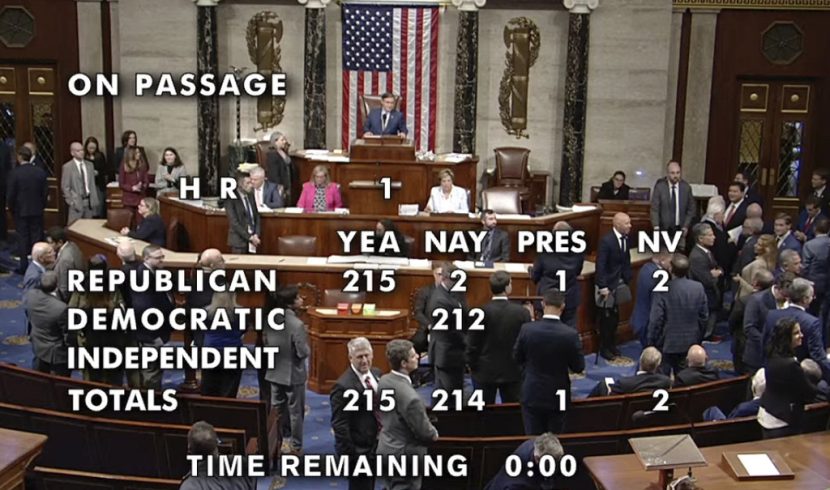
WASHINGTON — Alabama’s congressional delegation split along party lines in voting on President Donald Trump’s “big, beautiful bill,” which narrowly passed the U.S. House Thursday.
The sweeping legislation provides tax breaks, bolsters defense and border spending, and cuts billions of dollars from health care and food assistance programs. It now moves to the Senate.
The impacts are expected to be wide-reaching for Alabama and the country. The House vote was 215-214, with one Republican voting present. Alabama’s five Republicans supported the bill while the state’s two Democrats opposed it.
The dean of Alabama’s delegation, U.S. Rep. Robert Aderholt, R-Haleyville, praised the bill’s passage after all-night negotiations that ultimately got the package over the finish line Thursday morning.
“I voted yes because hardworking families deserve tax relief, a secure border and a government that lives within its means,” Aderholt said in a statement. “This bill delivers real results while continuing to support our most vulnerable.”
A member of the House Freedom Caucus, Rep. Barry Moore, R-Enterprise, told Alabama Daily News last month he was initially hesitant to support the legislation over concerns there weren’t enough spending cuts. However, he supported the bill and was not one of the hardline conservatives who had to be swayed this week with help from Trump to vote for it.
“The passage of President Trump’s One Big, Beautiful Bill delivers a victory for hardworking families by extending the Trump tax cuts, fully funding border security, lowering energy costs, and investing in new defense technologies,” Moore said in a statement.
Democrats stood united in their strong opposition to the bill. Lawmakers warned of people going hungry and losing health care coverage because of the bill’s spending cuts to federal programs. Rep. Shomari Figures, D-Mobile, spoke on the House floor against the cuts before the final vote.
“People will lose those benefits,” Figures said. “All in an effort to make long money even longer. So, my question is, ‘Is their money being longer, worth people in my district’s lives being shorter?’ It’s not.”
The package also allocates $150 billion to defense over the next decade, which Rep. Mike Rogers, R-Saks, championed throughout the process. Rogers is the chairman of the Armed Services Committee.
“That $150 billion will fund key initiatives in President Trump’s Golden Dome, revitalize our defense industrial base, help secure our southwest border, because border security is national security, deter Chinese aggression, and enhance service members’ quality of life,” Rogers said during a press conference alongside Republican leadership after the bill passed.
Tax cuts
The bill extends Trump’s 2017 tax cuts, including on individual income taxes. It provides a temporary boost through 2028 to the standard deduction for individuals by $1,000, making it $16,000, and boosts it by $2,000 for joint filers, making it $32,000.
An Alabama family of four making $62,212, the median income in Alabama, would see a $1,143 tax increase if Trump’s tax cuts aren’t extended in the bill, according to a Republican Ways and Means fact sheet.
The child tax credit will also get a boost by $500 through 2028, bringing it to $2,500. However, the credit would be restricted to families whose parents and children have Social Security numbers.
It also raises the estate tax exemption to $15 million.
Medicaid
The bill will slash Medicaid spending by nearly $700 billion, according to the Congressional Budget Office. The cut in spending would result in millions losing health care, including thousands in Alabama. The estimates for the number of Americans who could lose health insurance under the bill were made before Republicans agreed to move up the work requirements to save more money.
Up to 67,000 Alabamians could lose health care coverage under the legislation, according to the Kaiser Family Foundation. In Alabama, 1.09 million adults and children are on Medicaid, according to a May report from the Kaiser Family Foundation. Medicaid spending in the state totals $7.9 billion, and federal funding covers 78% of the cost.
The legislation expands work requirements for Medicaid. It will require individuals to complete 80 hours of work, education, or service per month for able-bodied adults without children. Alabama already has strict eligibility requirements for Medicaid and it doesn’t cover childless, able-bodied adults.
Medicaid recipients would also have to prove their eligibility twice a year instead of once a year.
SNAP
The legislation will cut Supplemental Nutrition Assistance Program spending by $267 billion, according to the Congressional Budget Office.
Roughly 752,200 Alabamians relied on SNAP in 2024, according to an analysis from the Center on Budget and Policy Priorities.
The expanded work requirements for SNAP increase the age limit for individuals to 64, up from 54, and only exempt individuals who are caring for a child under 7 years old.
In Alabama, 28,000 people in households with adults ages 55 to 64 with no children and no disability could lose at least some SNAP benefits. In households with adults ages 18 to 64 with school-age children, with no disability, 137,000 Alabamians could lose at least some SNAP benefits, according to the Center on Budget and Policy Priorities.
Some of the costs of SNAP benefits will also be moved to states based on their payment error rates. In Alabama, that could cost the state about $90 million, according to the Feeding Alabama CEO. The state would also be responsible for millions more dollars to pay for additional administrative costs that are shifted to states in the bill.
What’s next
The tax cut package is now in the hands of the Senate, which is expected to make changes to the legislation. Republican leaders hope to have the final package sent to President Trump’s desk by July 4.
The Senate will begin work on it when it returns from recess on June 2.
U.S. Sen. Tommy Tuberville, R-Ala., said he was hopeful the chamber would get it passed.
“We must help our farmers, deliver tax cuts for hard-working Americans, and get rid of waste, fraud, and abuse, and we must reauthorize the 2017 Tax Cuts and Jobs Act,” Tuberville said.
The bill will only need a simple majority to pass the Senate because reconciliation allows the lawmakers to bypass the filibuster.