
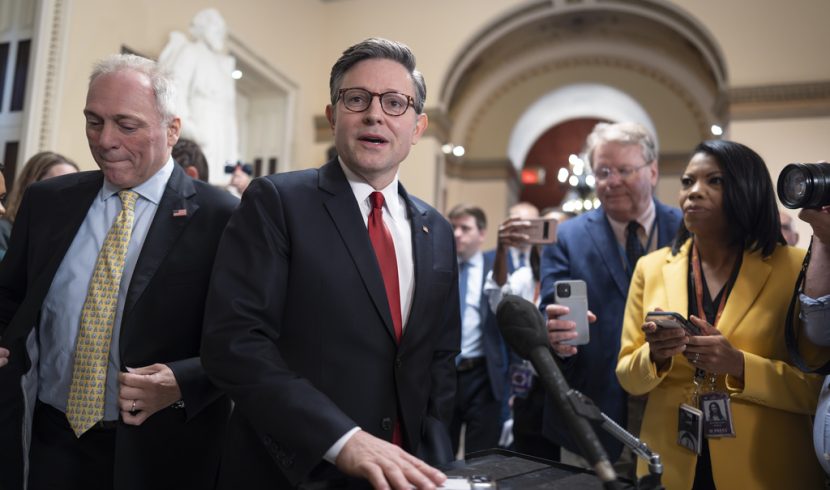
WASHINGTON — As Republicans fight tooth and nail to drum up enough support in the U.S. House to pass President Donald Trump’s tax breaks and spending cuts package, Alabama’s delegation is split along party lines on the sweeping legislation.
Speaker Mike Johnson, R-La., and Republican leaders held the House in a holding pattern for much of Wednesday, as they worked to secure enough votes on procedural steps to get the chamber to final passage of the megabill before Friday. The Senate narrowly passed the legislation with Vice President JD Vance breaking the tie Tuesday.
Members of the House Freedom Caucus railed against some of the changes made to the bill in the Senate, including on green energy tax credits, immigration provisions and increasing the deficit.
U.S. Rep. Barry Moore, R-Enterprise, told Alabama Daily News he was feeling “pretty good” about Trump’s agenda bill. He argued there had to be some give and take among members to get it passed.
“So you got principled and you got practical and you got perfect,” Moore said. “And so I think we have to hit between (principled) and practical to make sure that it makes sense. It’s not going to be perfect.”
Moore highlighted the increase in reference prices to help farmers, food aid reform and the tax breaks in the bill as his rationale for supporting it.
The nonpartisan Congressional Budget Office estimated that the Senate-passed bill would add $3.4 trillion to the nation’s deficit over the next decade.
When discussing the potential growing deficit from this bill, Moore again acknowledged that the bill “isn’t perfect” but said there will be other ways to help address the debt, such as through tariffs, the rescissions package and Trump’s leadership.
“So there will be some things I think will help with the debt, but right now, I think this is a step in the right direction,” Moore told ADN.
U.S. Rep. Dale Strong, R-Huntsville, said the big bill will help Trump achieve his goals as president, including growing the economy, bringing businesses back to the United States and cutting spending. He also said the tax breaks will benefit his constituents in north Alabama.
“I think the people of my district overwhelmingly support this package,” Strong told ADN. “You start talking about 13, 14, $1,500 per household in a district (that) makes a difference, and he’s trying to put money back in the pockets of the American people.”
Chairman of the House Armed Services Committee, Rep. Mike Rogers, R-Saks, cheered the Senate’s vote on the bill Tuesday, celebrating the $150 billion allocated toward defense spending.
“The House and Senate Armed Services Committees worked closely with the White House to ensure the (One Big Beautiful Bill) carries the President’s Peace through Strength agenda,” Rogers said in a statement. “We’re in lockstep on the priorities needed to restore American deterrence, revitalize the defense industrial base, and modernize our military.”
House Democrats are firmly united in their opposition to the legislation, citing their concerns about people losing health care and food assistance from the spending cuts.
Alabama’s Democrats, Reps. Terri Sewell, D-Birmingham, and Shomari Figures, D-Mobile, joined with their Congressional Black Caucus colleagues to fight against those cuts outside the Capitol Wednesday.
.@RepTerriSewell and @repscfigures join their Congressional Black Caucus colleagues to fight against Trump’s megabill as the House tries to get it passed before July 4. #alpolitics pic.twitter.com/0HtMl9g14w
— Alex Angle (@alexangle_) July 2, 2025
“It is a disastrous bill,” Sewell told ADN. “It is literally giving a tax break to the rich on the backs of the most vulnerable communities.”
Sewell said the bill was fiscally irresponsible and “immoral” for cutting social safety net programs that Alabamians rely on, such as Medicaid and the Supplemental Nutrition Assistance Program.
Democrats also worry about the impact the freeze on the provider tax for non-expansion states like Alabama will have on rural hospitals. The tax is used to boost federal Medicaid payments. For expansion states, the provider tax would be lowered.
“The provider tax is obviously a big issue that we’re seeing members on both sides push back against, and I think that just really highlights the uninformed nature that this bill was drafted under,” Figures told ADN.
Alabama could also have to pay around $172 million for its share of the Supplemental Nutrition Assistance Program benefits under the bill if its payment error rate is equal to or greater than 8%. It was at 8.32% in fiscal year 2024. Error rates measure the accuracy of a state’s eligibility and benefit determinations.
“The state is not accustomed to spending this kind of money,” Figures said. “We don’t even know if the state is going to be willing to spend this kind of money, and we’re still a little bit in the dark about what happens if the state does not spend this type of money.”
Alabama Republicans remain positive about the bill, with Rep. Robert Aderholt, R-Haleyville, expressing his support of the megabill in a social media post Wednesday.
“Getting this bill to the President’s desk fulfills promises of an economy that is pro-growth, pro-family, pro-business, and pro-worker,” he said on X. “It also continues to support the most vulnerable in our society while helping able-bodied individuals get back to work.”