
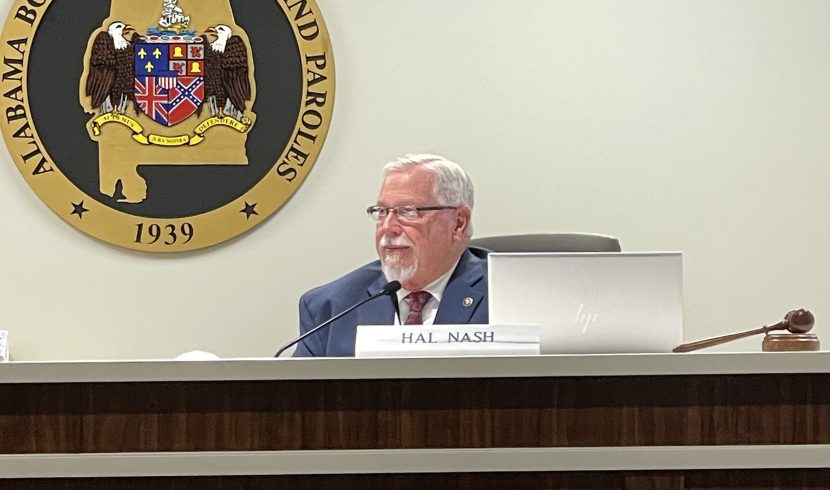
When the Alabama Board of Pardons and Paroles met last week, associate member Gabrelle Simmons called the docket and announced the vote outcomes of the 55 potential parolees as they came before the body.
Alternating the running of the hearings each week among the three board members started last month with the appointment of Chairman Hal Nash. If he chose to, Nash could do most of the talking at all the hearings.
“I want us to be a team,” Nash told Alabama Daily News of himself, Simmons and associate member Darryl Littleton.
He extends that spirit to the board and Bureau of Pardons and Parole staff. And he regularly thanks the people who come before the board, including victims and the families of inmates. The process doesn’t work without them, he said.
But being fair to all those who come before the board is how he’ll sleep at night, he said.
A self-described “old country cop,” Nash, 73, was most recently chief corrections deputy at the Jackson County Sheriff’s Office. He carries into his new role his decades-old pledge to maintain public safety.
Nash already had a career in the manufacturing and construction businesses when, at age 40, he went through the police academy in his hometown of Chattanooga, Tenn..
“I learned long ago how to build a team,” Nash said, “And that’s the concept that we have at the board now.”
Nash’s team building comes at a high-profile time for the board. He was picked by Gov. Kay Ivey from a list of candidates when former chair Leigh Gwathney’s term expired. Under Gwathney, the board’s parole grant percentage rates dropped to record lows — single digits in 2023 — and her management and communication style frustrated enough lawmakers to result in Republican-sponsored legislation this year to reform the board. It didn’t pass but the scrutiny likely remains.
“Whether we’re under the microscope or not, our job is not going to change,” Nash said. “Fairness is fairness.”
Of the 55 hearings last week, 15 people were granted parole, a grant rate of 27% and higher than the 22% average so far in 2025.
But Nash said he’s not paying attention to those stats and others shouldn’t either.
“People talk about percentages and numbers,” Nash said. “The board does not deal in percentages and numbers. We deal in individuals’ lives. And each case has to be looked at individually. We might have a 50% parole rate during a week, but that would be because the right circumstances presented themselves that week. And we might have a 5% week because those circumstances were egregious.”
It’s a sentiment similar, though maybe more gently expressed, to Gwathney’s, who defended in 2023 8% grant rates by saying the “board is not driven by statistics.”
Nash said parole is for those who aren’t a threat to public safety and are ready for successful release.
“We have to focus on that individual,” he said. “How can we help that individual? I don’t want to just push someone out the door, so how can we help them?”
Nash is quickly becoming an advocate for the BPP’s PREP Center in Perry County. The 90-day residential training facility for the recently paroled will in October celebrate 400 graduates since opening in 2022. None have returned to prison.
Nash would love to see the center duplicated in other regions of the state to further reduce recidivism rates.
When considering whether someone should be paroled, Nash said he wants to know they’ve changed for the better in prison.
“People can change when given an opportunity,” Nash said. “If they will take advantage of it. It’s entirely up to them.”
J.F. Ingram State Technical College offers adult education programming, including GED services at 23, almost all, of the state’s prisons. Ingram State additionally offers career technical programming in 10 locations across the state.
“… That’s what I’m looking for, did you take advantage of the opportunity that’s given you? Did you take advantage of the courses that are available if you didn’t finish high school? Did you get a GED? Did you fall back into old habits, or did you develop new habits? That’s what I’m looking for.”
New parole guidelines coming
It was the board’s nonconformance to its parole guidelines and failure to update them as required by law that led Gwathney last fall to clash with some lawmakers. The Legislature tied the board’s 2026 funding to the approval of new guidelines.
The guidelines are a scoring system that weighs several factors, including risk of re-offense and behavior while in prison. The lower the score, the better. The board is not obligated to follow the guidelines and often doesn’t. In July, the recommended grant rate under the current guidelines was 74%. The board paroled 29% of those before it that month.
“The guidelines, I think, are perceived incorrectly by some people,” Nash said. They’re not rules for who gets released, but an indicator, a part of the puzzle, he said.
New guidelines proposed in July are still under a review process.
Nash said when they go into effect later this year, they’ll be a better indicator of candidates for parole.
Changes include factoring in whether an inmate was a juvenile when they committed their crime.
“I do things a lot differently now than I did when I was 17, 18, 19, years old, and hopefully we all do, so that’s more consideration given,” Nash said.
Other changes include additional points based on the severity of the crime and a reduction of points for completing educational programs.
Ward said he expects new guidelines to be modified more before they go into effect. More consideration could be given to someone’s post-release job and home plan, he said.
During a public comment period, it was suggested the board consider in its decisions the crowded conditions of Alabama’s prisons.
While Nash says he’ll focus on the individual, easing prison crowding isn’t in the board’s wheelhouse.
“That is not our responsibility or our role,” Nash told ADN.