
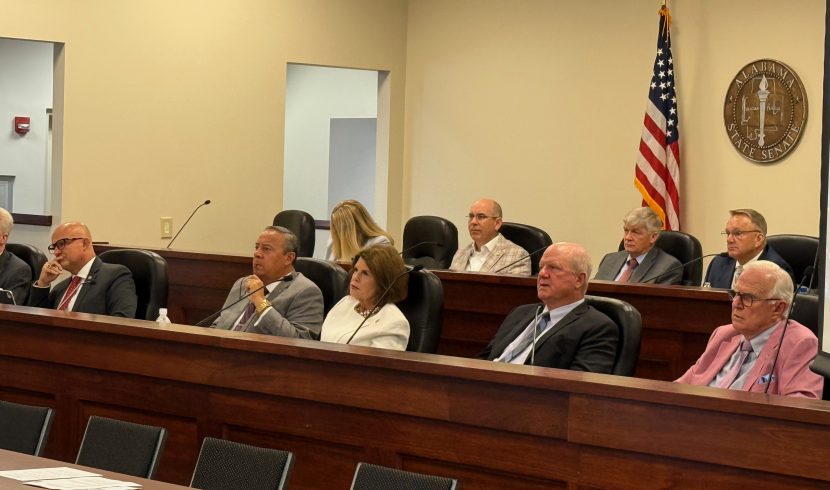
Lawmakers on the Alabama Legislature’s General Fund budget committees heard a “cautionary tale” about expected dips in revenue in the coming years.
The fiscal year 2025 receipts are fine. The General Fund and the Education Trust Fund are both up more than 3% compared to fiscal 2024. But the concern in the General Fund is that much of its growth since 2023 is from interests on state deposits, the earnings from high interest rates and billions of dollars in federal COVID-19 funds sitting in state coffers waiting to be spent. It’s been a lucrative situation.
But that COVID money must be spent by the end of 2026, and those interest rates will, eventually, drop. While reducing interest rates is good for the economy, it’s going to have a negative impact on the General Fund, Kirk Fulford, deputy director of the Legislative Services Agency, said during budget discussions at the State House on Tuesday.
The interest earnings have been worth more than $439 million so far this year in a General Fund that’s totaled $2.8 billion. But it’s down 5.5% from last year and is expected to continue declining.
“Everything else in the General Fund doesn’t grow by enough to offset a big decline in this one revenue source,” Fulford said.
Fulford showed the lawmakers projections of flattening revenues in fiscal 2027. Fulford and several state agency leaders also discussed expected and possible increased spending in 2027. Lawmakers will begin working on the 2027 budget soon after the January start of the 2026 legislative session.
“The asks are not going to go away, just because we have less money to deal with,” Fulford said.
Among the expected challenges are state obligations for Medicaid, prisons and other state agencies and services.
Fulford also said he’s watching the recently filed lawsuit against the state over the collection and distribution of online sales tax revenues. Plaintiffs, including the cities of Tuscaloosa and Mountain Brook, want the structure thrown out and redone.
“If something were to happen to the revenue stream, that’s a $350 million hole in the (General Fund) budget,” he said.
During Tuesday’s hearings, agency leaders were asked how the federal “big, beautiful” spending bill will impact their agencies.
Bo Offord, the state’s new Medicaid Commissioner, reiterated that Alabama won’t be affected as much as states that had expanded Medicaid under the Affordable Care Act. Meanwhile, the state can keep and renew current provider taxes, which help fund Medicaid, but can’t issue new ones.
Another pending Medicaid concern is the pending expiration of tax credits that help about 400,000 people in Alabama pay for their ACA marketplace plans. Unless Congress acts, they’ll expire at the end of the year.
Fulford said that will mean fewer people in the state with health insurance, which increases costs for providers, and less state revenue via the insurance premium tax.
One of the more high-profile impacts from Trump’s big budget bill is on the Supplemental Nutrition Assistance Program, or SNAP. The Republican-supported legislation puts more fiscal responsibility on states, especially if they have high payment error rates, to provide the food assistance. An error rate of 6% or less will require no state contribution. In Alabama, the error rate in 2024 was 8.32%, the lowest in the Southeast. If Alabama doesn’t get its error rate down, the cost in fiscal 2028 could be $176.3 million, Alabama Department of Human Resources Director Nancy Buckner told lawmakers.
Buckner also said that at least half of those errors are made by benefit recipients. She gave the example of a grandmother who has a grandmother move in with her, but doesn’t report the additional dependent on her SNAP paperwork.
“Client errors are beyond our control,” Buckner said.
Bucker also pointed out to lawmakers that the states with some of the worst error rates are getting more time — until 2029 or 2030 — before financial penalties take effect. Alabama Daily News previously reported that 10 states, including Florida and Georgia, have error rates high enough to give them a temporary reprieve from cost-sharing.
Sen. Greg Albritton, R-Range, asked Buckner if Alabama should not focus on improving its error rate, but instead make it worse to buy more time.
“That’s what we’re having some conversations over,” Buckner said.
State lacks civil commitment beds
In her presentation to lawmakers, Alabama Department of Mental Health Commissioner Kim Boswell noted the continued need for long-term civil commitment beds in the state.
For every 100,000 Alabamians, the state needs 30 commitment beds, Boswell said.
“Right now we’re at 13.7 beds (per 100,000),” Boswell said. Her department is using some opioid settlement money to add another 57 beds.
Albritton asked why there is a shortage of beds when the state still owns the shuttered Searcy Hospital in Mount Vernon.
It was one of several state mental health hospitals closed amid court orders and budget cuts in 2012 and 2025.
Reopening Searcy would not be cost efficient, especially when smaller community based facilities receive more federal funding than larger state-run sites do, she said.
Albritton asked why the state hadn’t sold the Searcy property. Boswell said it’s a combination of buildings with some historical significance and others that are in bad shape. There’s also a cemetery on the property.
“If you have a buyer, I’d be happy to,” she said.
The budget hearings continue this morning, starting at 10:30 with the Alabama Department of Public Health.