
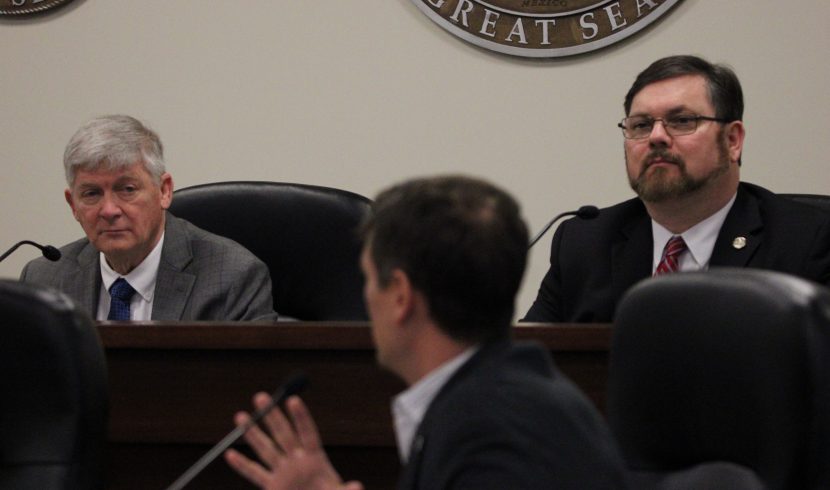
MONTGOMERY, Ala. — Members of the Alabama Blockchain Study Commission agreed recently the state of Alabama should work toward “getting on the front end” of emerging blockchain technology in becoming among the most cryptocurrency and blockchain-friendly states in the nation.
“There are very few states right now that can put themselves out there as really crypto-business friendly, or at least open to working with crypto businesses and wanting to interact with them,” said Wade Preston, a member of the commission and leader at the Alabama Blockchain Alliance. “Crypto entrepreneurs have been seen as kind of pariahs for so long that getting on the front end of that would be a good leg up for the state, in my opinion.”
Blockchain technology refers to a type of digital database that can act as a secure public ledger that records and verifies all transactions, and is the foundation of which cryptocurrencies such as Bitcoin are built. While its roots can be traced back to the early 1980s, more advanced and decentralized forms of blockchain technology have only emerged within the past decade or so.
The study commission was established last year by Sen. Greg Albritton, R-Range, as a tool to research ways the state could potentially utilize blockchain technology to improve government efficiency, as well as how it should be regulated. Some states have already implemented blockchain technology for government operations, with California digitizing its 42 million car titles last year, though states have generally been slow to adopt regulation around the industry.
That could change soon, however, with the second Donald Trump administration, with several key cabinet picks, including Paul Atkins as SEC chair and David Sacks as AI and Crypto Czar, being advocates for regulation favorable to cryptocurrency. Trump has also pledged to enact executive orders to benefit the cryptocurrency sector.
Many bitcoin enthusiasts and investors are quick to say government-backed currencies are prone to devaluation and increased government buy-ins will stabilize future price swings, giving them more legitimacy and boosting already rising prices.
But the risks are significant. Critics say crypto investments are highly speculative, with so much unknown about projecting future returns. They warn that investors should be prepared to lose money.
Only a couple of public pension funds have invested in cryptocurrency. A U.S. Government Accountability Office study on 401(k) plan investments in crypto, issued late last year, warned it has “uniquely high volatility.” It found no standard approach for projecting the future returns of crypto.
Members of the commission agree it would be advantageous for the state to establish favorable policy for blockchain and cryptocurrency entrepreneurs, and soon.
“I think we need to be on the cutting edge of this; it’s coming, it’s here,” Albritton told Alabama Daily News. “We don’t want to be (on the) tail end.”
While the commission did not take any votes during its meeting on Jan. 16, members agreed that state leaders should consider collaborating with Innovate Alabama, the state initiative designed to foster entrepreneurship and technological advancement, in developing a cohesive message that the state of Alabama was welcoming to cryptocurrency and blockchain entrepreneurs.
Members maintained, however, that the proper guardrails around the technology should still be established to protect consumers.
“I would suggest that we continue to move forward in spite of whatever the feds are going to do, we still have to be responsible for the state of Alabama,” said Sen. Bobby Singleton, D-Greensboro. “I think we should continue to listen to experts, learn as much as we possibly can, be prepared to set up those guardrails for consumer protections, and be open minded to the industry as it develops, and yet still make sure that we protect our citizens.”
Rep. Mike Shaw, R-Hoover, who last year floated the idea of introducing legislation related to the regulation of cryptocurrency and blockchain technology in the state, told ADN that adopting a friendly posture, both rhetorically and policy-wise as it relates to cryptocurrency and blockchain entrepreneurs, could produce a significant economic benefit to the state. He also confirmed that he still intends on introducing at least one “crypto-related bill” during the 2025 legislative session.
“My hope is that we can keep communicating both in what we do and laws we pass that we want to be a Blockchain friendly state,” Shaw said. “We want to protect our people obviously, but this new technology has so many applications that could be really good for the economy of our state.”
The Associated Press contributed to this report.