
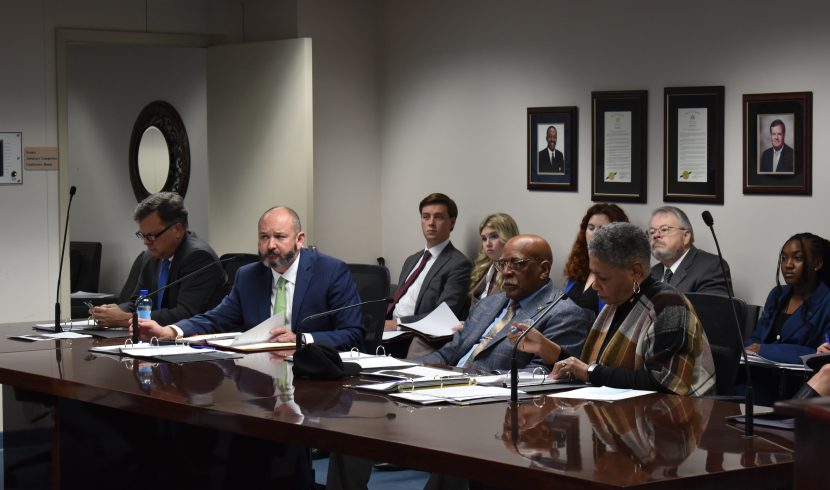
MONTGOMERY, Ala. — Several high-profile anti-crime bills were debated in the Senate and House judiciary committees Wednesday. While some advanced to possible floor votes as early as today.
House Bill 20
House Bill 20 by Rep. Matt Simpson, R-Daphne, received a favorable report in the House committee.
It adds to the current capital offense statute “murder when the defendant knowingly creates a great risk of death to multiple persons.”
“(In cases) where you’re putting multiple people in danger, I believe capital murder should be included,” Simpson previously told Alabama Daily News.
Capital offense convictions can be punished with the death penalty or life in prison without parole.
House Bill 71
House Bill 71 by Rep. Chris England, D-Tuscaloosa, would make it a Class C felony for medical examiners to remove or retain the organs from a body without the permission of next of kin. Such removal is already against the law.
“This adds a penalty to that because apparently it’s a problem,” England said in committee Wednesday.
England has sponsored similar bills the past two sessions. He previously said the effort is in direct response to several incidents in which the bodies of deceased Alabama inmates have been returned to their families – after state-ordered and performed autopsies – with organs missing.
Trey’s Law
Both judiciary committees approved their identical versions of “Trey’s Law” to prohibit nondisclosure agreements in civil settlements involving sexual abuse or human trafficking.
Senate Bill 30 by Sen. Matt Woods, R-Jasper, and House Bill 93, by Rep. David Faulkner, R-Mountain Brook, are part of a national effort named for Trey Carlock. The Texas native was abused as a youth for several years at Kanakuk Camp in Branson, Missouri. Pete Newman, the camp leader convicted of abusing Carlock and others, was sentenced to multiple life sentences in prison. Carlock then sued the camp and his civil case settlement included a restrictive NDA. Being silenced by the NDA led to Carlock’s 2019 suicide at age 28, his family has said.
Senate Bill 20
The Senate committee approved Senate Bill 20 by Sen. Chris Elliott, R-Josephine, to increase the penalties for injuring a public official.
The bill expands the definition of assault in the second degree to include “injury to a current or former local, state, or federal public official during or as a result of the performance of the current or former official’s duty…”
State law already increases what would be a misdemeanor to a Class C felony for the assault of law enforcement, correctional employees, firefighters, utility workers and emergency medical service personnel.
Current law also covers health care workers. The new bill clarifies that it includes those who work in hospitals, doctors’ offices and long-term care facilities. The bill was amended in committee to also include pharmacy workers and health care workers who work in private homes.
Some Senators said the law is growing too large, creating separate classes of citizens.
Sen. Larry Stutts, R-Tuscumbia, said assaulting him shouldn’t carry a larger punishment than assaulting anyone else.