
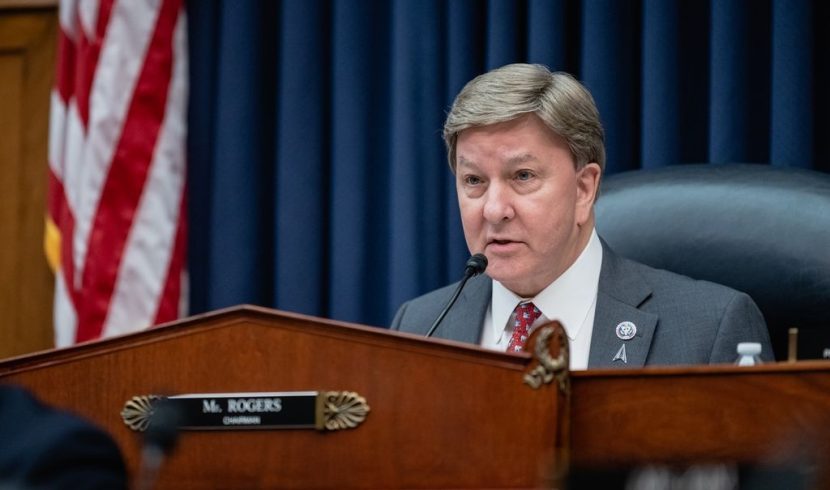
WASHINGTON — The House is set to vote on the annual defense policy bill to authorize Pentagon spending this week, spearheaded by House Armed Services Chairman Mike Rogers.
On Monday, the House Rules Committee began to tee up the FY 2026 National Defense Authorization Act, which authorizes about $893 billion for defense spending.
“This is a strong bipartisan bill that puts our warfighters first,” Rep. Rogers, R-Saks, said. “It builds the ready, capable and lethal fighting force we need to deter our adversaries and ensure peace through strength.”
Reforming the federal acquisition process is the main focus of the package this year, which includes the Streamlining Procurement for Effective Execution and Delivery (SPEED) Act, to speed up the process of getting military technologies and capabilities into the hands of service members.
“It can take up to 10 years between identifying a battlefield need and delivering a solution to the warfighter,” Rogers said. “By that time, the threat has changed, the cost has ballooned and the solution is outdated.”
The legislation would lessen the regulatory burden on the private sector to make it easier for outside companies to offer solutions. It would also shorten timelines for the permitting process.
“One of the things that we do is, instead of giving these detailed requirements, we’re giving a problem, saying, ‘This is the problem we need a solution for,’ and inviting the private sector to give us solutions to that problem,” Rogers said. “That is going to abbreviate that dilemma of several years down to a matter of weeks.”
The NDAA garnered bipartisan support in the House Armed Services Committee when it approved the bill in July.
“The Pentagon moves too slowly, and when you’re looking at technologies like drones and AI…we need to buy those more quickly,” Rep. Adam Smith, D-WA, the committee’s top Democrat, said. “This bill, I think, really gives us a good chance to get there.”
However, Smith said the House could lose Democratic support if Republicans add onto the bill a plethora of “extreme right-wing amendments,” as he said the GOP did to last year’s defense authorization package.
About 1,200 amendments were filed this year, including one that would require the Department of Defense to be renamed the Department of War in all regulations, following President Donald Trump’s executive order last week. Rep. Barry Moore, R-Enterprise, signed onto that one. Moore also submitted an amendment to prohibit those who are receiving gender affirming care from serving in the armed forces. Rep. Terri Sewell, D-Birmingham, and Moore submitted an amendment to include the surviving children of veterans in the definition of small businesses owned and controlled by service-disabled veterans for three years.
Much of the NDAA debate will also revolve around Trump’s use of the military on U.S. soil as he threatens to deploy the National Guard to other cities besides D.C..
Other parts of the NDAA include a 3.8% pay raise for service members and construction for new housing, dining and medical facilities.
During the rules hearing, Smith also highlighted the “strong support for Ukraine” in the package. It includes $400 million for the Ukraine Security Assistance Initiative, which provides funding to improve Ukraine’s defense capabilities.
Before the package receives a final vote, the House will have to confer with the Senate. One key difference between the two versions of the bill is the topline number. The Senate’s NDAA authorizes $925 billion compared to the House’s $893 billion, which aligns with Trump’s budget request. The Senate will also consider the NDAA this week.