
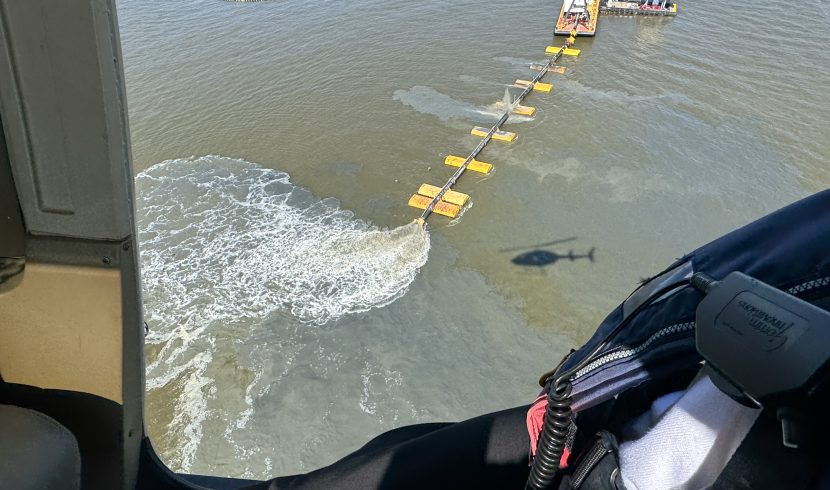
MONTGOMERY, Ala. – Legislation limiting the practice of “mud dumping” in Mobile Bay could get final passage this week.
House Bill 181 received unanimous approval in the House last week and could be on the Senate floor today. It mirrors federal law enacted by U.S. Sen. Katie Britt, R-Alabama, in 2024 that requires the Army Corps of Engineers to use at least 70% of dredged materials for “beneficial use,” including marsh creation, shoreline protection and restoration of eroding coastal habitats.
The bill specifies that beneficial use does not include “the deposition of dredged material into public waters unless that deposition is part of a shoreline restoration or marsh creation project.”
Since that 2024 bill, the federal government is required to fully fund disposal of dredge from the Mobile Harbor Ship Channel. This legislation would likely increase the cost of maintaining the Mobile Bay, as mud dumping is the cheapest option for disposal.
Sponsor Rep. Rhett Marques, R-Enterprise, said that the bill was at a point “where everyone seems to be happy” when presenting two friendly amendments to the bill in a January House committee meeting.
Marques said that the House Ways and Means General Fund Chairman Rex Reynolds, R-Hazel Green, had concerns about protecting the state’s budget, and the Alabama Port Authority wanted to make sure its federal dollars were protected – both of which were addressed in the amendments.
The amendments were compiled into a substitute passed on the floor of the House. They clarify that no funds appropriated from the state General Fund should be used to fulfill the 70% beneficial use requirement and that compliance is only required to the extent that federal funds and beneficial use sites are available.
“I’m committed to protecting Mobile Bay and making sure Alabama leads on coastal stewardship,” Marques, who is running for Congress in the 1st District that includes Mobile and Baldwin counties, previously told ADN. “This legislation reflects conservative principles: protect what drives our economy, use taxpayer dollars wisely, and follow the science on what works.”
Environmental groups like the Mobile Baykeeper have previously pushed back on the practice of mud dumping because of its negative impact on marine life and coastline.
The Army Corps of Engineers defended its current practice of thin-layer placement and argued it does not qualify as mud dumping in an open letter published by U.S. Army Brigadier General Zachary Miller.
“(Thin-layer placement) is a measured, monitored, and science-based sediment management practice designed to mirror natural sediment processes that have shaped Mobile Bay over thousands of years,” the letter said. “This practice has been used in Mobile Bay for more than a decade under state and federal permits, with continuous environmental monitoring and regulatory oversight.”
The Corps has previously considered dispersing the dredge materials in the bay a beneficial use, according to lawmakers. Sen. Chris Elliot, R-Josephine, and others raised concerns about mud dumping in the bay last summer.
Elliott is sponsoring the bill in the Senate.
Other states like Florida, Georgia, Louisiana, North Carolina and Virginia have already enacted state legislation against mud dumping.