
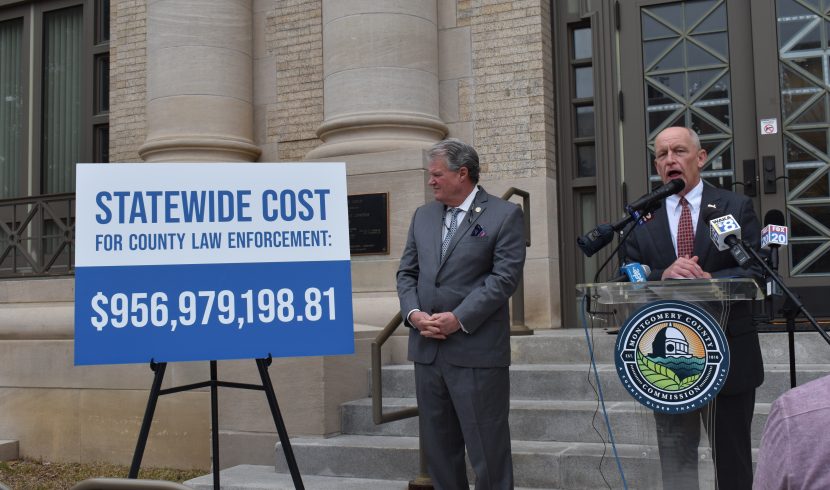
MONTGOMERY – Some county law enforcement leaders fear changes to the state’s online sales tax revenue distribution would harm public safety.
At a press conference Thursday morning, they said if a lawsuit calling for changes to the revenue distribution structure is successful and they get less funding, they’ll have to alter operations and training, ultimately hurting law enforcement’s ability to do its job. The lawsuit was brought by cities, including Tuscaloosa and Mountain Brook, that say they’re losing money on the current Simplified Sellers Use Tax structure compared to traditional sales taxes applied to in-person purchases.
The controversial SSUT is a significant and growing source of revenue for the state, as well as city and county governments, with more than $3.5 billion generated in revenue since its enactment in 2016, according to data from the Association of County Commissions of Alabama, which is opposed to the lawsuit or any changes to the tax revenue distribution.
The SSUT was established about a decade ago to collect a flat 8% on online purchases from distributors without a physical presence in Alabama. Half of revenue goes to the state and 30% to cities and 20% to counties, based on population.
The lawsuit argues online sales tax should operate how it would at a brick-and-mortar store: a 4% tax – all of which goes to the state’s Education Trust Fund – plus local sales tax based on where the purchase is made and that support the local city and county’s needs, including local police and fire personnel and road work.
A Montgomery judge recently issued an order establishing mediation in the lawsuit. A hearing has been pushed from later this month to early March.
Currently, counties decide how they want to spend their SSUT money, and a “vast majority” of it goes toward law enforcement, said Sonny Brasfield, executive director of the ACCA. Law enforcement makes up at least half of the budget in 55 of Alabama’s 67 counties, Brasfield said.
County governments across the state are expected to spend over $956 million on law enforcement this budget year.
“If there was any of this money that were to be taken away, it would compromise public safety,” said Huey “Hoss” Mack, executive director of the Alabama Sheriffs Association. “It would compromise public safety, not only in this area, but all across the state of Alabama.”
The lawsuit will be an issue in the Alabama Legislature’s session that starts on Tuesday. Senate General Fund budget committee chairman Sen. Greg Albritton, R-Range, has called the lawsuit a “money grab” by municipalities and said they agreed to this structure in legislation a decade ago.
The SSUT totaled $963.3 million in fiscal 2025. Up significantly from $851.1 million in 2024 and $386.3 million in fiscal 2020. The SSUT contribution to the General Fund in fiscal 2025 was $357.5 million, nearly 10% of the fund’s about $3.58 billion.
At a State House meeting on Thursday, Albritton said Tuscaloosa’s traditional sales tax revenue has increased significantly in the last 10 years, and they’re getting a portion of the SSUT.
“If there’s harm, I’d like to have a discussion about it,” Albritton said. “ But I don’t think there’s any harm.”
In response to the SSUT lawsuit, Albritton has pre-filed for the session two bills that would let people opt out of paying sales taxes in cities outside of where they reside.
A member of the Legislative Contract Review Committee, Albritton delayed Thursday several state contracts unrelated to the lawsuit or tax collection. He did the same thing last month as a way to draw attention to his opposition to the lawsuit.
Rep. Chris England, D-Tuscaloosa, also on the contract review committee, said the discrepancy between traditional sales tax and online sales tax revenue for cities is only going to continue to grow.
“As more people buy things online, it reduces the amount of money you take in through your brick-and-mortar sales, through sales taxes,” England said in an exchange with Albritton. And, the online rate is less than traditional sales taxes in many parts of the state.
Meanwhile, school boards are the biggest losers in the SSUT structure, England said.
“(We need to) figure out a way to remedy the fact that local school boards are losing revenue every time somebody orders something online and it’s not being made up (with a different revenue stream),” England said.
England and the plaintiffs also argue the lawsuit was needed because they believe the Alabama Department of Revenue, which administers the SSUT law, is incorrectly implementing it. He and others argue goods and food picked up at local stores and restaurants via local drivers should not be taxed like out-of-state vendors in the SSUT formula.
Albritton said the Legislature, not the judicial system, should be deciding tax policy in the state.
“Let’s get it back here and fix it,” he said. “I welcome that opportunity.”