
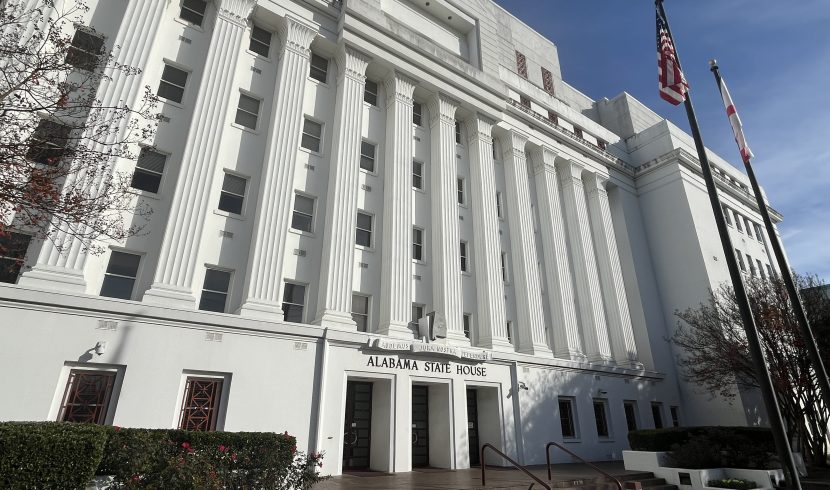
Two bills ready for the Alabama Legislature’s upcoming session could cut cities’ sales tax revenue by allowing people to opt out of or receive a refund on sales taxes paid to municipalities other than where they reside.
The bills are Sen. Greg Albritton’s latest warning shot to municipalities in an ongoing battle over the distribution of revenue from the state’s online sales tax, formally called the Simplified Sellers Use Tax, or SSUT.
The bills haven’t yet been assigned to a committee, but the Senate General Fund budget chairman wants them in his. Asked if it might be hard to get some of his colleagues to vote for a bill that could financially hurt the cities they represent, Albritton said he didn’t think so.
“All they have to do is tell their city centers to get out of our knickers with this SSUT, stop trying to steal money from us and we can come to terms,” Albritton told Alabama Daily News.
A total of 17 cities and school systems have a lawsuit against the state over the collection and distribution of the decade-old Simplified Sellers Use Tax. It differs greatly from the sales tax paid on purchases made at brick-and-mortar stores, and entities in the suit argue they’re financially hurt by the distribution structure, an issue that only worsens as Alabamians spend more money online each year.
Albritton, the state, every county and more than 100 mid-sized and small municipalities want the lawsuit dismissed or dropped. Any court-ordered changes to the revenue, which is approaching $1 billion a year, would be chaotic for them, they’ve argued.
The SSUT rate is 8%. Currently, 50% of that goes to the state where it is further split, 75% to the state General Fund and 25% to the Education Trust Fund. The other half is split among local governments, 40% to counties and 60% to municipalities based on population.
Plaintiffs in an August lawsuit first brought by Tuscaloosa, Mountain Brook and Tuscaloosa City Schools want a tax collection system in which retailers with stores and facilities in the state remit for online purchases the same state and local taxes they would for in-store purchases: A 4% state sales tax that goes to the Education Trust Fund, and any local sales taxes. In Tuscaloosa, for example, a person pays a total of 10% sales tax.
Albritton said he’s pre-filed the bills. They’re not yet available on the Legislature’s website, but he shared copies with ADN. Each is only a few paragraphs.
One says an Alabamian can be exempt from paying sales and use taxes in a municipality they don’t reside in “upon proof of residency by the taxpayer.”
The other says non-residents of a city may “file a petition for refund of the taxes paid with the municipality based on a process established by the municipality.”
Albritton said his bills are needed to address a fairness issue in which large cities have an advantage.
“The concentration of resources in cities, and particularly in the larger cities, is just becoming overwhelming,” he said. “People are forced, whether it be medical, whether it be construction, whether it be education, everything is centered and governed by the cities, and all the small town folks have to go to the larger cities to get any kind of services, and when they are have to go there, they have to pay a tax to that city for the privilege of spending their money in someone else’s city.
“I’m trying to prevent a drain of resources from rural and small towns.”
These bills are not Albritton’s first swipe at cities over the SSUT lawsuit.
A few weeks ago, Albritton held four state contracts during the Legislative Contract Review Committee’s monthly meeting.
“Politics has repercussions, decisions have consequences and this decision, this poor decision to bring this suit, is going to have long-lasting difficulties,” Albritton said at the time.
He is still holding those contracts.
Asked about the bills and potential resolutions, Senate President Pro Tem Garlan Gudger’s office said it hadn’t yet studied them.
“We have not yet had an opportunity to review the legislation, but our office continues to monitor developments in the SSUT lawsuit,” chief of staff Jesse Skaggs said.
Legislation and lawsuit
Albritton wants the lawsuit dropped and has said this issue should be handled legislatively.
Since it passed in 2015, the SSUT law has been modified a few times, including a 2018 change that gave municipalities more revenue. It took the city-county split of half the total funds from 50-50 to 60-40.
Rep. Chris England, D-Tuscaloosa, has sponsored multiple SSUT-related bills in the last two legislative sessions. He said the issue he originally wanted to fix was the loss of revenue to local school systems.
“The SSUT directly takes money from local school boards and does not replace it,” England told ADN on Friday.
England is an assistant city attorney for Tuscaloosa. He said the Legislature has been given recent opportunities to address concerns and hasn’t.
He filed House Bill 17 in 2024 to increase the SSUT rate from 8% to 9.25%. The additional funds would be sent directly to schools based on population size. It didn’t go anywhere.
He later filed House Bill 258 with a similar increase on the SSUT, but split between counties, cities and schools. Municipalities would have gotten the largest piece of the increase. It came out of committee but was largely panned by Republicans as a tax increase and never got a floor vote.
In this year’s session, he again sponsored a bill to direct a 1.25 percentage point increase in SSUT to schools. It didn’t get a committee vote.
England said if he brings legislation this year, it will be focused on sending more revenue to schools.
Another reason the lawsuit is needed, England said, is plaintiffs do not believe the Alabama Department of Revenue, which administers the SSUT law, is correctly implementing it. He and others argue goods and food picked up at local stores and restaurants via local drivers should not be taxed like out-of-state vendors in the SSUT formula.
Legislation this year to exclude them, sponsored by Rep. Jamie Lomax, R-Huntsville, did not advance from committee.
“The only place to get that remedied is in the courts,” England said.
While some lawmakers are sympathetic to plaintiffs’ arguments, especially on allowing services like DoorDash and UberEats to participate in SSUT, some, like Rep. Kerry Underwood, the Republican former mayor of Tuscumbia, said he’ll have a hard time voting for any bill that would raise taxes.
Tuscumbia is one of the cities siding with the state and seeking a dismissal of the lawsuit. Underwood said it receives about $900,000 per year in SSUT revenue. He said all cities are benefiting from the SSUT structure.
“I fully see that there are some things that we have to work through on this, and I’m willing to have those discussions and see what can be done,” Underwood said. “But those things take time.”
$963.3 million in ’25
The Alabama Department of Revenue recently released 2025 revenue numbers. The SSUT totaled $963.3 million in fiscal 2025. Up significantly from $851.1 million in 2024 and $386.3 million in fiscal 2020.
The SSUT has become an anchor for the General Fund that has “always been choked down,” as Albritton said. The SSUT contribution to the General Fund in fiscal 2025 was $357.5 million, nearly 10% of the fund’s about $3.58 billion.
“No one likes to pay taxes for services that are covered in the General Fund,” Albritton said. “… But we’ve got to provide services like law enforcement, we’ve got to provide courts, we’ve got to provide means by which we can care for people and and we have to have the resources to do that, because the demands continue to increase yet, and we’ve done a fairly good job with that, but, but at this point, the demands are beginning to exceed the resource.”
England said he understands a General Fund chairman would “react ferociously” when the millions of new dollars are threatened. Other revenue streams are relatively static and there are increasing demands, including shifts from the federal government.
“I get it,” England said. “But on the other hand, I’d hate to see anything operate in a punitive fashion to scare people from saying, look, ‘I know you’ve got issues, but we’ve got issues too. How can we figure this out together versus everybody in a standoff, pointing guns.’”