

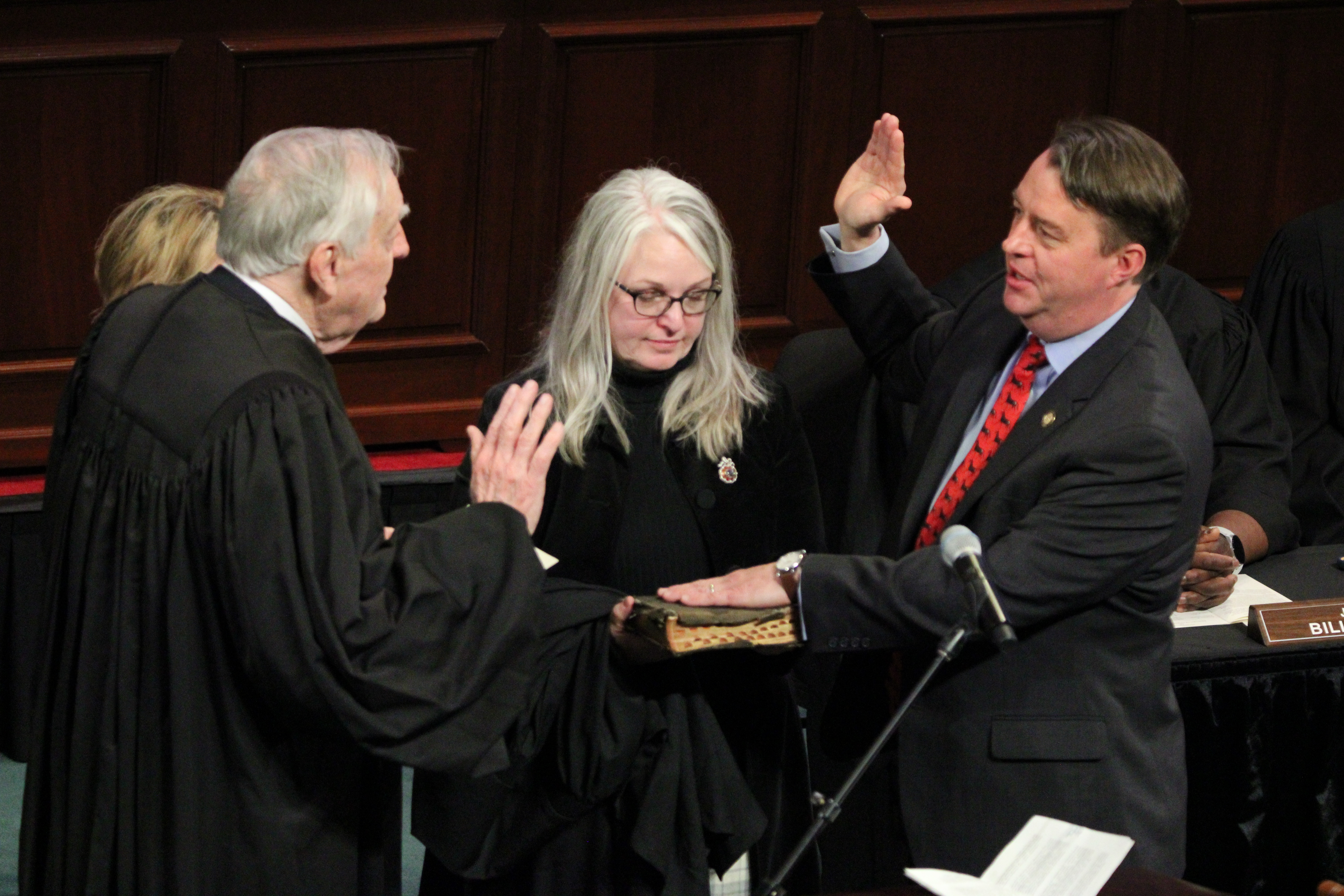
MONTGOMERY, Ala. — Hundreds gathered at Montgomery First Baptist Church Friday to witness new Alabama Supreme Court Chief Justice Sarah Stewart, associate justices Tommy Bryan and Chris McCool, and Judge Rich Anderson take the oaths of office.
Stewart, who previously served on the Alabama Supreme Court as an associate justice, defeated her Democratic opponent Greg Griffin for the top position on the court in the 2024 general election. She has been vocal about wanting to help expand access to treatment courts, reduce recidivism and increase funding the state’s court system ahead of her swearing in.
“We will be doing everything we can, every day, to make sure that we are fulfilling our mission of delivering justice to the people that we serve,” Stewart said at the ceremony. “I also know that we take full responsibility and will never waiver in our commitment to growing and earning the peoples’ trust in our branch of government.”

Several prominent members of the Alabama Legislature and various state agencies attended the ceremony, among them Lt. Gov. Will Ainsworth, who told Alabama Daily News that he was particularly excited about Stewart’s commitment to help improve the state’s judicial system.
“I’m (excited about) her plan to make sure the courts get adequate funding, to make sure the needs are met for all the judges across the state,” Ainsworth told ADN. “Probably the one thing that stands out to me is that I think she’s really going to look out for the judicial system and find out what she can do to improve it.”
Stewart’s plans include the creation of a criminal division at the Alabama Administrative Office of the Courts, the entity responsible for administering the state’s judicial system, which she said would help expand the state’s treatment courts, such as veterans or drug courts.
Also attending the ceremony was Attorney General Steve Marshall, who told ADN as a former district attorney he was happy to hear of Stewart’s aspirations to support judges across the state. He also said he had spoken with her regarding violent crime in the state, discussions that could potentially lead to legislation in the upcoming session.
“I know she’s got a particular interest in trying to figure out how the court system can be a vehicle to be able to help (with violent crime in the state),” Marshall told ADN. “We’ve had discussions about potential legislation that we’ll have that may assist, and looking forward to having continued discussions moving forward.”
Rep. Ed Oliver, R-Dadeville, had previously told ADN that he had recruited Stewart’s help to draft a bill that would expand the state’s veteran treatment courts. And House Speaker Nathaniel Ledbetter, R-Rainsville, recently unveiled that legislative leadership would be introducing a package of bills this year to address violent crime.
“Beyond that, there’s very much a renewed interest in what’s going on at the trial court level and being able to support our trial judges in what they do,” Marshall said. “As a guy that comes from that world and has tried many jury trials over my career, I’m excited about the support for our judges across the state.”
Others sworn in at the ceremony included Bryan, who was re-elected in the general election to associate justice, a role he’s held since 2012, McCool, who was also reelected in November, having first been elected in 2018, and Anderson, who was elected to the Alabama Court of Criminal Appeals.
In his remarks, Anderson urged not only the members of the Alabama Supreme Court, but judges across the state to perform their duties as intended by making judgement based strictly on the law as interpreted.
“We need judges to not make decisions based on emotion, feelings, the whims of personal opinion or the fickle winds of politics, we need them to do justice,” Anderson said. “To do justly means we follow the law of the facts wherever they go, and we render the opinion based upon the laws and facts.”