
BIRMINGHAM, Ala. – Alabama’s Education Trust Fund collections were essentially flat through May, but State Superintendent Eric Mackey said he is watching one revenue source in particular: sales tax, which has been down year over year in seven of the first eight months of the fiscal year.
The fund had collected about $7 billion since Oct. 1, the start of the 2026 fiscal year, according to the state’s fiscal dashboard.
Mackey said he is not ringing alarm bells, but seven months of declining sales tax collections have his attention as state leaders start looking toward future budgets.
“When you look back and you see we’re on a trend now – unless it picks up – to have negative sales tax for the first time that I’ve seen in a long time,” Mackey said.
“We’ve gotten only one positive month now,” he continued, “and that was at the first of the year. If we continue to see it go negative, then as you’re thinking about how are we going to budget for FY 28, that has to give everybody some pause.”
Sales tax started the year in positive territory in Alabama. In October, collections were up 2.4% year over year, but since then, year-over-year collections have remained below last year’s revenue.
The table below depicts monthly sales tax year-to-date revenue for the 2026 fiscal year, which started Oct. 1. Click here if you’re unable to see the table.
Figures for sales tax collections do not reflect the two-month state sales tax holiday on food that Gov. Kay Ivey signed into law for May 1 through June 30, according to the dashboard.
Income tax collections remain flat
Collections from the largest source of state education revenue, income tax, also remained flat through May, down 0.04% year over year and totaling $4.8 billion for the year to date.
Year-over-year income tax collections have been more variable than sales tax collections, declining as much as 15% in October, then fluctuating month to month between a loss of 2% and a gain of 2%.
The chart below shows year-to-date income tax collections. Click here if you’re unable to see the chart.
Alabama is not alone in seeing slower or uneven revenue growth.
The National Association of State Budget Officers’ spring survey showed 29 states with fiscal 2026 revenues exceeding original forecasts, nine states reported revenue collections were on target and 11 states reported revenue was below original estimates at the time the survey was given.
Meeting FY26, FY27 obligations
Despite the slower sales tax collections, Mackey said he isn’t concerned about ETF revenue hitting the mark for the current or coming fiscal year. But longer-term trends matter, he said, as lawmakers and education officials look ahead to the cost of continuing statewide programs.
Those include TEAMS, which pays additional salary to qualifying middle and high school math and science teachers, and a program to support the development of school principals.
State lawmakers have invested heavily in the state’s early literacy and math initiatives, including teacher training, reading and math coaches and new curricular materials aligned with Alabama’s academic standards.
“We’re always thinking about the legacy programs,” he said. “What’s it cost to continue them?”
Sen. Arthur Orr, R-Decatur, who chairs the Senate education budget committee, said sales tax collections are worth watching, but said the state’s budget structure gives lawmakers room to manager slower growth.
“Sales taxes are definitely a concern,” Orr said. “But I think it’s still important to look at the broader picture.”
Orr pointed to the state’s practice of not budgeting every dollar or available revenue. Under state law, annual ETF spending growth is capped, with revenue above that cap flowing into reserve or special-purpose accounts.
“That’s the impact of not budgeting to the revenues,” Orr said. “We capped it…to the 5.75% growth, and after that everything is put into special spend accounts that are always conditioned on what kind of revenue we receive.”
Those accounts include the ETF Budget Stabilization Fund and other education-related funds lawmakers have used to support one-time spending, including recent investments tied to the RAISE Act – which provides additional monies to K-12 schools targeted at student needs – and the CHEER Act – which provides outcomes-based funding to eligible colleges and universities.
“I think we’ve got a manageable situation here,” Orr said.
The dashboard shows the ETF needs $2.9 billion from June through September to meet $11.95 billion in budgeted obligations for FY26. That includes the $9.9 billion regular education budget and other obligations.
Lawmakers approved a $10.5 billion education budget for FY27, which begins Oct. 1.
The chart below, a screenshot of the state’s fiscal dashboard, shows each year’s collections from October through May since 2021. Click this link for the interactive dashboard.
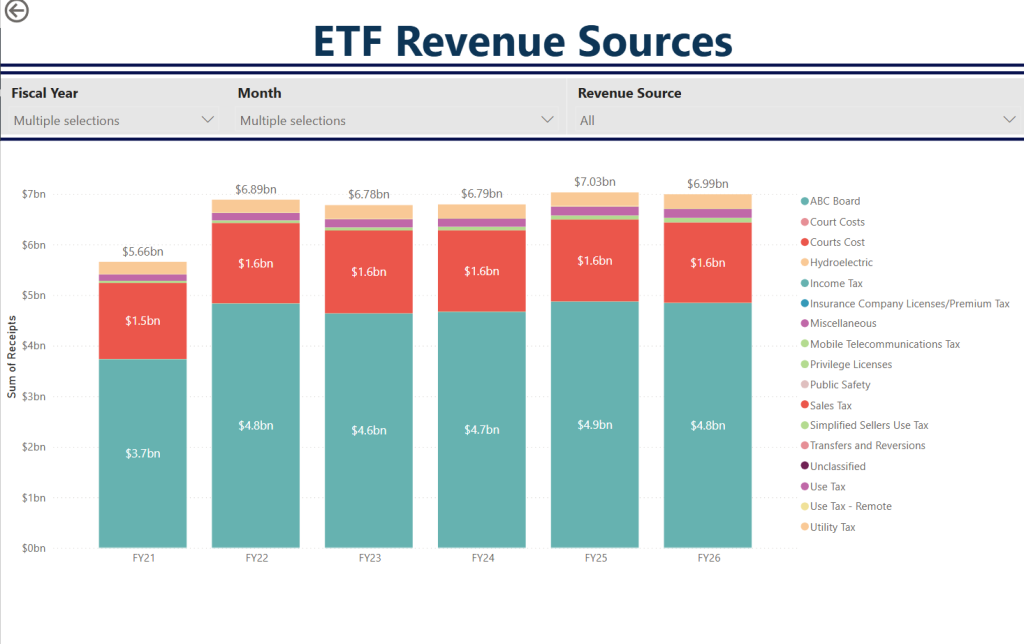
The FY26 target should be reachable if ETF revenue performs as it did last year, when the fund collected $3.9 billion during the final four months of FY25.
The table below shows total ETF collections are essentially flat at this point in the fiscal year compared with the same point last year. Click here if you’re unable to see the table.
While ETF collections were essentially flat, the state’s General Fund was up through May. Through May 31, gross receipts totaled $2.4 billion, compared with $2.3 billion at the same point last year, an increase of 4.05%.
However, the General Fund is facing pressure from several directions, including expected increases in costs to administer the federal food assistance program known as SNAP.