
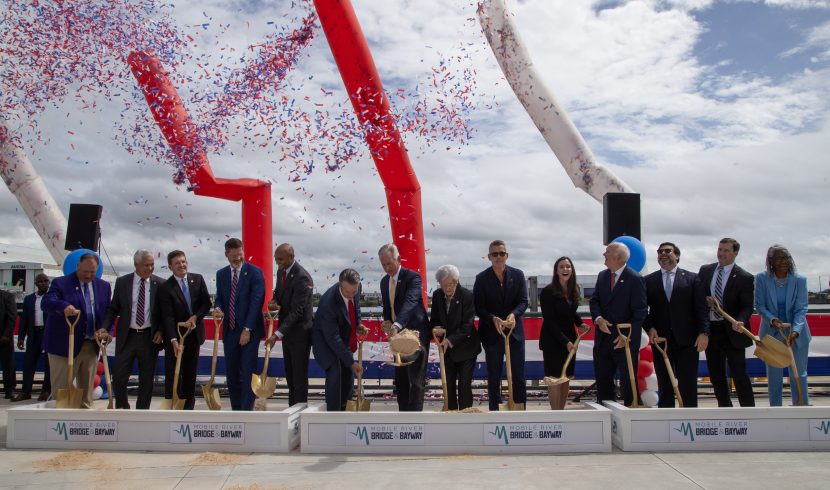
MOBILE, Ala. – After almost 30 years of effort to fix gridlock along Mobile Bay, local, state and federal officials broke ground on the new Mobile River Bridge and Bayway Friday morning.
The construction, including the new bridge and bayway, is the largest transportation infrastructure project in Alabama history and will take about five years to complete. The South Alabama Regional Planning Commission first pursued new infrastructure to ease congestion along Interstate 10 with a feasibility study in 1997.
Underscoring the need for the new bridge, Gov. Kay Ivey said the current infrastructure was designed for 35,000 vehicles to pass through per day but operates with 95,000 in peak season.
“This new bridge is simply a must,” Ivey told the crowd Friday morning. “Secretary Duffy, you and President Trump made a very wise investment in Alabama. We are proud to be part of ushering in the golden age of transportation. And as we’re in the middle of college football season in Alabama, we can always appreciate a good team effort. It was a team that got us here today.”
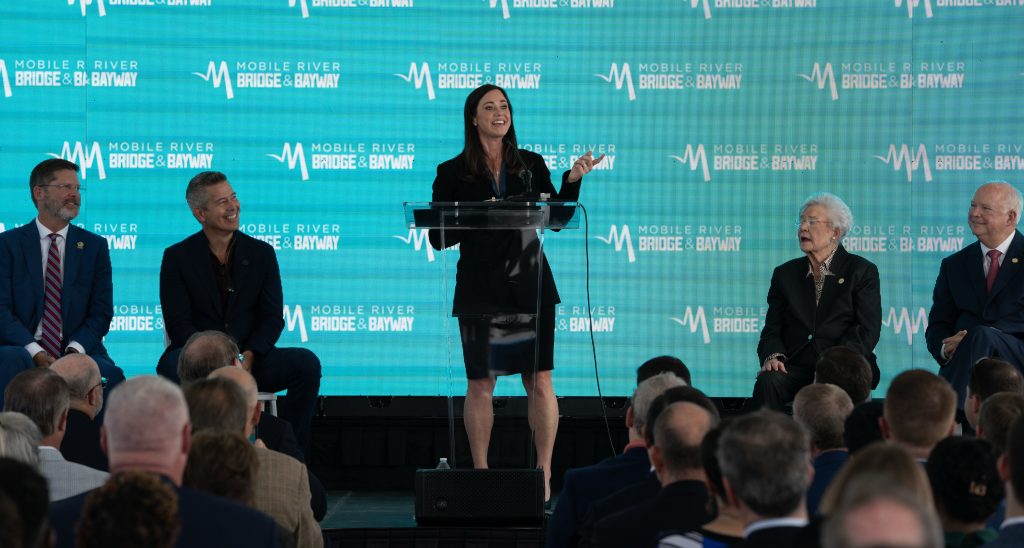
Several of the speakers – including U.S. Sens. Katie Britt, R-Ala., and Tommy Tuberville, R-Ala., U.S. Reps. Shomari Figures, D-Mobile, and Barry Moore, R-Enterprise, and University of South Alabama President Jo Bonner – emphasized the value of the partnership between all levels of government and multiple presidential administrations to make the new infrastructure a reality.
Britt said Friday’s event is a testament to what is possible when multiple levels of government work together. Though formal efforts to build began in 1997, the Mobile and Baldwin county communities have worked to elevate the need for a new bridge for even longer than that, she said.
“This corridor is going to be a lifeline for Alabama, for the region, and for the nation,” Britt said. “It’s going to connect the port of Mobile. It’s going to connect our shipbuilders, our military assets, our hardworking Alabamians and wonderful Americans who travel to visit our great state. This investment will mitigate ongoing safety concerns and also strengthen our hurricane evacuation routes.”
Figures, who grew up in Mobile, asked all local and state lawmakers in the audience who helped to push the project forward to stand up and be recognized, saying the project was “a long time coming.”
“It is truly a team effort. Truly something that everyone from our Senate delegation to our House delegation has been working on for decades,” Figures said. “I will also tell you this, when we look at where we are and where we’re going here as a city, this is an enormous investment. So I do want to thank the Trump administration for their role in getting us here, but I would be remiss not to thank the Biden administration as well.”
The project is funded in part by a $550 million grant awarded under the Biden administration in 2024 as part of the 2021 Infrastructure Investment and Jobs Act
The state secured the final piece of funding last month with a Transportation Infrastructure Finance and Innovation Act loan through the Build America Bureau from the Trump administration.
Britt and Tuberville both lobbied U.S. Secretary of Transportation Sean Duffy and President Donald Trump to secure funding for the project, Duffy said.
Recounting calls from Britt and Tuberville explaining how badly south Alabama needed new infrastructure, Duffy said that the administration chose to prioritize the project because of the widespread impact it would have on people in the area.
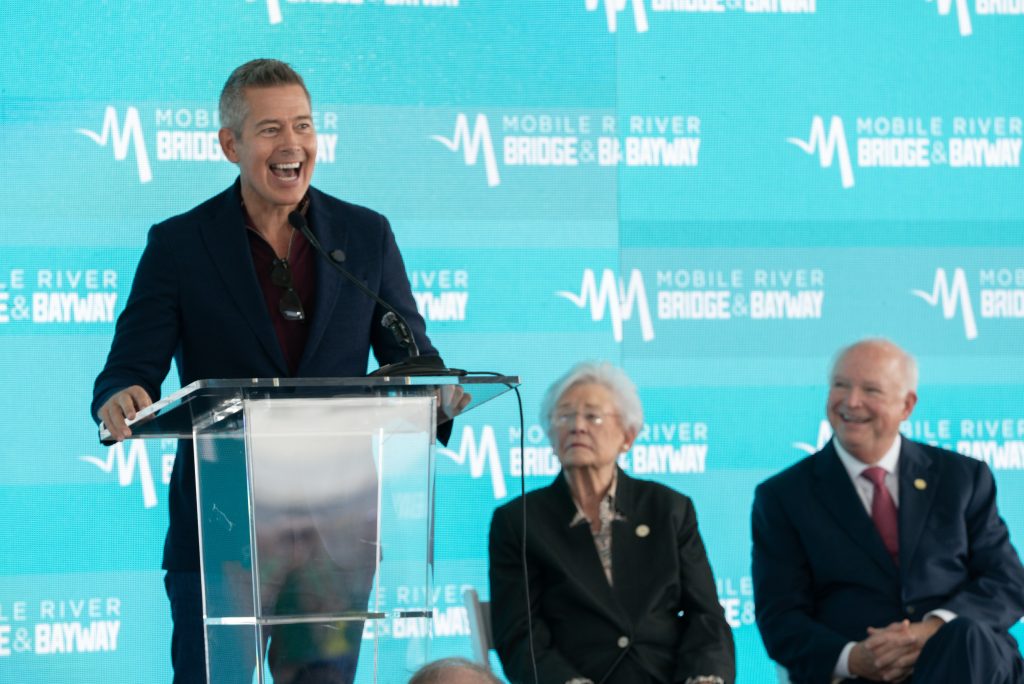
“What I think is really cool is when you have a federal delegation that takes the energy and the passion of a community and can harness that and bring it to Washington and say you need to understand how important this project is for us to understand how much time our people get back,” Duffy said. “It’s time with their families. You’re going to save on average 30 minutes plus in travel, and that’s time they get with their husbands, their wives, their grandkids, their kids.”
Once the bridge is complete, tolls will help the Alabama Toll Road, Bridge and Tunnel Authority pay back the large federal loan.
The Trump administration allowed Alabama in July to become the first state to implement the Interstate System Reconstruction and Rehabilitation Pilot Program, which will allow it to collect tolls on the interstate for reconstruction and rehabilitation purposes.
Tolling has been a controversial topic for decades and killed previous attempts at building. Tolls will ultimately depend on the driver crossing the bridge. Passenger vehicles with an ALGO Pass will pay $3 per trip, while those with interoperable transponders will pay $7.70.
The causeway, Wallace Tunnel, Bankhead Tunnel and the Africatown Bridge will remain toll-free routes.
The first phase, which the Alabama Department of Transportation said will cost $3.2 billion, is the construction of a new, six-lane cable-stayed Mobile River Bridge. The state will also update the existing bayway by restriping it to include six lanes of capacity during that period.
Phase two will be the construction of a new bayway.