
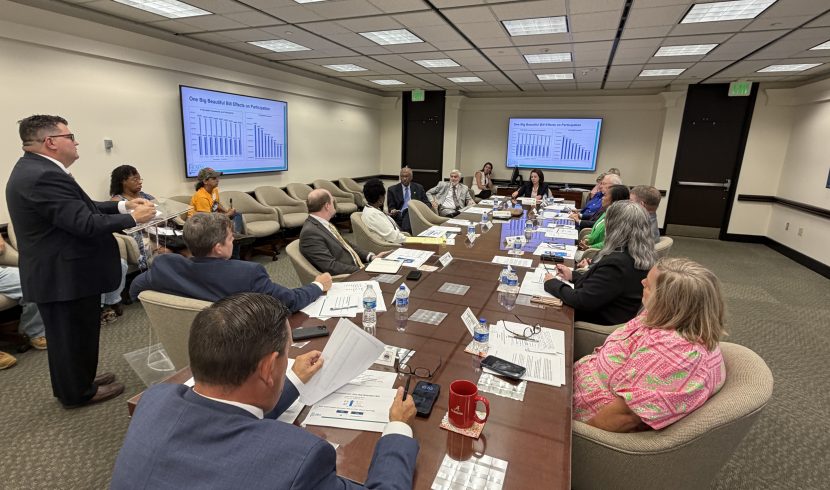
BIRMINGHAM, Ala. – The Alabama Department of Human Resources Board voted unanimously Thursday to ask Alabama’s congressional delegation to seek the same two-year delay already granted to states with the nation’s highest SNAP payment error rates.
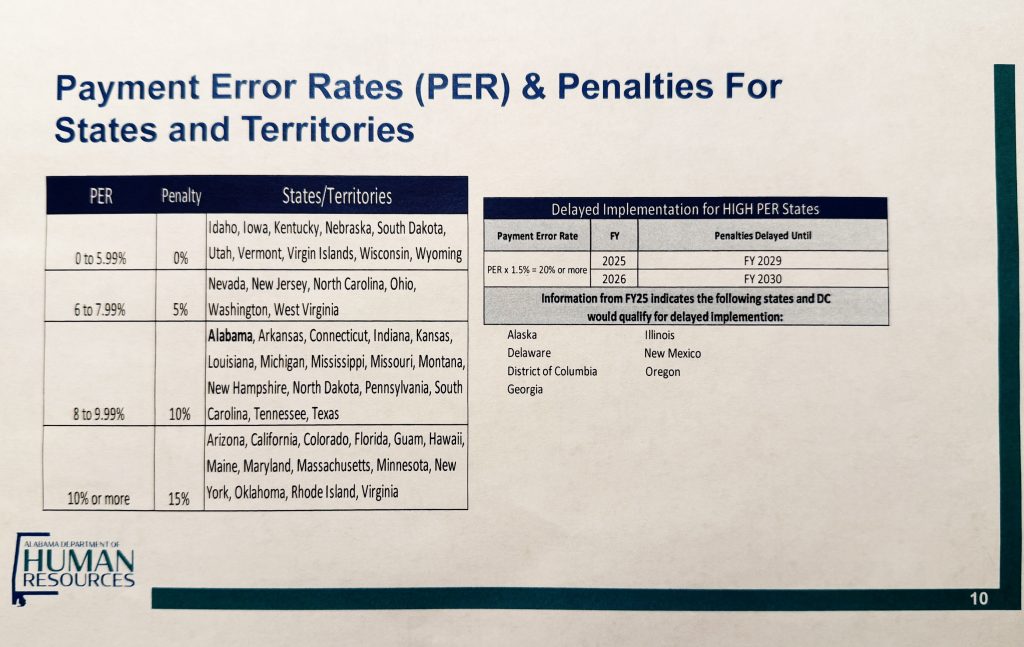
Under the federal One Big Beautiful Bill Act, states with the highest payment error rates have two additional years before they must begin paying part of the cost of SNAP benefits. Alabama and other states with lower rates could face those costs sooner.
Board members said Alabama should receive the same amount of time to improve its payment error rate before being required to pay a share of benefits.
Under the new federal law, Alabama could be required to pay 10% of SNAP benefit costs beginning in fiscal year 2028, based on its payment error rate for either fiscal year 2025 or 2026.
Alabama’s official payment error rate for fiscal year 2025 was 9.52%.
Based on last year’s benefit total, a 10% share could cost Alabama as much as $174 million.
SNAP currently serves about 648,000 Alabamians, roughly one in eight state residents, down from about 722,500 in October. The average monthly benefit is about $194 per person and $392 per household.
Board member Joe Morton, who made the motion, said states already working to improve should receive the same amount of time as states with the worst payment error rates.
“If we had more time, we could lower it more,” Morton said. “The worst states get two years of relief. Let’s at least give those that are making the effort the same courtesy.”
Members of the Make Alabama Healthy study group discussed seeking a similar delay in June, after DHR officials warned Alabama could eventually face three choices: lower its payment error rate, pay the required state share or end SNAP participation.
Alabama’s payment error rate has begun to improve, officials said, but Buckner warned the state may not be able to get below the federal limit quickly enough.
“It’s probably going to be almost impossible, if not impossible, to get below 6% for FY26 because of what we had to start with,” Buckner said.
Brandon Hardin, who manages Alabama’s SNAP program for DHR, said early fiscal year 2026 results show improvement, but Alabama began the year with high monthly payment error rates during the federal government shutdown.
The preliminary payment error rate was about 9.2% in October and 12.9% in November, officials said. The unofficial rate for February dropped to 5.37%.
“When you start off in a hole like that, it’s going to be very difficult,” Hardin said.
With six months remaining in the fiscal year 2026 review period, Hardin said he expects Alabama’s payment error rate to improve but does not yet have enough information to predict the final result.
“I think we’re going to do a lot better, but I will need some more data before I can actually tell you where we’re going to be,” he said.
DHR officials said the federal payment error rate does not always fairly reflect how well the agency is administering the program and stressed that it is not a measure of fraud.
Payment errors can result from unreported household changes, worker mistakes or missing paperwork. Some are counted even when the household received the correct benefit amount.
“It’s misleading to say something is a payment error when there’s no change in the payment,” Buckner said.
DHR officials have asked the federal government to change several parts of the way the payment error rate is calculated.
Federal officials denied Alabama’s requests to consider only information available when a case was approved and to separate recipient-caused mistakes from agency errors. A third request – to remove proven fraud from the payment error rate – is pending.
“What they’ve legislated at this point discourages states from finding fraud,” Hardin said, because finding fraud can raise the payment error rate.
Officials said SNAP eligibility decisions can also affect Medicaid, WIC and school meal eligibility.
Buckner said reduced food assistance could lead to poorer health, higher medical costs and broader community problems.
There are no other programs that can replace the amount of food assistance SNAP now provides, Buckner said.
Asked after the meeting whether the new costs could eventually lead Alabama to end SNAP, Buckner answered, “It could be.”
She said she still hopes federal policymakers will reconsider.
“I’m hoping there’s enough compassion in people’s hearts that are in control of whether we have to go forward with this or not, that there will be some wiggle room … to make it more fair for states (like Alabama) versus other states with the highest payment error rates that got a two-year pass,” Buckner said.
She said policymakers may not fully understand how deeply the changes could affect Alabama families and communities.
“I’ve worked a long time. I’ve seen lots of changes in FNS and child welfare and everything else. But I don’t think I’ve ever seen anything quite like this,” she said.
“I still think part of the problem is that the people in charge of this, above us, just don’t understand the significant impacts this is going to have on people – our people.”