
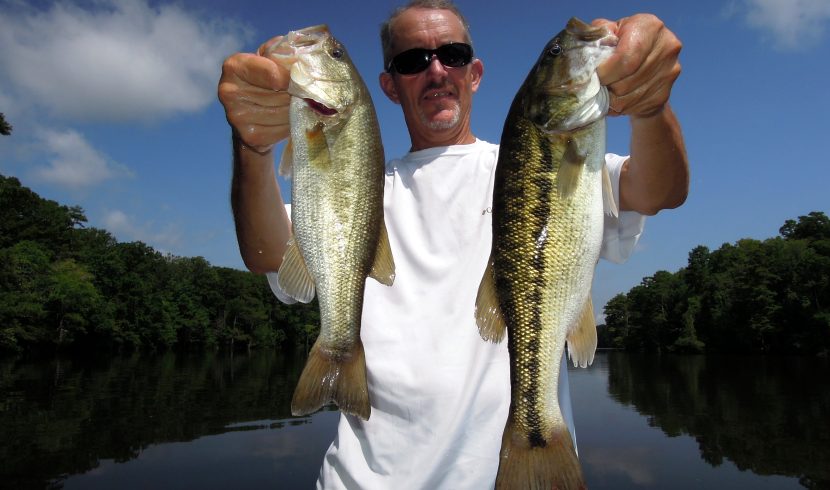
Two very similar fish, spotted bass, sometimes called Kentucky spotted bass, and Alabama bass both look nearly identical. Both can provide great action.
“Alabama bass were formerly known as spotted bass in the Mobile River drainage,” explained Chris McKee, an Alabama Wildlife and Freshwater Fisheries Division fisheries biologist in Northport. “In Alabama, spotted bass are only native to the Tennessee River drainage, but they have been introduced into the Chattahoochee River drainage. The maximum size of an Alabama bass is smaller than a largemouth, but bigger than spotted bass.”
Spotted bass usually tops out around six pounds. Still listed as a spotted bass, the Alabama record weighed eight pounds, 15 ounces and came from Smith Lake. However, some Coosa River Alabama bass released into California reservoirs hit double digits.
The Black Warrior River system can also produce some monster Alabama bass. Named for the native chief Tuskaloosa, which means “black warrior” in the Muskogean language, the river begins west of Birmingham and flows 178 miles until it flows into the Tombigbee River at Demopolis.
Along the way, the river runs through a series of dams separating the river into pools. Major pools include Holt Reservoir, William Bacon Oliver Lake and City Pool. Altogether, the Black Warrior watershed drains about 6,300 square miles.
“The Black Warrior River is known for largemouth, but it can produce some big Alabama bass,” reported Russell Jones with Alabama Guide Services (205-454-7313.) in Tuscaloosa. “I’ve had days where I’ve caught five spots totaling more than 25 pounds. My biggest weighed 6.4 pounds.”
Both species look similar to largemouth, but they act more like smallmouth. Both love rocks and current. Look for either species around main channel points, ledge edges with rock or woody debris, rocky shorelines, gravel bars, sandbars, riprap and similar places. Either fish might hit anything that tempts largemouth or smallmouth bass. Often, anglers catch these species and largemouth at the same time on the same baits, but people know when a big spot or Alabama bass strikes.
“Fighting current all the time gives Alabama bass a vicious attitude,” Jones commented. “Many anglers believe they hooked into a much larger fish than they did, especially when they get out into the current. When feeding, Alabama bass are very aggressive and often feed in packs. After hooking one fish, 10 or 12 other bass might try to get that bait out of the hooked fish’s mouth.”
Since spots and Alabama bass primarily feed upon threadfin shad, anything that mimics a baitfish could entice these fish. Spinnerbaits, crankbaits and topwaters rank among the best baits for tempting bass chasing shad.
“Whenever I see a fish following a crankbait, I like to rip it away as the fish comes toward the bait,” Jones commented. “That makes them mad and triggers a strike. Alabama bass will also grab a crawfish. On days without as much current, I like to throw crawfish-type baits, like a finesse jig or a shaky head fished along the bottom.”
Lipless crankbaits also make great enticements to throw at Alabama bass, especially when schooling. Let it sink a few feet. Then, burn it just under the surface. Occasionally pause to let the hefty lure sink again.
Anglers can find many places to catch Alabama bass and other species throughout the entire system. Look for Alabama bass near the dams. The Black Warrior River separates the cities of Tuscaloosa and Northport with the Oliver Lock and Dam between them. People without boats can fish off the bank in several places. Water flowing over the spillway cools and oxygenates the system.
“The river level fluctuates, so current determines the style of fishing we do,” Jones detailed. “Where the dams generate current is always a good place to fish for Alabama bass. Early in the morning, I like to throw topwater baits around the rocks and the dam. The river is a good place to fish spinnerbaits and crankbaits. I also like to flip a jig around laydowns. Alabama bass will smash a jerkbait.”
When water flows through the dams or barges pass through the locks, that generates current. Flowing water stirs up baitfish, sparking a bass feeding frenzy. Alabama bass lurk behind structures to stay out of direct current, but face into the flow.
“For Alabama bass, current is the key,” Jones advised. “When the current is rolling, big swimbaits, Alabama rigs, deep-diving crankbaits that resemble shad and similar baits can work great. I like to work a swimbait downstream right over the top of a rockpile. Bass usually hit as soon as the bait comes over the pile. If not, I stop the retrieve so it sinks behind the obstruction down to where the fish are.”
From the Oliver spillway, people can run all the way down to Demopolis and fish rocks, fallen trees and other structures. Just upstream from the Oliver Lock and Dam and minutes from downtown Tuscaloosa, the City Pool, also called Riverview, offers good Alabama bass action.
Behind another dam, Lake Tuscaloosa provides water for the area and covers roughly 6,300 acres about five miles north of its eponymous city. The North River flows out of Lake Tuscaloosa into the Black Warrior River and provides good action for varied species.
“On the Black Warrior system, it’s common to catch several species the same day,” Jones explained. “Besides largemouth and Alabama bass, anglers might also catch stripers, hybrid bass, catfish, drum, crappie, white bass, bream and other species. Where the North River hits the Black Warrior is a good place to catch Alabama bass because the water is usually cooler coming off the bottom of Lake Tuscaloosa. Up the North River is a great place to catch hybrids and stripers with large live baits or swim baits.”
Farther upstream, Holt Reservoir covers roughly 3,300 acres about five miles northeast of Tuscaloosa. It holds a good Alabama bass population as well as other fish. Holt Reservoir produced the state record blue catfish at 120.25 pounds.
For area information, call 205-861-8563 or see visittuscaloosa.com.
**********
An avid sportsman, Felsher is professional writer, photographer and radio show host who has written thousands of articles for many publications. He’s always looking for ideas or outdoors adventures that will make good stories. Contact Felsh at [email protected] or through Facebook. He also hosts an outdoors tips show for WAVH FM Talk 106.5 radio station in Mobile.