
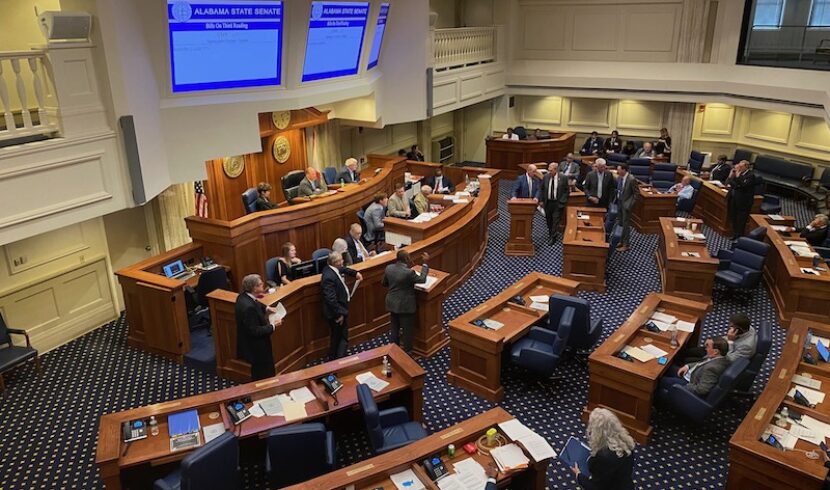
Alabama lawmakers this session have described some controversial bills and conflicts as “spicy” and Tuesday may be habanero hot.
Fresh off a week-long spring break and with six legislative days remaining to pass bills, the Senate Republican supermajority appears ready to cloture their Democrat colleagues over a handful of bills, including one requiring the Montgomery Police Department to increase its force or risk state intervention in the department’s operations and hiring.
Meanwhile, the General Fund is expected to receive another committee vote, and the House has some controversial bills on its calendar as well.
MPD bill
Senate Bill 298 would give law enforcement agencies in Class 3 municipalities five years to have at least two full-time officers for every 1,000 residents. There are yearly benchmarks set in the legislation that must be met to hold off any state action. Huntsville and Montgomery are the only two Class 3 municipalities in the state, but Montgomery’s struggle in recent years to fully staff its department prompted Sen. Will Barfoot, R-Pike Road, to sponsor the bill.
Barfoot told Alabama Daily News last week the bill will be amended on the Senate floor to decrease that ratio to 1.9 officers for every 1,000 residents. He said that will give Huntsville “a bit more breathing room.”
Barfoot, who represents a portion of Montgomery, has said repeatedly that his intention is to make the Capital City safer for residents, state employees and visitors.
“It’s been not just difficult, it’s been impossible to find out what the actual numbers for the Montgomery Police Department are,” Barfoot said last week.
“… So there’s obviously a lack of officers.”
He previously said the city budgets each year for well over 400 officers, the target number under his bill, but has about 220 to 230 officers.
The bill passed out of a Senate committee in late February, despite opposition from Democrats, including Sen. Kirk Hatcher, who represents most of Montgomery, and the city’s mayor and police chief.
Senate Minority Leader Bobby Singleton, D-Greensboro, told ADN on Friday he hadn’t had discussions with his GOP colleagues about Tuesday’s agenda, but his caucus will oppose Barfoot’s bill. He called it an unfunded mandate on the city.
“I do not think this is going to move the needle on crime in Montgomery,” he said, noting that other law enforcement agencies, including the Alabama Law Enforcement Agency, also need more personnel.
Singleton and other Democrats have also argued that Republicans made communities less safe when in 2022 they did away with the licensing requirement to carry concealed handguns in 2022.
Assuming it passes the Senate, it will need House committee and floor votes in the remaining five legislative days.
‘Thai hot’
When the Senate last met on March 19, Democrats filibustered a House-passed bill to rename on state documents the Gulf of Mexico the Gulf of America.
Sen. Chris Elliott, R-Josephine, is carrying the bill in the upper chamber and expects it to be back up for a vote in what he described as “Thai hot” Tuesday.
“If you’re going to have a calendar that the Dems are going to burn everything down over, then you might as well get all the burn-it-down bills on there,” Elliott told Alabama Daily News.
Another proposal that didn’t receive a vote prior to the break was the bill to require the Ten Commandments to be displayed in many public schools.
Meanwhile, there are still discussions about possible rule changes in the Senate. Last year, dozens of local bills died amid Democrat-led slowdowns in the Senate in the final days of session. Even if Republicans cloture their counterparts across the aisle, that process takes about an hour per bill.
Elliott said he expects Democrats to protest some bills, but widespread filibusters by Democrats could further the call for rule changes that wouldn’t allow Democrats to burn hours on one bill.
Singleton said it wouldn’t reflect well on Republicans who have the votes to pass what they want to limit debate on bills.
“I hope they would not be in the mode to do so,” he said.
House floor action
Based on a proposed agenda released by the Rules Committee, the House is in for a busy and controversial day on Tuesday.
Lawmakers will start debate with House Bill 580 by Rep. Troy Stubbs, R-Wetumpka. The bill would require faculty senates at Alabama’s public four-year universities to serve only in an advisory role, require periodic post-tenure reviews and give governing boards final approval over degree requirements and curriculum.
That would shift more authority over faculty governance, tenure and curriculum to university governing boards. In effect, the legislation would reduce faculty influence over university decision-making while expanding the formal authority of boards of trustees.
The bill also says accrediting agencies could not require institutions to violate state law or penalize them for complying with it. It would take effect Oct. 1.
Also on the education front, the House will consider Senate Bill 248, which deals with release for religious instruction, and House Bill 584 to limit screen time in classrooms.
The House will also take up Majority Whip James Lomax’s legislation to cut taxes on overtime pay. Republicans have called it a priority piece of legislation heading into the end of session.
House Bill 527 would establish an individual income tax deduction of up to $1,000 on Alabamians’ overtime pay per year.
The Legislature first adopted an overtime tax cut in 2023, but after the fiscal note underestimated the cost by more than $350 million, the Legislature never put a permanent extension to a vote. The law expired in June of 2025.
Income taxes paid in the state benefit the Education Trust Fund, which supports K-12 and higher education. The fiscal note for Lomax’s bill estimates that it would reduce income tax receipts to the ETF by $37.4 million annually.
If passed, the new deduction would be valid for money earned between Jan. 1, 2026 and Dec. 31, 2028.
Another major piece of legislation set for a House vote is Senate Bill 269 by Singleton.
The bill requires health insurers to reimburse ambulance providers a set percentage of the federal Medicare rate and establish coverage when EMS provides care without transporting a patient to a hospital. This is known as “treat in place” coverage that allows EMS to address the medical issue on site and avoid what can be lengthy transport times to hospitals, freeing up the EMS staff for the next emergency.
The bill also would prohibit “balance billing.” Ambulance providers could not charge an individual more than the in-network cost-sharing amount under an insurance contract.
There are 20 bills on the calendar, setting the House up for a long day after lawmakers head back from spring break.
General Fund budget moving
The House Ways and Means General Fund committee will take up the General Fund budget on Tuesday.
The Alabama Senate passed its proposed $3.72 billion fiscal 2027 General Fund budget earlier in the month. It includes a 2% raise for state employees and fully funds the expected increase in their health insurance costs.
The $3.72 billion spending bill is about $37.1 million more than what Gov. Kay Ivey sent to lawmakers two months ago and about $8.5 million more than the current year’s budget.
Several state agencies are experiencing slight increases in 2027, although some will see small decreases, including the Alabama Department of Mental Health, which will receive approximately $4 million less next year. Asked about that on the Senate floor, Sen. Greg Albritton, the Senate General Fund committee chairman, said the department’s other funding sources, including federal money, mean its services won’t be affected.
Lawmakers also had to find $10 million for the first payment due this fall for the Legislature’s new about $400 million State House.
Alabama Daily News reported earlier this month that the budget includes conditional appropriations for several agencies, assigning the departments of corrections, human resources and mental health tasks before they receive all of their 2027 funding.