Families across Alabama are asking hard and necessary questions about what’s next for their high school students. What’s the right path for my child? What if my student isn’t excited about enrolling in a traditional, four-year college program? And how can our schools better prepare students for a future that’s changing faster than ever before?
The questions aren’t coming out of nowhere. College completion rates hover around 61 percent. Nationally, student loan debt has climbed to $1.6 trillion, and here in Alabama, the average borrower owes about $38,000. At the same time, many of the fastest growing jobs in our state, including welders, machinists, builders, and healthcare workers, offer starting salaries well above average and don’t require a four-year degree. Alabama isn’t unique in this moment. Families across the country are increasingly considering the many pathways available after high school.
At the heart of this conversation is how we define and measure post-high school readiness. For too long, the nation has relied on a definition of readiness focused almost exclusively on whether students are ready for success in four-year college degree programs. College is a tremendous pathway, and we want it to be a viable choice for all students. We know, however, that college immediately after high school isn’t the only great option, and we’ve come to realize that a single measure of readiness doesn’t tell the full story for every student.
That reality is clear for young people themselves. The number of students successfully going from high school to work or enrolling in skilled trade and technical programs continues to increase. Those young people are demonstrating that there’s more than one pathway to success and they are demonstrating the need for a broader definition of readiness.
Our accountability system should reflect these realities. It should uphold academic standards, give students and families meaningful information, and empower them to make more fully informed decisions.
That’s why the Alabama State Department of Education has proposed a waiver to the U.S. Department of Education to allow the state to incorporate the ACT WorkKeys National Career Readiness Certificate (NCRC) into our system for measuring student and school success. I believe this is the right step forward for Alabama’s students and families and I look forward to continuing the conversation we’ve started.
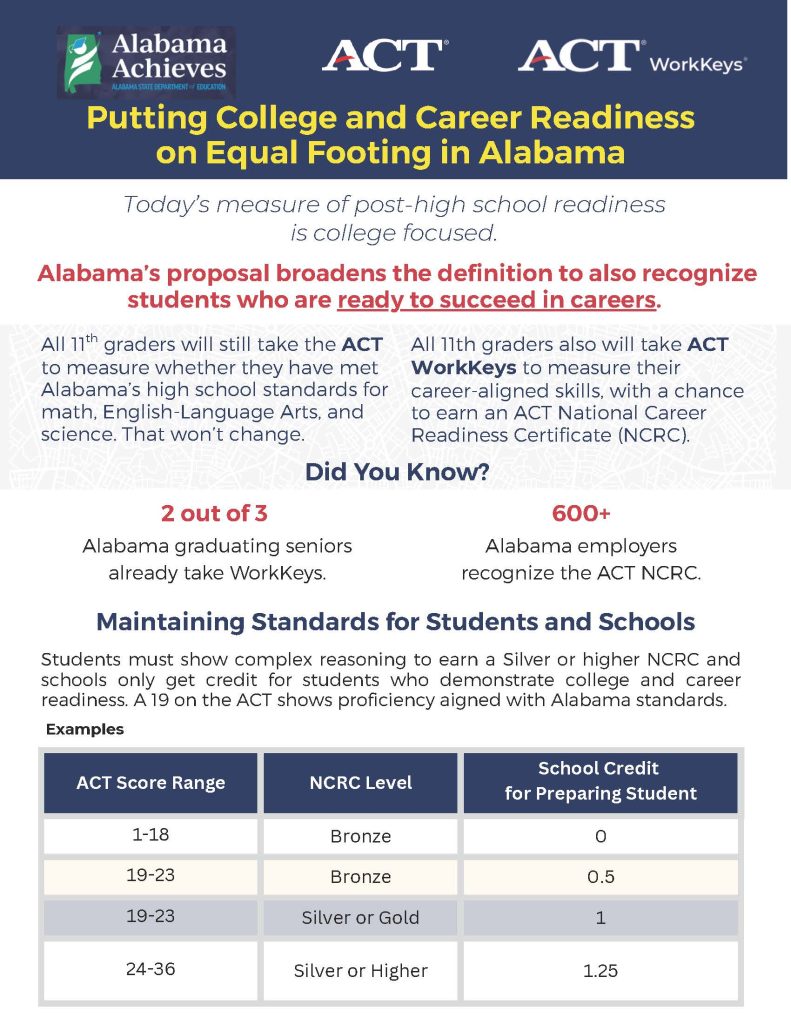
To be clear, the ACT WorkKeys NCRC would be added to our current system, which uses the ACT to assess whether students have met our rigorous high school academic standards. The new accountability system will give schools full credit for academically preparing a student only if the student demonstrates college and career readiness.
What is WorkKeys?
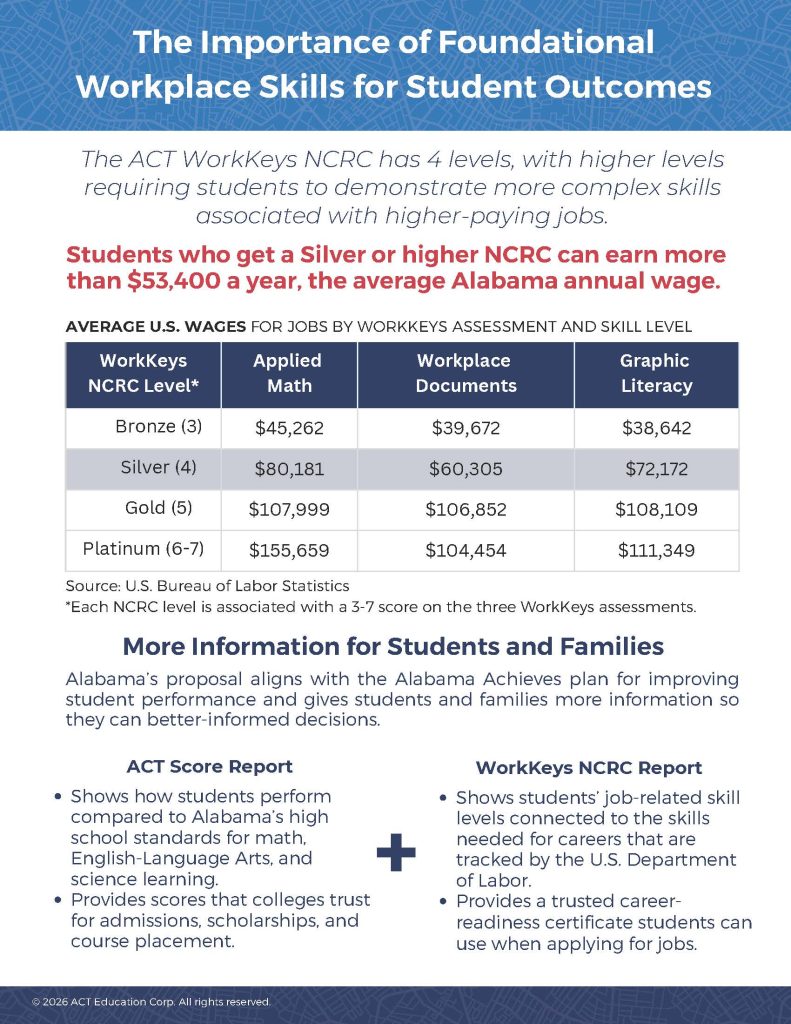
While the ACT is focused on academic skills in a college context, the three WorkKeys tests that lead to the ACT NCRC measure students’ ability to use academic skills in work contexts related to applied math, graphic literacy, and workplace documents. WorkKeys tests are scored on a 3-7 scale and students must earn at least a 4 on the three tests to earn a Silver NCRC and be counted as proficient for accountability purposes.
Here are just two examples of how the system will work:
1. Students who score between 1 and 18 on the ACT and don’t earn at least a 4 on each of the three WorkKeys assessments would not be counted as academically proficient.
2. Students who score 19-23 on the ACT and at least 4 on each of the three WorkKeys assessments would be counted as academically proficient.
This system measuring academic preparedness through both lenses will give a more complete assessment of whether students are truly ready for life after high school.
If this system were in place last year, another 11,000+ graduates would have been deemed academically proficient. Is that lowering the bar and inflating preparedness? I don’t believe so, and importantly, the research proves these students are ready to apply academic skills in in-demand jobs.
Why select Silver NCRC as the threshold?
The Silver NCRC aligns to 71% of the jobs that the U.S. Department of Labor tracks. It requires students to demonstrate a range of skills, including complex reasoning skills required for jobs that pay greater salaries.
The WorkKeys assessments and the NCRC also have potential value for students who go straight to college after high school or enroll later. The assessments help students connect skills to careers and the American Council on Education recommends colleges and universities give students up to 9 credit hours if they have a Silver or higher NCRC.
What about our high academic standards?
This effort isn’t a departure from Alabama’s vision for education. It’s deeply aligned with Alabama Achieves, our long-term strategic plan for education and workforce development and it embodies our commitments: “Every child. Every chance. Every day.”
The proposal keeps the ACT as the measure of whether students meet our standards in math, English-Language Arts, and science.
At its core is a simple idea: Every student deserves access to pathways that lead to meaningful careers and economic mobility. That means preparing students not only for college, but also for high-demand technical fields, skilled trades, and emerging industries.
Employers across Alabama, including the more than 600 employers that recognize the ACT NCRC as trusted evidence of readiness, are looking for workers who bring both knowledge and practical skills. By giving students the opportunity to demonstrate those skills through both the ACT and WorkKeys, we strengthen the connection between our high schools and the workforce our state is building.
At a moment when more students are thoughtfully considering options beyond a four-year degree, they deserve clearer signals about where their strengths lie. These are not second choice pathways. They are essential ones. Our goals are to expand, not limit, opportunity; to meet students where they are and prepare them for the future they will enter, not the one we imagined decades ago.
Education must evolve alongside the economy it serves. By aligning our assessments with future-ready skills and employer needs, Alabama is helping students see the full range of possibilities ahead and giving families the information they need to make confident, informed choices.
Imagine a student who has earned a WorkKeys Silver NCRC and an industry-recognized credential in advanced manufacturing. She can read technical diagrams, calculate tolerances, and apply proportional reasoning on the job. Yet under our current accountability system, her abilities don’t count toward her school’s academic achievement rating if she doesn’t also meet a college-aligned benchmark. Imagine expanding our accountability model to equally recognize her achievement.
I appreciate the thousands of public comments submitted about our proposed federal accountability waiver. I look forward to learning from those, continuing the dialog, and moving our state forward to the benefit of all our students.
Dr. Eric Mackey is the State Superintendent of Education for K-12 public schools. He was appointed superintendent by the Alabama Board of Education in April 2018.