
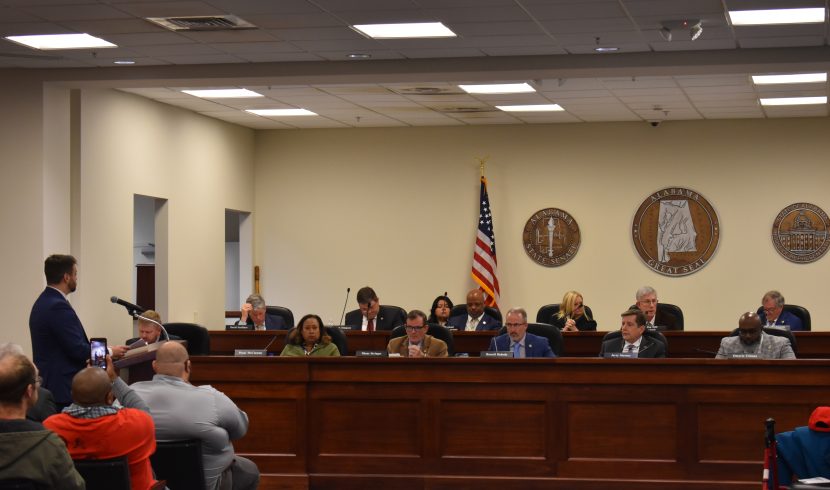
MONTGOMERY, Ala. – A bill that would expand Alabama law enforcement’s power on immigration enforcement was met with significant criticism during a public hearing in the House Judiciary Committee on Wednesday.
House Bill 13 would enable state and local law enforcement agencies to enter into memorandum of agreement with any federal agency “for the purpose of enforcing federal immigration and customs laws and the detention, removal, and investigation of illegal aliens and the immigration status of any individual in this state.” The state’s attorney general already has the authority to enter these agreements with the U.S. Department of Homeland Security.
“This is to help with the flooding of particularly criminal elements into our country over the last several years and collect grassroots help to work together with the federal government on existing laws that will make our communities more safe,” said sponsor Ernie Yarbrough, R-Trinity, while introducing the legislation.
Yarbrough sponsored a similar bill last session that passed in the House of Representatives but never received a Senate vote. Democrats in the House opposed the bill and raised concerns about the possibility of racial profiling and arbitrary deportations, a sentiment that came up repeatedly during Wednesday’s public hearing.
The bill is called the Laken Riley Act and complements federal legislation sponsored by U.S. Sen. Katie Britt of the same name. Laken Riley, a nursing student in Georgia, was killed by an illegal immigrant from Venezuela while out for a jog in 2024. The federal law, which was signed by the president last January, requires the U.S. Department of Homeland Security to detain such immigrants who have been arrested for burglary, theft, larceny or shoplifting.
The Alabama bill would allow state and local law enforcement to arrest people who they think are in the country illegally and to transport these individuals to a federal facility within the state if they are confirmed to be undocumented.
Four members of the public spoke in opposition. No one spoke in favor, other than Yarbrough.
Rev. Kevin Thomas, senior pastor at First Church Birmingham, shared how his daughter, whom he and his wife adopted from Guatemala, is afraid to leave the house because of potential encounters with U.S. Immigration and Customs Enforcement, even though she is a U.S. citizen. He said he tries not to let her leave her house without her passport.
“As I read this bill, I see that it potentially makes any state law enforcement officer an ICE officer, including even those on her campus at UAB,” he said. “It enables those officers to arrest and detain someone on probable cause of being an undocumented immigrant. It doesn’t define what that probable cause looks like, and I’m curious if my daughter’s skin color is probable cause for her detention.”
Rep. Matt Simpson, R-Daphne, vehemently disagreed with the notion that the bill in any way establishes skin color as a probable cause for arrest. He said Thomas’ statement linking skin color and arrest creates fear of interactions with law enforcement and is “just not a correct statement of the law.”
Ranking minority member Chris England, D-Tuscaloosa, said he wanted to make sure to point out the long history of racial profiling in both Alabama and the country as a whole. He has concerns that vague language in the bill will weaponize law enforcement against everyday Americans.
“The reason that we can’t have a reasonable conversation about immigration enforcement is because instead of hearing what people say is their personal experience, those voices are marginalized and turned into conversations about impugning law enforcement as an entire body, which means that ultimately, we’re not listening or respecting the voices of people who may have been who have experienced some of this discrimination or racism,” England said.
England said it’s not unreasonable for people to be fearful of law enforcement or be afraid that their race and ethnicity might make them a target based on their personal experience.
“I’m not speaking from just some general terms,” England said. “As a black person in Alabama, I have experienced it myself.”
Rep. Russell Bedsole, R-Alabaster, later weighed in and said he never encountered a directive or unorganized agreement between officers to racially profile people in his 27 years as a law enforcement officer.
Allison Hamilton, executive director of the Alabama Coalition for Immigrant Justice, brought up in her remarks the story of Leonardo Garcia Venegas, a construction worker in Baldwin County, who was arrested by ICE officers two times despite the fact that he is a U.S. citizen.
“We are in a very dangerous moment when a federal agency is being used to silence American people,” Hamilton said. “Alabama law enforcement officers did not sign up for that. If they wanted to, they could take a $50,000 hiring bonus to work for ice and skip the intensive training that Alabama requires.”
Hamilton further opposed the bill because it diverts the state’s resources.
“It makes no sense for Alabama to use our very limited resources to supplement the work of the highest funded federal law enforcement agency, especially when that agency has been turned against the American people,” she said.
Under the bill, state and local law enforcement agency employees could also send and maintain information about any person’s immigration status “as reasonably needed for public safety purposes” if passed. This would include looking into the immigration status of any person confined in a county or municipal jail.
The bill would also establish reporting requirements for jails holding noncitizens.
After the comments from members of the public, Simpson said he wanted to stand up for ICE agents and law enforcement from “continuously being attacked.”
“We just sat up here and listened to three people whine about law enforcement, attack our ICE agents, attack their decency, attack their intelligence, attack everything that goes on with law enforcement…” Simpson said. “When we get up here and hear more and more attacks on ICE agents, ICE agents, ICE agents, and we stoke fear and say, ‘Well these people are afraid and these people are afraid,’ we send the message that they should be afraid because we send such a bad message for law enforcement, and that’s not right.”
Chair Rep. Jim Hill, R-Odenville, said the committee would vote on the bill next week.
Another immigration-related bill, also left over from the 2025 session, was approved Wednesday in the Senate State Governmental Affairs Committee.
Senate Bill 45 invalidates driver’s licenses issued in states that do not require people to prove their legal status when they receive licenses.
“Essentially, illegal immigrants who have driver’s licenses — we want to invalidate those,” sponsor Rep. Chris Elliott, R-Josephine, said.
Elliott sponsored the same bill last year. It passed the Senate but died in the House without a vote. Elliott included in this year’s version changes made during the 2025 process.