
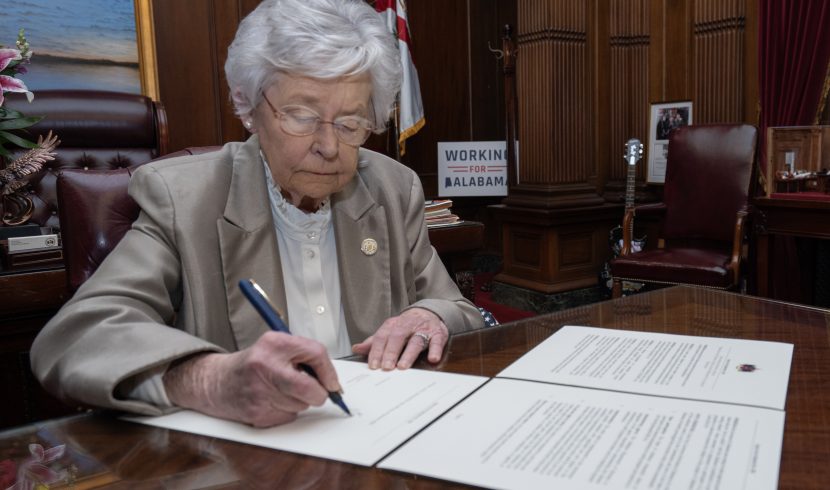
BIRMINGHAM, Ala. – Alabama will participate in the new federal school choice program, Gov. Kay Ivey announced Friday morning when she signed an executive order to opt the state into the Federal Education Freedom Tax Credit program.
“For over a decade, Alabama has been a trailblazer in offering parents and students options to access and afford the best quality education, and soon our families will have even more resources,” Ivey said in a statement. During her state of the state address, Ivey said she wanted to make Alabama “the most school choice friendly state in the nation.”
Ivey pointed to Alabama’s existing school choice laws as a foundation for participating in the new federal program.
“Beginning with the Alabama Accountability Act passed in 2013, many qualifying students have benefitted from scholarships allowing them to move to a better performing school,” she said.
“Two years ago, I championed and signed Alabama’s universal school choice law, the CHOOSE Act, which provides families with refundable income tax credits for qualifying educational expenses, including tuition, textbooks and after-school programs.”
The federal program was authorized under the One Big Beautiful Bill Act approved by Congress in July and allows donors nationwide to receive federal income tax credits for contributions to scholarship granting organizations, or SGOs, serving eligible K-12 students.
Participation is limited to eligible students based on household income but does not depend on the type of school a student attends, including public, private or religious schools.
Eligible students are those whose family income is below 300% of their area median income, as calculated by the U.S. Department of Housing and Urban Development. Scholarships awarded through the program are not subject to federal or state income taxes. The law does not specify a maximum scholarship amount an eligible student can receive.
Although the program is created under federal law, the scholarships themselves are funded through those private donations to state-approved SGOs. Alabama currently has approved six in-state and two out-of-state SGOs.
Beginning in the 2027 calendar year, individuals may receive a dollar-for-dollar federal income tax credit for donations made to a state-approved SGO, up to $1,700 per taxpayer. There are no provisions for corporate donations.
Those donations are then awarded to eligible students as scholarships that can be used for a wide range of K-12 educational expenses.
Federal law prohibits donors from claiming both federal and state tax credits on the same contribution. Any federal credit claimed must be reduced by the value of a state tax credit received for that donation, according to the federal law.
The federal scholarship can be used to pay for a broad range of eligible expenses, including:
- Tuition, fees, books, supplies, other equipment, academic tutoring and services for students with special needs in connection with enrollment or attendance as an elementary or secondary school student at a public, private, or religious school;
- Room and board, uniforms, transportation and supplementary items and services if these expenses are required or provided by a public, private, or religious school in connection with enrollment or attendance; and
- Computer technology, equipment, or internet access and related services if used by the student and the student’s family during any of the years the beneficiary is in elementary or secondary school
The federal program operates similarly to Alabama’s Accountability Act (AAA) scholarship program, which is also funded through donations to SGOs.
However, unlike Alabama’s program, schools that accept students using federal tax credit scholarships are not subject to any participation or accountability requirements under federal law.
Under AAA, individual donors receive a dollar-for-dollar state income tax credit of up to $100,000 for contributions to SGOs. Alabama’s law has provisions for corporate donations.
Seventeen other states have some form of state-level tax credit scholarship program, according to the national school choice advocacy group EdChoice.
Critics of tax-credit scholarship programs have raised concerns that they can reduce public revenue and lack academic accountability requirements, while supporters argue the programs expand educational options for families and rely on private donations rather than direct public spending.
During the 2024-25 school year, about 3,900 students participated in Alabama’s Accountability Act scholarship program. About $29.5 million in state income tax credits were claimed for the 2024 tax year, below the state program’s $40 million annual cap.
Updated 1:45 p.m. to correctly state that Alabama has approved eight SGOs.