
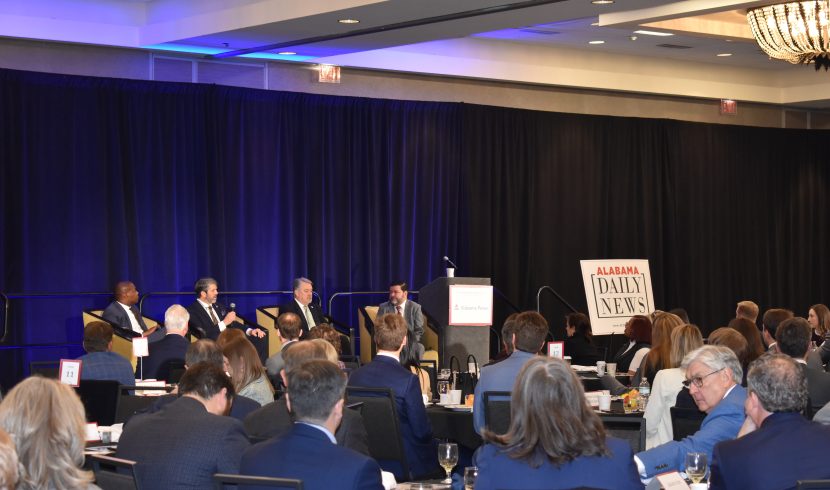
MONTGOMERY, Ala. – Alabama legislative leaders discussed ways to keep Alabama and its economy growing, including expanding workforce training, keeping up with energy demands and revisiting the state’s tax exemption on overtime earnings, in a wide-ranging panel discussion Wednesday morning.
House Speaker Nathaniel Ledbetter, Senate President Pro Tem Garlan Gudger and House Minority Leader Anthony Daniels joined Alabama Daily News Publisher Todd Stacy for the outlet’s annual Legislative Issues Breakfast attended by about 400 lawmakers, agency leaders and other government officials and association members.
Leadership has said they will move quickly in the election-year legislative session that kicked off this week.
“While we’re here, we’re going to make sure we’re efficient at passing legislation that matters to the people of Alabama,” Gudger, R-Cullman, said.
A priority on the education side is expanding career technical education opportunities. Ledbetter previously told ADN he’d like to see the Legislature this year increase a $100 million fund created last year to help schools create or expand their career tech offerings. And job training may look different depending on the region of the state and the industry in it.
Alabama’s workforce participation rate trails the national rate, 57.2% compared to 62.5%.
“We need to quit doing things the way we’re doing because that’s always how we’ve done them and that’s where we are in career tech,” he said. “In west Alabama, if they need (certain skills) based on what Mercedes needs, that’s what we ought to be training. In my area, if they need a certain job based on manufacturing automobile parts, that’s what we need to be teaching.”
Stacy asked Gudger about recent polling that showed costs increases were the top concern likely GOP primary voters would like to see state leaders address.
Gudger agreed everyone is feeling the pinch of higher expenses. The discussions in the Legislature about receiving some of that pressure for individuals and businesses.
“How do we slow down on any permits (and) fees on small businesses?” he said. “How do we (help) with corporate tax structures to relieve some of that for them?”
Daniels said he will bring this session a bill to revive a state income tax exemption on workers’ overtime. He previously passed such a bill in 2023 but it expired last year after it cost more than expected to the Education Trust Fund, which feeds education in the state.
Daniels said the cut was less harmful to the ETF that people believe because it generated other tax revenue, like sales tax when people had more money to spend.
“Everything in our budgets costs something, but is it yielding the returns needed to feed our budgets so we can do more?”
The Trump administration last year created a federal exemption on overtime, up to $12,500 for a single filer, and Ledbetter told the crowd that Daniel’s proposal is worth discussing.
“I think we’ll see something like what (Daniels) is talking about,” Ledbetter said. He said there may have been discrepancies in how the tax was applied that may have led to the higher cost to the ETF and more “guardrails” may be needed.
Gov. Kay Ivey on Wednesday gave lawmakers her budget proposals for 2027.
Asked about the possibility of a tax cut on overtime, Alabama Finance Director Bill Poole said the governor’s proposals reflect the current tax structure.
“I think there’s a lot of discussion on that (overtime) issue – what may emerge in the legislative process, we’re unsure of,” he said. “We forecasted based upon current revenue streams.”
The breakfast discussion, sponsored by Alabama Power, touched on energy demands. Growth in the Tennessee Valley is expected to be 30% in the next decade, Ledbetter said.
Last year, the Legislature approved Senate Bill 304 by Sen. Arthur Orr, R-Decatur, authorizing the State Industrial Development Authority to issue up to $1 billion in bonds to provide loans and other financial assistance for eligible energy infrastructure projects through an “energy infrastructure bank.”
The legislation targets rural areas by mandating that 40% of the loans and financial assistance given out by the newly created Alabama Energy Infrastructure Bank are allocated toward projects in rural counties, defined as having populations of less than 150,000.
Gudger and Ledbetter also said that as more data centers, which have high-energy demands, look to locate in Alabama, leadership needs to be strategic about where they locate and making sure residential rates don’t go up.
The men also talked about bipartisanship in the Legislature and their relationships.
“Anthony Daniels is my friend,” Ledbetter said. “And I think that’s where it needs to be with partisanship.”
Gudger said that having trust in each other and that they all want to improve the state helps the Legislature avoid some of the “toxic politics” seen at the federal level.
There are policy disagreements, Daniels said, but they are respectful.
“It’s like a marriage,” the minority leader said. “Communication and being open and honest about things on the front end (is critical), so that there are no surprises on the back end, and so that our members understand exactly what is going on.”