
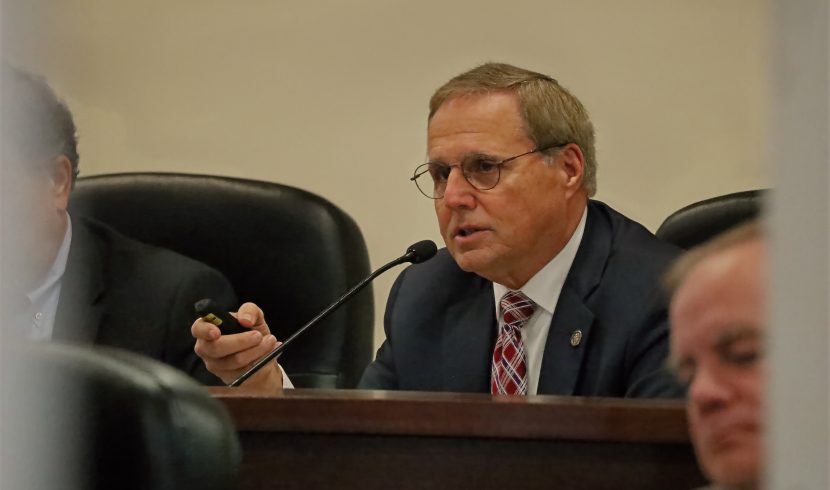
MONTGOMERY, Ala. – A bipartisan commission of Alabama lawmakers agreed Thursday to recommend a new way to target education funding to address student needs, while keeping the current system in place.
The hybrid approach would modernize how Alabama funds K-12 schools while maintaining the familiar safety net schools rely on, lawmakers said.
“The Foundation Program would continue to be how it is today, but then we would add to that money that would be appropriated by the Legislature based upon what we have available and what we think is important,” Rep. Danny Garrett, R-Trussville, said. He chairs the House education budget committee.
The commission recommended allocating additional funding to schools based on their numbers of students who:
- Have special education needs;
- Are English learners;
- Live in poverty;
- Are gifted.
In addition to the student-based funding weights, the commission also recommended adjustments for charter schools to account for their lack of access to local tax revenue.
Gov. Kay Ivey supports the change and included a $100 million allocation for the new model in her fiscal 2026 budget proposal.
Her proposal specifies only three weights that would garner additional funding: Students with special needs, economically disadvantaged students and an allocation for county school districts with sparse populations.
While Ivey’s plan aligns with some of the commission’s recommendations, Garrett said he and Senate education budget committee Chair Sen. Arthur Orr, R-Decatur, will now work on drafting legislation, acknowledging the details could change as the bill works its way through the Legislature.
The new funding system could be phased in over five years, starting as early as the fiscal 2026 budget. The total cost will depend on which weights they choose, and no recommended amounts were included in the final 25-page report. The full report is available at the end of this article.
Garrett presented an example of how weights would work, showing funding layered on top of Foundation Program funding. Garrett stressed this was an example, not a recommendation.

State finance officials said the state is well-positioned to provide additional funding through weights, as hundreds of millions of dollars have been placed in reserve during recent years.
No school systems would receive less than they currently are receiving, a point repeatedly made in each of the five meetings the commission held.
Despite broad support, lawmakers stressed that any changes must be considered carefully to avoid unintended consequences.
“We’re not going to do anything rash, or, pardon my word, stupid,” Orr said. “We’re going to be very deliberate about it and move at the pace the revenues dictate. Because we do not want to cause problems in the school systems across the state.”
To ensure the targeted funding achieves its intended impact, the commission also recommended accountability measures such as public reports, audits and corrective action plans for schools not getting expected results.
House Education Policy Committee Chair Rep. Terri Collins, R-Decatur, emphasized that accountability is key.
“That is the piece, to me, that makes it work,” Collins said. “If we’re going to give you more money to grow these different populations, then we need to see growth in these populations.”
She added that school officials will receive technical assistance to help maximize the impact of additional funding.
Education advocates say this shift is not just about targeting student needs, it’s about results.
A+ Education Partnership President Mark Dixon said the hybrid approach is the first step toward improving student outcomes.
”Our top priority is investing in student needs and doing that in a way that is very impactful,” he said. His organization has worked to educate lawmakers on the benefits of a weighted student funding formula, and the research supporting it.
“When you invest $1,000 more per pupil from these education reform efforts, that has yielded an additional 72 days of learning, which is a significant impact, regardless of how it is spent,” Dixon said. “The better you spend it, the better impact you get.”
For some commission members, this shift marks a meaningful step toward addressing long-standing gaps in student support.
“I’m optimistic about the opportunity to address student needs for the very first time in our funding cycle,” Sen. Bobby Singleton, D-Greensboro, said. “Yes, it’s new. It’s going to take work. But if we’re intentional about educating our students and our kids in this system, then we need to make sure that we’re trying something different and new. We shouldn’t be afraid.“
Joint Legislative Study Commission on K-12 School Funding Report 2.13.25 FINAL by Trisha Powell Crain on Scribd